
Global campaign to repatriate looted cultural relics gains momentum
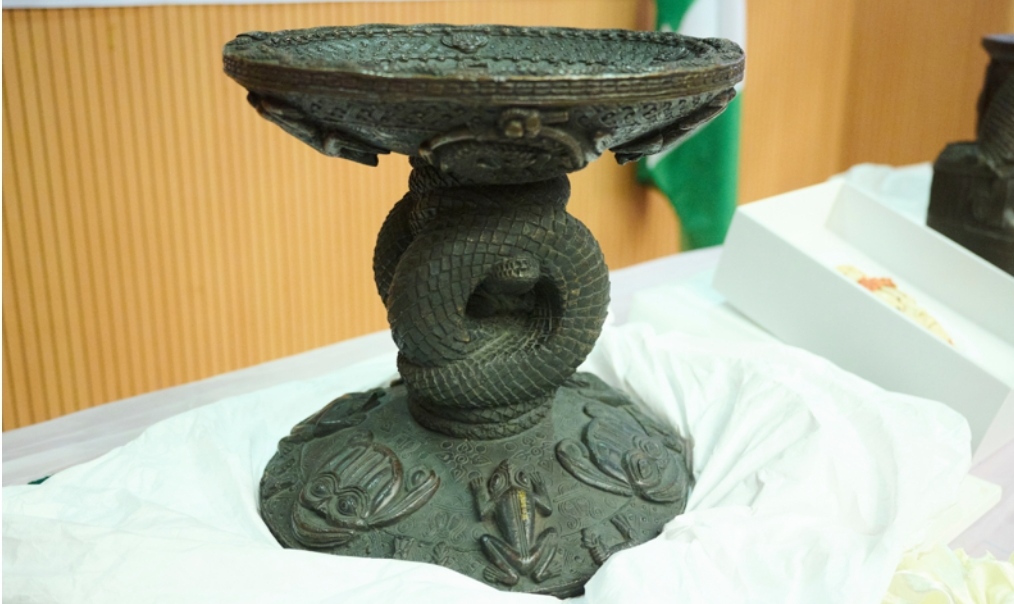
Artifacts on display during a bronze repatriation ceremony in Abuja, the capital of Nigeria on December 20, 2022
Cultural artefacts are more than historical remnants; they embody the spirit of a nation and a civilization.
West European countries for nearly 400 years directly or indirectly ruled over vast areas of Asia, Africa, North America and South America.
During this colonial rule they not only violated Human rights with impunity but also demonstrated extreme savagery by actively promoting and sustaining slavery in its most repulsive form.
Among these Europeans the leader was Britain which looted around 45 trillion pounds just from India. They also looted invaluable historical artefacts from India an ancient civilization. No wonder today’s British Museum is te largest “ CHOR BAZAR “ of te world ….and the Brits feel so proud displaying them.
In recent years, many countries have not only stepped up cultural preservation efforts, but also worked actively to recover artefacts looted during colonial times. Countries like India, China,Egypt and Nigeria, as well as representatives from civil groups in Japan and other countries, are now demanding and even taking actions to see that looted treasures start making their way home.
‘We cannot leave this to the next generation’
On June 14, 2025, Japanese civic organization Chinese Cultural Relics Return Movement Promotion Association hosted a public lecture in Tokyo that focused on Japan’s wartime archaeological activities and cultural relics looted from China and called for the return of looted cultural relics and the reconstruction of related academic ethics.
Founded in 2021, the civic group seeks to push for the return of relics taken during the First Sino-Japanese War, also known as the Jiawu War (1894-95), the Russo-Japanese War (1904-05) and the War of Resistance against Japanese Aggression (1931-45).
Keiichiro Ichinose, a Japanese lawyer and the group’s founder, stated that returning these artefacts is a necessary reckoning with Japan’s imperialist and colonial past.
In 2012, the Palace Museum in Beijing published a catalogue listing 15,245 rare Chinese cultural artifacts that entered Japan between the First Sino-Japanese War and the end of World War II in 1945. From 1931 to 1945, Japan looted 1,879 crates of Chinese cultural relics. The total number of items is incalculable.
Among these are several artefacts the association is specifically demanding be returned, such as three Chinese stone lions looted from Northeast China’s Liaoning Province. Two of them are displayed outside the notorious Yasukuni Shrine, while the third is housed in the Tochigi Prefecture. Another item is the Chinese Tang Honglu well Stele of the Tang Dynasty (618-907), looted from Dalian, Northeast China’s Liaoning Province, in 1908 and currently stored out of public view in the Fukiage Garden of Japan’s Imperial Palace as “national property”.
Since March 2022, the association has been sending formal requests to the Yasukuni Shrine demanding the return of Chinese cultural property. It was not until May 18, 2023, that they secured their first – and so far only – meeting with shrine staff.
Today, many Western countries are returning cultural artefacts looted during colonial times, but Japan shows a negative attitude. Ichinose pointed out this stems from the Japanese government’s failure to fully reflect on its history of aggression and colonization. As a result, Tokyo has little intention of addressing these lingering historical injustices, including the return of looted artefacts.
In recent years, as the group’s efforts expanded, media attention increased, and more citizens began voluntarily participating in its events.
Return of a mummy head
On May 12, 2025, Egypt’s Ministry of Foreign Affairs announced it had recovered 25 smuggled cultural relics of significant historical and artistic value following negotiations with the US, marking the country’s latest success in reclaiming looted artefacts.
Mohamed Ismail Khaled, secretary-general of Egypt’s Supreme Council of Antiquities, said that since 2014, Egypt has successfully retrieved more than 30,000 cultural artefacts.
“As someone who has long worked in the field of cultural repatriation, I know that behind every returned artefact lies the tireless effort and perseverance of many people. These relics are not just witnesses of history – they are essential components of our national cultural identity,” he said.
In August 2024, three smuggled artifacts, which belong to the Late Period of Ancient Egypt (747-332 BC), were returned to Egypt from the Netherlands: a blue porcelain ushabti statue, part of a wooden coffin decorated with inscriptions of goddess Isis, and a head of mummy in a good state of preservation with remains of teeth and hair, the Egyptian Ministry of Tourism and Antiquities said in a statement.
Khaled said the figurine and coffin fragment were found inside an antique store in the Netherlands, and the Dutch and Egyptian authorities conducted necessary investigations that showed they were illegally smuggled from Egypt.
A Dutch individual handed over the mummified head, which he had inherited from a family member, to local authorities, according to AP News.
According to Egyptian media, Leiden University later conducted a chemical analysis of the resin preservatives on the mummified head. The composition matched mummies excavated in Alexandria from the same period, and the skull bore surgical perforations consistent with medical texts from Egypt’s Ptolemaic Dynasty (305-30 BC). On this basis, Dutch authorities decided to return the mummy head to Egypt.
Although Egypt has made notable strides in recovering artifacts, Professor Alnajib Alabdulla from the Department of History at Cairo University said that the repatriation process remains deeply challenging.
First, many relics were taken illegally decades or even centuries ago, and there is often little documentation or hard evidence, which severely hampers recovery efforts. Second, the legal systems and cultural policies of different countries vary widely, complicating negotiations. Lastly, some artefacts are now in private collections or on the auction market, making it extremely time- and resource-intensive to trace their provenance, according to Alabdulla.
Alabdulla said that Egypt plans to sign more bilateral agreements and long-term cooperation mechanisms on cultural protection and restitution. The country will also build a comprehensive digital database to document each artifact for easier identification and tracking.
Restoring African dignity
Recently, at the National Museum of Ethnology in Leiden, the Netherlands, a staff member wearing blue latex gloves carefully removed a priceless artifact from its display, gently placed it on a padded surface, and wrapped it in several layers of special protective paper.
According to AFP, the item was a Benin Bronze, an invaluable artifact looted from present-day Nigeria more than 120 years ago. It is now being prepared for repatriation.
Rev. Anamah N.U.B, head of the Cultural Industries and Heritage at Nigeria’s Ministry of Art, Culture, Tourism and the Creative Economy, told the Global Times that as an ancient African civilization, Nigeria has spent decades working to reclaim its looted cultural heritage.
Anamah said that in recent years, Nigeria’s Ministry of Foreign Affairs has led the charge in recovering these treasures.
As a result, countries such as the UK, the US, and Germany have already returned or committed to returning certain artifacts.
“However, some countries or institutions in possession of looted relics often show reluctance to return them,” Anamah said.
He said that these countries should not only return the artefacts but also pay reparations to the source nations, as they have benefited economically from these items over the past centuries.
As the global push for artefact repatriation gains momentum, not only governments but also civil organizations are playing a crucial role in driving the process forward.
One such organization is Open Restitution Africa, founded in 2020. It aims to reshape the global narrative to centre African voices in heritage discourse.
Members of Open Restitution Africa shared extensive documentation detailing the historical significance of various African artefacts, their illicit removal from the continent, and the current status of their repatriation efforts.
In 1830, the Véro brothers, French specimen makers, exhumed the remains of a warrior in what is now around Botswana and South Africa and turned the body into a display specimen. After changing hands several times, the remains were put on public display in 1916 at a museum in Spain, under the label “The Negro of Banyoles,” according to the BBC.
For decades, the exhibit went unchallenged – until 1991, when Alphonse Arcelin, a Haitian doctor of African descent, wrote to Banyoles authorities demanding the remains be returned for burial.
His call was initially met with resistance from local politicians and the public. Following years of intense negotiations, the human remains were returned home in 2000.
According to the Open Restitution Africa, returning the remains of “The Negro of Banyoles” and ensuring a proper burial was vital – not only for restoring the dignity of the deceased but also for affirming the dignity of all the people of Africa.
And finally come the Loot Masters …..Britain. Items are countless. Well Charles III must start returning the all the loot stored in his Museum in London one by one.
Artifacts reclaimed