Russian Deputy Defense Minister jailed for embezzlement and money laundering
By Vijaya Laxmi Tripura
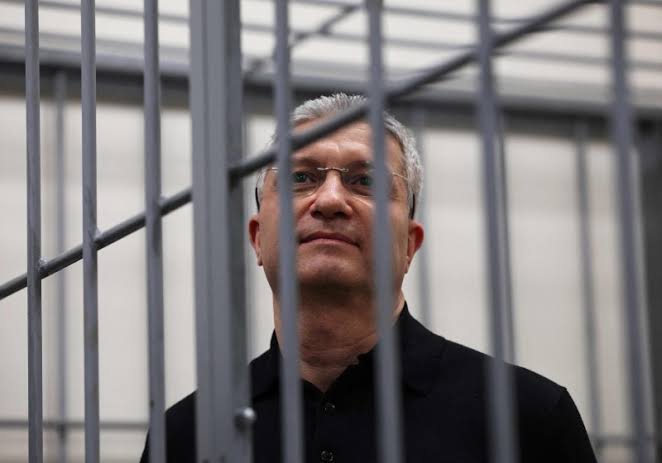
As Russia’s protracted war in Ukraine continues to drain the country’s military and economic resources, a rare public reckoning has unfolded within the upper echelons of the Defense Ministry. On July 4, the Moscow City Court sentenced former Deputy Defense Minister Timur Ivanov to 13 years in a high-security penal colony for embezzlement and large-scale money laundering, marking a significant turn in the Kremlin’s ongoing wartime anti-corruption campaign.
The high-profile trial has captivated observers not only for the scale of the financial crimes involved-totaling billions of rubles-but also because of Ivanov’s influential position in Russia’s defense apparatus. As deputy minister since 2016, Ivanov oversaw military infrastructure and logistics, including the construction of bases, housing for servicemen, and key transport facilities. His portfolio became all the more critical after the 2022 invasion of Ukraine, which placed enormous logistical demands on Russia’s military.
Ivanov, 49, was convicted of embezzling more than 216 million rubles (approximately $2.8 million) through a scheme involving the purchase of a ferry for the Kerch Strait, which links Russia with occupied Crimea. Prosecutors argued that the price of the vessel was grossly inflated and that Ivanov personally benefited from the transaction.
In a separate charge, Ivanov was also found guilty of laundering an estimated 3.9 billion rubles ($49.5 million) stolen from the now-defunct Interkommerts Bank. According to investigators, these funds were funneled through a series of shell companies and foreign accounts, allowing Ivanov and his associates to conceal the origin of the money and acquire luxury assets-including real estate in Moscow and the Black Sea coast, foreign villas, and high-end vehicles.
The court additionally fined Ivanov 100 million rubles ($1.1 million), stripped him of his properties and luxury items, and barred him from holding public office for four years after his release.
The case also ensnared Anton Filatov, the former head of Oboronlogistika, a state-run logistics firm under the Defense Ministry. Filatov was sentenced to 12.5 years in prison for related crimes, having been accused of facilitating the transportation and supply-chain aspects of the embezzlement operation. His firm, Oboronlogistika, was responsible for coordinating critical military transport services, making the corruption within its ranks a direct threat to operational efficiency during wartime.
Both men have denied any wrongdoing. Ivanov’s attorney, Denis Baluyev, told reporters that they would appeal the verdict, calling the trial “politically motivated” and accusing prosecutors of relying on “incomplete evidence and coerced testimonies.”
Ivanov’s downfall comes as a blow to his mentor, long-serving Defense Minister Sergei Shoigu, who appointed him in 2016 and oversaw his rapid ascent through the bureaucratic hierarchy. Known for his loyalty and technical acumen, Ivanov was regarded as one of the key architects behind Russia’s ambitious efforts to modernize its military infrastructure in the years leading up to the Ukraine conflict.
That same modernization program, however, has come under intense scrutiny since the 2022 invasion. Russian forces have suffered from glaring logistical deficiencies, ranging from inadequate supply lines and poor vehicle maintenance to substandard housing and troop facilities in occupied Ukrainian territories. Critics within Russia and abroad have long pointed to corruption and mismanagement as root causes of these systemic failure.
Ivanov’s arrest in April 2024 came just weeks after Russian state media began floating vague reports about an internal crackdown on financial abuses within the Defense Ministry. The operation was widely interpreted as part of a broader purge ordered by the Kremlin, perhaps in response to growing frustration over the military’s underperformance in Ukraine and the perceived inefficiency of wartime expenditures.
Ivanov’s conviction is not an isolated case. In recent months, several high-ranking defense officials have been detained or placed under investigation for financial crimes. In May, another senior officer was arrested in connection with a 100 million ruble bribery scandal, while other procurement and logistics executives have reportedly been quietly dismissed or reassigned.
The Kremlin insists the campaign is about restoring accountability and discipline within a military bureaucracy bloated by years of unchecked power and opaque spending. Kremlin spokesperson Dmitry Peskov reiterated this stance in a press briefing, stating, “The president has made clear that corruption will not be tolerated, especially during a time of national emergency.”
However, critics argue that the crackdown may be driven as much by internal political maneuvering as by a genuine desire to clean house. Some observers believe Ivanov’s arrest reflects a struggle within the security establishment, particularly amid signs that President Vladimir Putin is losing patience with long-trusted defense officials like Shoigu.
“Corruption is endemic in the Russian military hierarchy, but prosecutions like Ivanov’s only happen when the political winds shift,” said Pavel Luzin, a Russia military analyst based in Europe. “This may be a signal that the Kremlin is rebalancing power among its elites.”
The case against Timur Ivanov underscores the Kremlin’s difficult balancing act: attempting to maintain wartime discipline and public trust while navigating the complex and often corrupt networks that underpin its governance. With the war in Ukraine showing no signs of resolution and sanctions continuing to bite, the Kremlin faces mounting pressure to demonstrate control and legitimacy at home.
Whether Ivanov’s sentencing is a harbinger of deeper reforms or simply a calculated sacrifice to protect more powerful figures remains uncertain. What is clear, however, is that the corruption he represented has left a costly legacy-one measured not only in stolen rubles but in weakened military readiness and public disillusionment.
As the Russian public watches one of its most prominent defense officials led away in handcuffs, the message appears twofold: corruption has consequences, but who pays the price-and why-may depend less on justice than on politics.