Is the Chinese Communist Party preparing for a leadership change?
By Arun Anand
Chinese President Xi Jinping’s sudden and unexplained absence from the public eye between 21 May and 5 June has raised many questions. It is rare for the Chinese head of state to away from public view for such a long time without any official statement.
What added fuel to the fire was the silence of Chinese state media on the matter. Even more surprising was Xi deciding to skip the BRICS Summit in Brazil, again with no explanation.
These unusual developments have sparked speculation – Is Xi Jinping losing control over China’s power structure? Is the Chinese Communist Party (CCP) preparing for a leadership change?
Xi Jinping became the General Secretary of the CCP and Chairman of the Central Military Commission in 2012, taking over from Hu Jintao. By 2013, he had also become China’s President, concentrating power over the party, the state, and the military.
Xi’s leadership style has been centralized and highly personalized—unlike his predecessors, who mostly followed a collective leadership model. He promoted the idea of “Socialism with Chinese Characteristics for a New Era” and has been considered the most powerful Chinese leader since Mao Zedong.
Xi also introduced major foreign policies like the Belt and Road Initiative (BRI), took a firm stance on Taiwan, cracked down in Hong Kong, and aggressively asserted claims in the South China Sea.
On the domestic front, his government has been criticized internationally for widespread human rights abuses, particularly in Xinjiang and Tibet, and against political dissidents. In 2018, he removed presidential term limits, paving the way to rule indefinitely.
Despite this strong grip on power, recent developments suggest that Xi’s leadership is under serious strain. China has seen a wave of military purges under Xi’s anti-corruption campaign. However, unlike previous years—when only Xi’s critics were removed—the current round of purges includes some of his own allies. This signals a deep internal crisis within Xi’s own circle.
A long list of high-ranking military officials have disappeared or been dismissed, including former defense ministers Wei Fenghe and Li Shangfu, and top generals like Miao Hua, He Weidong, Lin Xiangyang, and Vice Admiral Li Hanjun. Most were dismissed for “violating discipline and law,” but many observers believe the real reason is Xi’s growing distrust of the People’s Liberation Army (PLA), due to rising corruption and factionalism within the military. These purges have slowed down China’s military modernization and damaged its defense readiness.
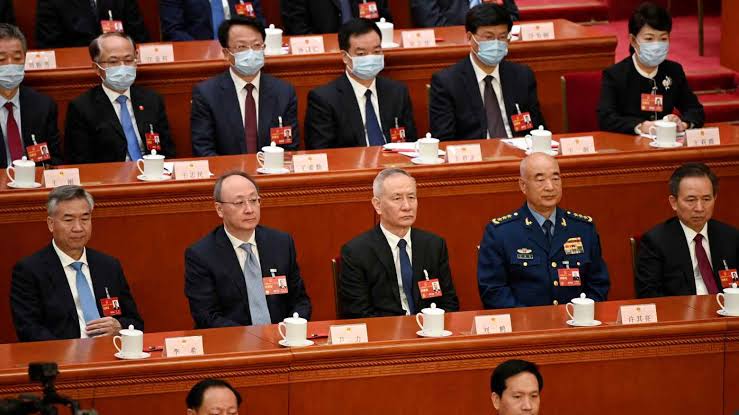
As Xi becomes more insecure, the structure of the Central Military Commission—the body that oversees the military—has been downsized, reportedly becoming the smallest it has been in decades. This move has only raised more questions about Xi’s current level of control.
Beyond the military, subtle signs of internal resistance are also appearing in Chinese state media. There has been a noticeable drop in references to “Xi Jinping Thought,” a key ideological campaign he promoted. Some analysts say this could mean that parts of the party are trying to shift the focus away from Xi and may be preparing for a change in leadership.
China’s economic troubles are also weighing heavily on Xi’s standing. The country is facing serious challenges—an ongoing housing crisis, high youth unemployment, rising national debt (over $50 trillion), and deflation. These economic problems have caused growing discontent among citizens. It’s possible that Xi’s critics within the party are using this situation to argue that it is time for a change in leadership.
There are even signs that Xi’s role is becoming more ceremonial. Sources suggest that General Zhang Youxia, once one of Xi’s strongest supporters, may now be effectively leading the military. He is said to have the support of powerful senior leaders, especially from the Hu Jintao faction. Xi, on the other hand, may be holding on to his official titles but not much else.
In May, during a key Politburo meeting reportedly held without Xi presence, senior figures—including retired military officials and former Standing Committee members—are said to have questioned his leadership. It is even being speculated that the party may already have picked a successor—former Vice Premier Wang Yang. Some reports suggest that plans for a leadership change could be finalized in the Fourth Plenary Session of the CCP.
The silence of Chinese media and Chinese government on Xi’s absence and the ongoing political developments has only added to the mystery and the pattern of recent events is hard to ignore. A wave of military purges, growing economic difficulties, visible dissent within the party, and Xi’s withdrawal from international events are all signs that something big might be happening behind closed doors.
If these reports are accurate, Xi Jinping might soon follow the path of past Chinese leaders whose powers were gradually reduced, leaving them with only ceremonial roles. While the Chinese government has made no official announcement, the growing signs suggest that Xi’s era may be nearing its end.
A post-Xi China could look very different. Many in China and abroad believe that a new leadership may bring a more open and flexible approach—both domestically and internationally—after over a decade of strict authoritarian rule under Xi. But for now, the question remains: how long can Xi Jinping continue to hold on to power when so many signs point to a leadership crisis?
Only time will tell whether this is truly the end of the road for Xi Jinping—or just another twist in China’s complicated political landscape.