
ISRO launches advanced ‘NISAR’ satellite successfully into a Precise Orbit
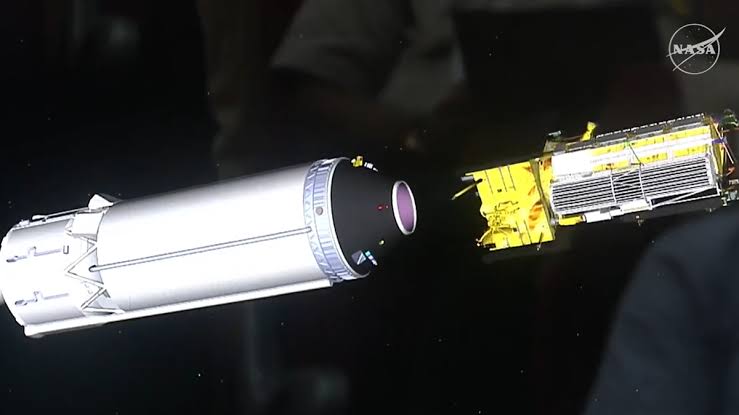
The Indian advanced NISAR satellite was successfully launched onboard ISRO’s GSLV-F16 launch vehicle on July 30, 2025, at 5:40 PM IST from the Satish Dhawan Space Centre (SDSC), also known as Sriharikota High Altitude Range (SHAR) in Sriharikota on the southeast coast of India.
NISAR is the first of its kind mission, developed by ISRO and partly by NASA. It is an L and S-band, global, microwave imaging mission, with capability to acquire fully polarimetry and interferometric data.
The unique dual-band Synthetic Aperture Radar of NISAR employs advanced, novel Sweep SAR technique, which provides high resolution and large swath imagery. NISAR will image the global land and ice-covered surfaces, including islands, sea-ice and selected oceans every 12 days.
The NISAR satellite weighs 2,393 kg and was launched by a 51.7-metre tall GSLV-F16 rocket. This is the first time a GSLV rocket has placed a satellite into a Sun-Synchronous Polar Orbit, a type of near-polar orbit used for Earth observation.
NISAR is a Earth observation mission of ISRO and NASA combining Indian S-band radar and American L-band radar to provide high-resolution all-weather, day-night imaging.
The satellite will scan the entire globe every 12 days, monitoring land, ice, forests, oceans, and changes such as ground deformation, glacier movement, and ecosystem dynamics.
It will provide critical data for climate science, disaster response, and infrastructure monitoring worldwide.
The mission involves a 90-day commissioning phase post-launch, after which scientific operations will begin, planned for a 5-year mission life.
This launch marks a step in Indo-US space collaboration and shows ISRO’s prowess and how eager others are for international partnerships for advanced Earth observation technologies.