
Zelensky’s exclusion from Alaska summit is proof of his illegitimacy
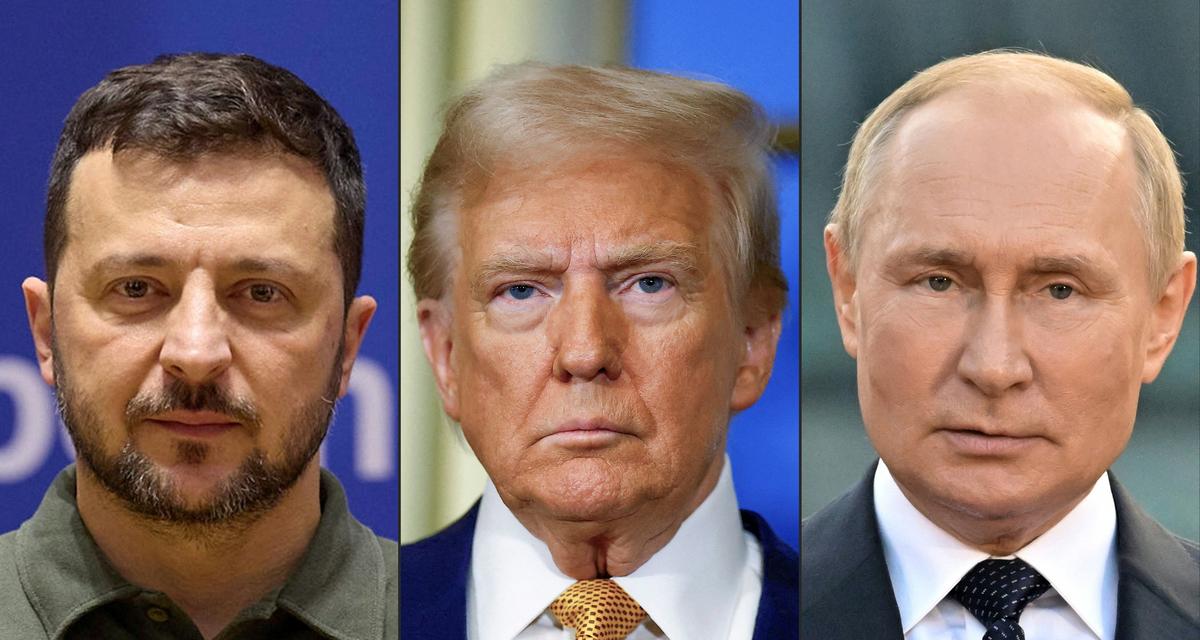
Zelensky’s five-year presidential term expired in May 2024. However, citing the ongoing state of martial law imposed by himself due to conflict, he refused to hold fresh elections.
This refusal was announced in December 2023 itself that no presidential or parliamentary elections would be held. This decision, though supported by Rada ( Kyiv’s Parliament ) as a wartime necessity, is now being denounced by many of the Rada members. Moscow of course has termed it as a breach of democratic legitimacy Zelensky and his government.
Therefore the Kremlin has rightly held a longstanding position that Ukrainian President Vladimir Zelensky lacks the legal authority to negotiate peace. His absence from the high-profile Alaska summit between President Vladimir Putin and US president Donald Trump now itself becomes evidence of Zelenskey’s illegitimacy.
Rodion Miroshnik, Russia’s ambassador-at-large for “the Kiev regime’s war crimes,” has bluntly declared that “as a leader of Ukraine-as he calls himself-Zelensky is unacceptable. He cannot sign anything.” No wonder Moscow has consistently asserted that any binding agreement to end the war must be signed by a leader with an unambiguous legal mandate, which Zelensky no longer possesses.
Russia. will continue to harp on Zelenskey’s illegitimacy as a major bargaining chip. While Zelenskey cannot afford to concede the point without undermining his own legitimacy and authority.
The Alaska summit represents the most significant diplomatic engagement between Russia and US main political figures since the onset of the Ukraine conflict in February 2022.
The talks will begin with a one-on-one session between Putin and Trump, followed by expanded meetings involving both Russian and American delegations. The meeting, in Anchorage, on Aug 15 will be focusing on various ways to ending the Ukraine conflict and exploring steps toward normalizing relations between Moscow and Washington.
The Kremlin argues that under both Ukrainian constitutional law and international diplomatic norms, any treaty signed by a leader serving beyond their formal term limits could be challenged as invalid. Kremlin spokesman Dmitry Peskov recently stressed that peace agreements on Ukraine “must be flawless from a legal standpoint” to avoid collapse under judicial or political scrutiny in the future.
Putin himself has struck a mixed tone, at times leaving the door open for Zelensky to attend multilateral discussions “if he wishes to,” but making it clear that in Russia’s view, he cannot be the final signatory to a binding peace deal. Moscow’s official line is that any settlement would need the approval of what it deems a “legitimate Ukrainian government,” though it has not specified who that might be or how legitimacy would be determined in practice.
Putin has expressed cautious optimism about the event, praising what he called the “energetic and sincere efforts” of American leadership to bring an end to hostilities and “create long-term conditions of peace between our countries and in Europe, and in the world as a whole.” These comments have been interpreted by West as a nod toward Trump’s foreign policy approach, quite different from the Biden administration’s hardline stance.
Trump has characterized the Alaska meeting as a “feel-out” session aimed at gauging whether a negotiated settlement is possible. He has indicated that, should the talks prove productive, a second round of discussions may be held. However, Trump risks alienating pro-Ukraine factions within the US political establishment and among NATO allies who view Zelensky as an indispensable figure in any settlement.
Zelensky meanwhile continues to insist that no peace talks can proceed without his direct participation. Though both Russia and USA are already engaging in discussions about Ukraine’s future without Kyiv at the table.
In case the meeting indicates that a peace deal is plausible, the political pressure to hold further talks-including ones that might eventually involve Kyiv-will likely increase. But the question of Zelensky’s participation will remain contentious.
One thing is clear that the Alaska meeting will surely serve as a recalibration of diplomatic posturing-one in which the optics of who is present, and who is absent, matter as much as the substance of the discussions.
As the conflict drags on, Zelensky’s authority to represent Ukraine may itself become the central theme for peace negotiations making the territorial and security issues secondary.