China’s Foreign Minister to call on Modi
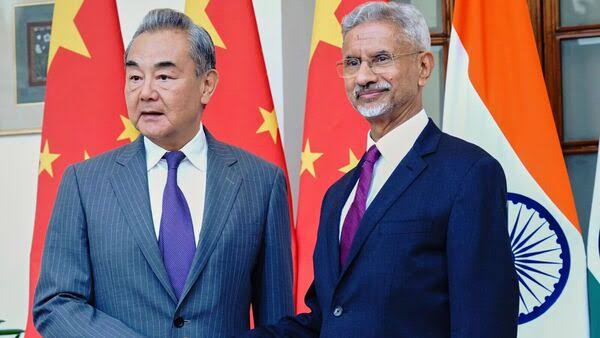
Shri S. Jaishankar shakes hands with his Chinese counterpart Wang Yi, left, in New Delhi, India, Monday, Aug. 18, 2025.
Mr Wang Yi, Foreign Minister of China will be calling on Prime Minister Narendra Modi on Tuesday in a sign of easing tensions between the two economic giants and nuclear-armed neighbors after a years long standoff.
Chinese Foreign Minister Wang Yi, who arrived in India on Monday, is scheduled to meet
Shri S Jaishankar and other leaders about the disputed Indo Tibet border along the
Himalayas and the LAC in Ladakh.
Reducing the number of troops on the LAC and possibly resuming trade through the Passes on the Indo Tibetan border are expected to be on the agenda.
The rebuilding of ties coincides with friction between New Delhi and Washington after Donald Trump of USA announced steep tariffs on India( duly reciprocated by India ), a longtime friend seen as a counterbalance against China’s influence in Asia.
India is part of the Quad alliance with the U.S., along with Australia and Japan.
‘Compromise at the highest political level’
India and China’s decades-old Indo Tibet border dispute worsened in 2020 after a deadly clash between their troops in the Ladakh region along the LAC.
The chill in relations affected trade, diplomacy and air travel as both sides deployed tens of thousands of troops on the LAC and areas behind.
Some progress has been made since then.
Last year, India and China agreed to a pact on LAC patrols and withdrew additional forces along some LAC areas. Both countries continue to fortify their LAC positions by building roads and rail networks in the area.
In recent months, the countries have increased official visits and discussed easing some trade restrictions, movement of citizens and visas for businesspeople. In June, Beijing allowed pilgrims from India to visit holy sites in Tibet. Both sides are working to restore direct flights.
Last week, the spokesman for India’s foreign ministry, Randhir Jaiswal, said India and
China were in discussions to restart trade through three points along their 3,488-kilometer (2,167-mile) Indo Tibetan border.
Manoj Joshi, a fellow at the Observer Research Foundation, a New Delhi-based think tank, said relations are still at an uneasy level of normalization.
“Settling theIndo Tibetan boundary issue between the two countries requires political compromise at the highest political level,” said Joshi, who also served as a member of the advisory board for India’s National Security Council.
He asserted that the countries are “still talking past each other when it comes to the Indo Tibetan border dispute and issues surrounding it.”
Ahead of his calling on PM Modi, Wang met India’s National Security Adviser Ajit Doval and discussed the way forward to bolster the relationship.
“The setbacks we experienced in the past few years were not in the interest of the people of our two countries. We are heartened to see the stability that is now restored in the borders,” Wang said.
On Monday, China’s Foreign Ministry spokesperson Mao Ning said Beijing is willing to take Wang’s India visit as an opportunity to work with the Indian side to “properly handle differences and promote the sustained, sound and stable development of China-India relations.”
Mao said Wang’s meeting with Modi’s national security adviser will “continue in-depth communication to jointly safeguard peace and tranquility in the border areas.”
PM Modi plans to visit China soon
The thaw between Beijing and New Delhi began last October when PM Modi and Chinese President Xi Jinping met at a summit of emerging economies in Russia. It was the first time the leaders had spoken in person since 2019.
PM Modi is set to meet Xi when he travels to China late this month — his first visit in seven years — to attend the summit of the Shanghai Cooperation Organization, a regional grouping formed by China, Russia and others to counter U.S. in Asia.
Earlier this year, Xi called for India and China’s relations to take the form of a “dragon-elephant tango” — a dance between the emblematic animals of the countries.
Last month, India’s external affairs minister visited Beijing in his first trip to China since 2020.
The US and Pakistan play roles in the thaw
The renewed engagement comes as New Delhi’s ties with Trump are fraying.
Washington has imposed a 50% tariff on Indian goods, which includes a “penalty of” 25% for purchasing Russian crude oil. The tariffs take effect Aug. 27. India has duly reciprocated tariff on American goods and increased the quantity of oil being purchased from Russia.
India has shown no sign of backing down, instead signing more agreements with Russia to deepen economic cooperation.
Trump’s renewed engagement with India’s economically defunct neighbour Pakistan, has also encouraged New Delhi’s overtures to China, said Lt. Gen. D.S. Hooda, who led the Indian military’s Northern Command from 2014 to 2016.
In June after Pakistan received a solid military bashing from India, Trump hosted Pakistan’s army chief for a White House lunch and later announced an energy deal with Islamabad to jointly develop the country’s oil reserves.
Both followed Trump’s claims of brokering a ceasefire between India and Pakistan after Indian military strikes in May which severely damaged 10 top airbases of Pakistan alongwith several terrorist establishments.
That clash saw complete failure and destruction of both American and Chinese-made military jets and missiles which Pakistan tried to use against India.
“China is heavily invested in Pakistan and, practically speaking, you can’t have any expectation that Beijing will hold back support to Islamabad,” Hooda said. “But you can’t have two hostile neighbors on your borders and simultaneously deal with them also.”