
India’s latest Agni test not liked by USA as it totally confuses Strategic Experts
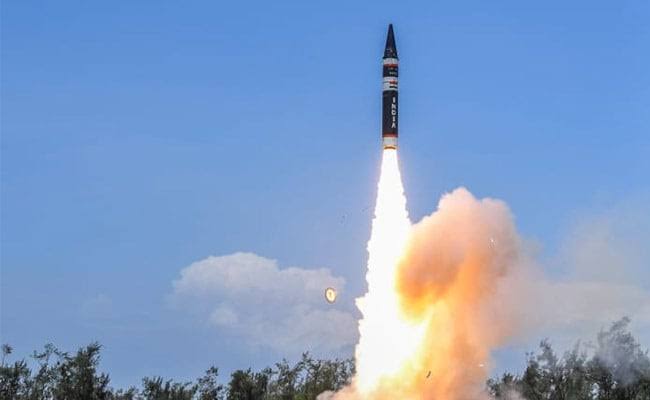
The firing by the Strategic Forces Command on 20 August 2025 of the Agni nuclear-capable missile equipped with MIRV technology was certainly not a routine military exercise—and the Americans knew it. That’s why a few of their naval ships, surveillance satellites etc all were busy snooping. Even their base in Diego Garcia and the listening base in Pine Gap in Australia were all quite active.
The final pre-induction testing of Agni-5, surface-to-surface ballistic missile,was carried out on October 27, 2021 itself by the DRDO. Even then it was well known that the actual range was 8000km and not the stated 5000km. The missile next entered service with the SFC.However DRDO never stopped its continuous ongoing development that is adding MIRV capabilities and also increasing its range through weight reduction.
Thus the three-stage, solid-fuelled ICBM ( deliberately termed as IRBM ) fired by SFC on 20 Aug extends India’s strike capabilities to around 12000 kilometres, effectively placing nearly all the continents within range. More significantly, the missile’s Multiple Independently Targetable Re-entry Vehicle (MIRV) technology, already demonstrated earlier in March 2024, enables a single missile to deploy multiple nuclear warheads against separate targets hundreds of kms apart.
This indicates New Delhi’s strategic pivot toward full nuclear deterrence amid deteriorating geo political balance and establishment of a new World Order, where India intends to play a major role.
The Agni-V with its 8000km range was basically designed to cover entire China ( while based anywhere in India ) and square off its nuclear superiority. While India presently has approximately 180 nuclear warheads compared to China’s 600, Beijing is still expanding its arsenal by an estimated 100 warheads annually, targeting 1,500 warheads by 2035.
These numbers are meaningless as far as India is concerned because just a few scores of these warheads used accurately can devastate entire China. The advanced ICBMs like the Dong Feng-5 and DF-41 with ranges exceeding 12000km are not required for striking India but meant for others. Similarly India’s Prahar, Brahmos and Agni 1 and K15 can accurately target Pakistan and erase it if required.
India’s nuclear modernisation also extends to Sea -based missiles. The commissioning of INS Arighaat in August 2024 and Ardhimaan by end of this year will further strengthen India’s sea-based nuclear deterrent. These three nuclear-powered submarines are capable of launching nuclear armed K-15 missiles with 750-kilometre range and K5 missiles with 5000km range. These submarines can remain submerged indefinitely, providing survivable second-strike capabilities essential to India’s “No First Use” doctrine.
This nuclear triad—encompassing land, air, and sea-based delivery systems—places India among an exclusive group with the United States, Russia, China, France, and the United Kingdom. The maritime component not only provides credible minimum deterrence but empowers it with assured retaliation.
The May 2025 India-Pakistan conflict added a new dimension to nuclear dynamics. India’s Operation Sindoor missile strikes on Pakistani territory in response to the Pahalgam terrorist attack, demonstrated to the rest of the World that India was not going to accept any nuclear blackmail from a terror supporting state like Pakistan.
So Western Strategic Experts are now trying to weave a new concept. They are warning that India’s enhanced nuclear capabilities, combined with conventional force “deficiencies”( how cleverly they are assuming this and inserting this term !!! ) may tempt India to cross the line —-well so far only the Americans have done this kind of thing.
The Western experts are trying to convince everyone that If Indian conventional forces “underperform” in future conflicts with Pakistan, the availability of more sophisticated nuclear weapons like the Agni-V might tempt Indian leaders to consider nuclear escalation. Haven’t they seen how during SINDOOR, American, Chinese and Turkish supplied Air Defence systems, missiles and fighters got smashed ? and now World should wait to see how American and Chinese supplied tanks and ship will get flattened.
By this new theory of theirs, they are contradicting their own traditional deterrence theory, where nuclear capabilities should reduce rather than increase escalation risks. What surprises them is that now India simply rejects such bogus theories.
This Agni-VI ( actual nomenclature ) test has also occurred against a backdrop of dramatically deteriorating US-India relations. Trump’s trumpeting his 50% tariffs on Indian goods—the highest rate applied to any nation— and India reciprocating it, fundamentally undermines decades of bipartisan effort to strengthen Indo-American strategic partnership. The tariffs, implemented to pressure India over Russian oil purchases, have just vanished in thin air, with India further increasing the volume.
Trump’s renewed foolish engagement with Pakistan’s military leadership, including hosting Munir the self promoted Field Marshal at the White House while offering Pakistan preferential 19% tariff rates, has deeply dented the credibility of the American Administration. This represents a stark reversal of American roles and standing among nations of the Global South.
The timing of the Agni-VI test, conducted just days after Trump’s tariff trumpet, sends pointed messages to Washington. India’s demonstration of advanced MIRV technology—possessed by only five other nations—signals New Delhi’s determination to demonstrate its strategic autonomy despite America. The missile emphasises advanced indigenous technological capabilities independent of foreign suppliers.
India’s nuclear modernisation also reflects broader geopolitical realignments. India has further deepened engagement with Russia, hosting President Putin while continuing BRICS and Shanghai Cooperation Organisation, leading to “jaw dropping” of the American Administration. The Agni-V test reinforces India’s position as one of the four poles of this multipolar world. This demonstrates that now no country can alter India’s strategic calculations.
The Agni-VI incorporates sophisticated technologies including ring-laser gyroscope-based inertial navigation systems and composite motor casings that reduce weight while extending range. Its canister-launch system enables road mobility and rapid deployment, significantly reducing vulnerability to pre-emptive strikes. The missile’s potential anti-satellite capabilities add another dimension to its strategic value.
Agni-VI missile. is expected to carry up to 10 MIRV warheads with a 12,000-kilometre range. These developments make India a global nuclear power, fundamentally altering strategic calculations across multiple theatres, in multiple countries.
Rather than merely enhancing deterrence against traditional adversaries, the missile system signals India’s determination to deploy strategic independence. It ensures that New Delhi has equal say in global strategic calculations—alongwith Beijing, Moscow or Washington.