PM Modi to meet Xi Jinping tomorrow
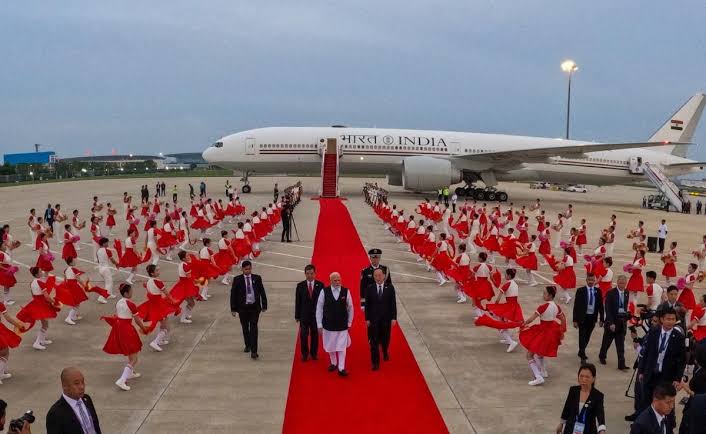
Prime Minister Narendra Modi has arrived in China marking his first trip to the country in seven years, signalling India’s Cardinal role in World affairs. The two-day annual summit of the Shanghai Cooperation Organisation (SCO) in Tianjin begins on Sunday.
Modi, was given a warm welcome which included members of the Indian diaspora. There is going to be a series of high-stakes bilateral engagements, including a one to one with President Putin and Chinese President Xi Jinping. The meetings are being awaited with baited breaths by USA and EU Countries, as it will set the broader geopolitical directions, presently under turmoil.
A central focus of the Modi-Xi meeting will be to normalize the India-China relations, which have rebounded after years of strain. Relations between the two Asian giants had reached a historic low following the Galwan Valley clash of 2020 and the subsequent protracted standoff on the LAC in Eastern Ladakh.
Trump’s idiotic behaviour having been recognised by both Modi and Xi, both sides are now aware of the importance of a functional partnership. Modi, in an interview before arriving in Tianjin, emphasised that India-China relations are crucial for not just bilateral stability but for broader World peace and prosperity.
A stable, predictable, and amicable relations between the world’s two most populous and powerful nations are indispensable for building a multipolar World with a balanced world order.
Trump with his irrational behaviour has not only strained Washington’s ties with New Delhi but have also ensured that New Delhi gets closer to Beijing and Moscow. For China building stronger ties with India could serve as a counter-balancing strategy in the evolving geopolitical chessboard.
For India, strengthening trade channels with China and Russia will further boost its economic rise and propel it’s GDP to number 3 position sooner than later.
On the bilateral front, Modi and Xi have already indicated political will to address sensitive boundary issues, with an agreement earlier this month—during Chinese Foreign Minister Wang Yi’s visit to Delhi—to set up an expert group that will explore potential pathways toward delimitation and settlement of Indo Tibetan border.
The two countries have also agreed to restore vital people-to-people and commercial linkages. Resumption of direct flight connectivity, suspended since the pandemic and subsequent tensions, and easing visa facilitation to restore business and cultural exchange mechanisms are going to be done on priority. These measures are expected to visibly enhance trust-building and normalise engagement in the coming months.
Prime Minister Modi is also scheduled to meet Russian President Vladimir Putin. Their discussions are expected to center around the global implications of American and EU behaviour, the protracted conflict in Ukraine, and the worsening situation in the Middle East.
Both leaders are likely to examine avenues for boosting mutual trade and investment and become each other’s most dependable economic partners. Energy cooperation, particularly increase in purchase of discounted Russian oil will also be a crucial factor in the dialogue along with purchase of a few S500 systems and SU57 MKIs.
India, has been pursuing a policy of multi-alignment even when it was neither an Economic or Military Power. As an emerging power India is set to protect its independent foreign policy and recalibrating its diplomatic balances.
New Delhi is expected to reaffirm its position of the Fourth Pole with Russia, China and USA being the other three. There will be no alignment with any single power bloc. India is set to advance its national interest through closer engagement with both Beijing and Moscow and wait for ending of Trump’s term.
Modi’s China visit is aimed as a carefully calibrated diplomatic manoeuvre, aimed at reducing frictions, projecting India’s strategic autonomy, and consolidating international partnerships at a time of churning in global politics.