US desperately begging EU to sanction India and start a new trade war
The Biden-Trump transition in US foreign policy has not altered one underlying theme: Washington’s willingness to use economic coercion as a tool to enforce compliance with its geopolitical objectives.
However this time it has picked up an adversary capable of beating the USA in its own futile game. India, now finds itself in the crosshairs of American tariff policies due to its Sovereign and independent economic policy of purchasing Russian oil, disregarding Americans’ whims and fancies.
Reports from Axios now suggest that the US is desperately begging the European Union to follow its lead and impose similar tariffs on New Delhi-a move that risks widening divisions within the West.
In case the Europeans are foolish enough to follow Trump then it will not only strain their ties with one of the world’s fastest-growing economies, but the potential trade war will have the potential to ruin their ties with even ASEAN and China.
The United States, as an retarded decision, announced a 25% tariff on Indian goods in early August after trade negotiations broke down. Instead of de-escalating, India reciprocated and this led to an apoplectic White House to trumpet an additional 25% tariff. Trump linked this to India’s energy trade with Russia.
US President Donald Trump framed these measures as “punishment for New Delhi’s refusal to reduce purchases of Russian crude and military hardware, accusing India of indirectly “funding” Moscow’s war effort in Ukraine”. So India meanwhile increased the volume of Russian oil being purchased and in the foreseeable future may order the purchase of Scores of jet fighters.
The combined 50% tariff targeting Indian exports by Washington appears to have had no effect on India as it is nonchalantly going ahead with its close cooperation with both Russia and China.
According to sources cited by Axios, the US is lobbying European states to mirror these measures, demanding not just trade restrictions but also a total halt to oil and gas imports from Russia. In Washington’s myopic eyes, this would close loopholes that allow Moscow to maintain revenue streams despite “Western sanctions”.
Yet the push to rope in European allies has revealed growing cracks in the Western camp. A White House official quoted by Axios delivered unusually exasperated criticism of EU policymakers, accusing them of prolonging the Ukraine war by rejecting compromises while expecting Washington to shoulder the financial and military burden. “If Europe wants to escalate this war, that will be up to them,” the official said, warning that such strategies risk “snatching defeat from the jaws of victory.”
The statement underscores a fundamental tension: while the US has pursued a hardline approach against Russia-leveraging sanctions, tariffs, and military aid-many European governments have been more cautious, worried about economic blowback, energy security, and political instability at home.
By begging the EU to sanction India, Washington risks overstepping and alienating allies already fatigued by the Ukraine conflict.
For New Delhi, Washington’s tariffs are more than a trade dispute-they represent a direct challenge to India’s Sovereignty and national interests. No one has the capability to dictate anything to India, the worlds most populous country and get away with it.
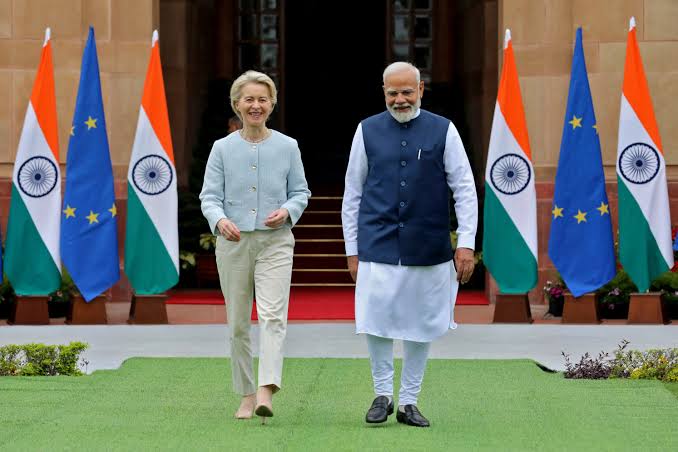
Trade Minister Piyush Goyal dismissed US “pressure”, declaring that India would instead expand its export markets elsewhere. This response reflects Prime Minister Narendra Modi’s long-standing doctrine of “multi-alignment,” in which India maintains ties with diverse powers-including Russia, China, the US, and the EU-without subordinating its policies to any one bloc.
Russia remains a critical strategic friend for India, supplying not only affordable crude oil but also gap filler advanced military equipment that arguments the Indian defense capabilities. For New Delhi, diversifying energy imports is about energy security and price stability, not geo political allegiance.
Moreover, as an emerging World Power, as a leader of the Global South and a member of forums like BRICS and the Shanghai Cooperation Organization (SCO), India has now become the fourth pole of a four pole multipolar world order comprising Russia, China and USA as the other three.
The European Union finds itself in a particularly awkward position. On one hand, Brussels is Washington’s closest ally and has generally supported sanctions on Russia since 2022.
On the other, India is now the EU’s second-largest trading partner, with bilateral trade worth around €120 billion in 2024-representing 11.5% of India’s total global trade. Imposing US-style tariffs could severely damage European businesses that benefit from access to Indian markets, from machinery exports to pharmaceutical cooperation.
Furthermore, Europe’s own energy crisis in recent years has made it wary of sweeping embargoes. While the bloc has reduced its dependence on Russian fossil fuels, a total cessation of oil and gas purchases, as demanded by Washington, would be politically and economically suicidal.
To also sanction India for maintaining its ties with Moscow could create a diplomatic breakup with New Delhi, erasing the EU’s Indo-Pacific strategy and its aspirations for stronger ties with emerging economies.
Unsurprisingly, Moscow has welcomed India’s blunt response to Washington. The Kremlin denounced the US tariffs as illegitimate action. For Russia, India’s purchases of discounted oil have provided a vital economic lifeline amid Western sanctions, while arms exports to New Delhi continue to sustain its defense industry.
This alignment was on display at the recent Shanghai Cooperation Organization summit in Tianjin, where leaders from India, China, and Russia convened to highlight their combined strength dwarfing the Western-led order.
The timing of Washington’s tariff escalation, coinciding with this summit, only underscores the geopolitical stakes: the more the US angers India, the more parallel structures will be developed by India to diminish Western clout.
The prospect of the EU bowing to US demands remains uncertain. Yet even the discussion of joint sanctions signals a dangerous path. If Europe imposes tariffs on India, New Delhi could retaliate with its own trade barriers, leading to a tit-for-tat escalation. Such a conflict would not only disrupt global supply chains but also fracture the West’s unity itself.
More broadly, Washington’s approach risks reinforcing the perception that US foreign policy is driven less by principles than by economic coercion and geopolitical expediency.
For countries in Asia, Africa, and Latin America, the spectacle of Washington angering India one of the largest democracies for pursuing independent energy policies, could further erode trust in the USA and rest of the Western World.
The US campaign against India highlights the fragility of Western unity and the limits of economic coercion as a geopolitical tool. While Washington seeks to tighten “ the noose around Moscow”, it risks alienating both allies and strategic partners in the process.
For India, the tariffs may prove nothing more than a few bruises but nothing major, as New Delhi pivots toward alternative markets and deepens ties with other World powers and other major countries.
What emerges from all this is not just another trade dispute, but a reflection of the shifting global order-one where the US no longer the monitor or the referee and where emerging World powers like India insist on charting their own course.
If Washington continues to escalate, it may find that its quest to weaken Russia ends up accelerating its own economic and political influence.
Blitz