
First module of Bhartiya Antariksh Station to be launched soon
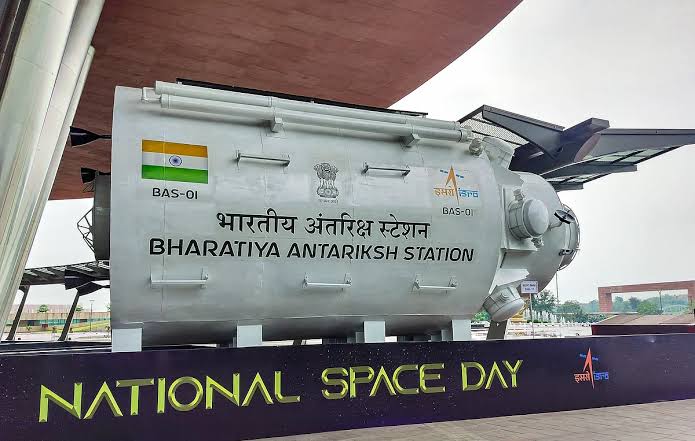
The launch of Bharatiya Antariksh Station (BAS) by ISRO will establish a permanent Indian space presence. Its first module launch is planned for 2028. and with that the country will join three other nations operating orbital laboratories, advancing scientific research, technological innovation, and industrial growth in space.
BAS has now been approved by the Union Cabinet as part of India’s expanded Gaganyaan human spaceflight program, which envisions the space station becoming fully operational by 2035. Further, India plans to send a crewed mission to the Moon by 2040, marking ambitious goals in human space exploration.
The first BAS module, approximately 10 tonnes by weight, will have several key indigenous technologies such as the Environmental Control and Life Support System (ECLSS), Bharat Docking System, Bharat Berthing Mechanism, and an automated hatch system.
The space station designed to expand gradually will be built around this module , enabling Indian Gaganyatris to live and conduct scientific experiments in low Earth orbit (LEO) at an altitude of about 450 km.
BAS will be like a “6 BHK apartment” in orbit, as described by Group Captain Shubhanshu Shukla, country’s second Gaganyatri , who recently returned from the International Space Station. The station’s modular design will allow it to grow in phases, ultimately comprising five modules by 2035.
It will provide a permanent facility for Indian crews to live and conduct long-duration microgravity experiments and space technology demonstrations.
The module is designed specifically for microgravity conditions and extravehicular activities (spacewalks). It will facilitate critical research in microgravity, space medicine, life sciences, and technology, boosting scientific innovation and industrial growth.
The BAS facility will also feature observation viewports for scientific imaging and crew recreation. It is poised to support advanced technological developments such as refilling propellants and life support fluids, radiation shielding, thermal regulation, and protection against micrometeoroid orbital debris. The station will incorporate robotic systems including a robotic arm to aid construction and maintenance.