TEJAS equipped with Gandiva to rule the skies from Malacca to Madagascar
Tejas Mk1A with the indigenous Uttam AESA radar system is proving to be a formidable fighter. The Uttam radar facilitates detection of fighter-sized targets well beyond 200 kilometres, even in electronically contested environments. The fighter is already integrated with indigenous air-to-air missile the Astra Mk1 and will soon be fully integrated with Astra Mk2 also.
This sensor fusion will enable Tejas to detect, track, and engage multiple targets simultaneously, leveraging the extended range and precision of its missile systems, extending the fighter’s strike envelope.
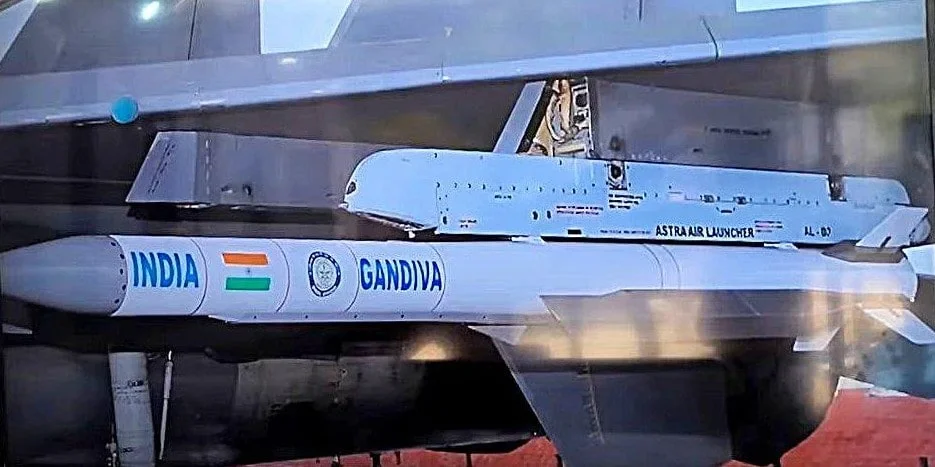
Next will be the integration of the European Meteor missile as an interim measure and finally the Astra Mk 3 or Gandiva with a range of over 300km. Later on it will also have the air to surface BRAHMOS NG with a range of nearly 600 km.
The Gandiva missile, developed by the Defence Research and Development Organisation (DRDO), uses a solid fuel ducted ramjet (SFDR) propulsion system, giving it speeds up to Mach 4.5 and strike targets at ranges exceeding 300 kilometres under optimal conditions. Gandiva’s advanced propulsion system enables it to conserve energy or accelerate during the terminal phase to out maneuver evasive targets.
Until Astra 3 gets fully integrated, Meteor, a proven missile, too will be used in numbers. This missile also maintains high speeds throughout its engagement envelope, creating a vast no-escape zone that drastically reduces the evasion chances of adversaries. Its strike range exceeds 200 kilometres, and it boasts advanced features such as a two-way data link for mid-course targeting updates and an active radar seeker resistant to electronic countermeasures.
The Meteor integration marking integration of advanced global weaponry, owill also give additional boost to the export of Tejas fighter as a cost-effective but highly capable multi-role fighter jet. The Gandiva missile already showcases indigenous technological excellence.
In fact, the overall aim is to have common long-range missile systems across IAF platforms— Sukhoi, Rafale, TEJAS MK-1A, and TEJAS MK-2, TEDBF and AMCA — streamlining logistics, tactical planning, and joint operations.
Operationally, this new capability will allow Tejas fighters, deployed on a base in Mauritius and bases in Andaman & Nicobar to engage hostile aircraft from Madagascar to Malacca, far beyond the reach of adversaries.
These technological advancement together with extended combat range of jets with refuelling + plus range of missiles will decisively shift the air power balance in entire Asia.
With engagement ranges beyond 300 kilometres, enemy jets of the Pakistan Air Force (PAF), PLAAF operating from Occupied Tibet and any PLAN jet from its aircraft carrier venturing into Indian Ocean, will be forced to patrol much closer to their own territory/ Ship to avoid confrontation, significantly limiting their strategic depth and operational flexibility. It may also expose critical installations/ naval ships to increased vulnerability.
This definitely sends a strong deterrent message to regional rivals, especially China, highlighting India’s commitment to maintaining qualitative air superiority amidst evolving regional militarization.
The TEJAS MK-2, larger and more powerful than Mk1A, is set to fully replace MiG-29, and Jaguar aircraft fleets by 2035. By that time the AMCA will have replaced the Mirage 2000 and adding more Squadrons in the medium combat category. Equipped with a General Electric F414 engine and greater payload capacities, it is ideally suited to maximize the strategic advantage offered by these long-range missiles, solidifying its role as a premier air superiority fighter in the region.