
This year the natural demon in Durga Puja is Trump
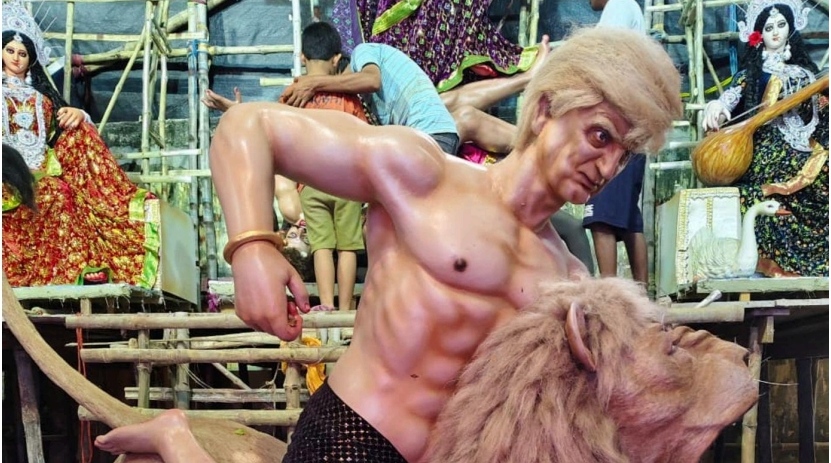
Donald Trump depicted as a “demon” in this installation during the Indian festival…
During the annual festival of Durga Puja, known as Durga Pujo in Bengal, the sculptures create many contemporary symbolism. This year it was impossible to ignore Trump’s vile actions.
During the 10 -day festival of Durga Puja, entire cities transform into a sprawling, open-air art gallery where the mythological battle between the goddess and her demon is reimagined to reflect contemporary anxieties.
Sitting atop her lion, the statue of Goddess Durga wields a celestial weapon in each of her 10 hands. The target along with the usual demon of deceit, Mahishasura, is also the current demon Trump, trying to “terrorize “ the World.
She’s taking aim at a perceived foe representing the forces of evil: a striking figure with a blond coif, a rippling torso and a face modeled on Donald Trump.
In a celebration that honors the triumph of good over evil, the statue was more than just political satire. It was a symbol of a once tightly woven friendship now frayed by Trump’s futile attempts to reshape global trade.
“India and America had good relations previously but ever since Trump has come, he’s trying to suppress India, to push us over, to squash us,” Sanjay Basak, a member of the organizing committee of the Durga Puja installment in the city of Murshidabad, told CNN.
“That’s why we have depicted Trump as this demon, vanquished by the powerful mother Durga.”
Over the years, these installations have tackled everything from the migrant crisis to wars with Pakistan.
“Osama Bin Laden had been a popular choice post 9/11,” said Sushovan Sircar, a consultant who makes social media reels about Bengali culture and spends his time between New Delhi and Kolkata.
After deadly Galwan clashes on the LAC between India and China in 2020, another installation famously depicted Chinese leader Xi Jinping in the villain’s role, pushing the boundaries of diplomatic commentary through religious art.
“It is in this vein that a pandal (pavilion) decided to depict Trump as an asur (demon), as an ostensible expression of a popular sentiment of the people,” Sircar said.
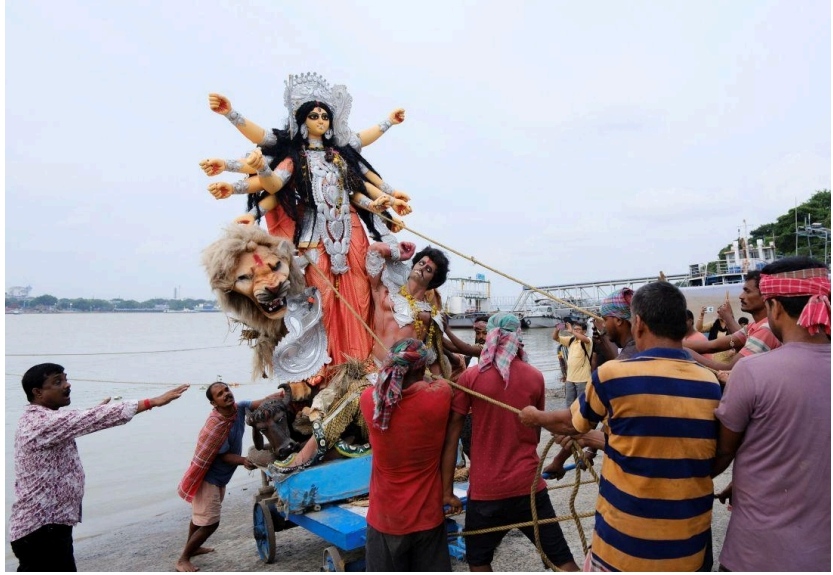
Worshippers immerse an idol of the Hindu goddess Durga in the river Ganges, marking the end of Durga Puja celebrations, in Kolkata, India, on October 4, 2025.
Six years ago, Trump stood hand in hand with PM Narendra Modi at Houston’s NRG Stadium as thunderous chants from 50,000 people. The show of political partnership known as the “Howdy Modi!” rally was mirrored at the subsequent “Namaste Trump” event in Ahmedabad in Gujarat the following February, solidifying a a seemingly unbreakable personal alliance.
But lately their friendship has been tested by Trump’s return to office.
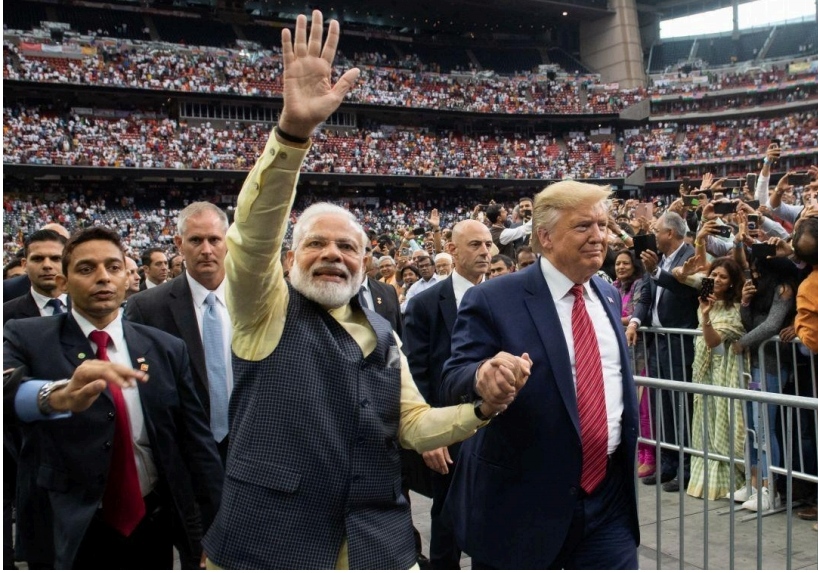
US President Donald Trump and Indian Prime Minister Narendra Modi attend the “Howdy, Modi!” rally at in Houston, Texas, on September 22, 2019
Earlier this year, Trump publicly but most foolishly derided New Delhi, labeling the Indian economy as “dead” while imposing some of the administration’s highest-ever tariffs on the nation. Whereas in contrast to the USA economy, Indian economy is most vibrant, with a vast internal market.
Half of the 50% levies are Trump’s “punishment” for India’s ramped-up purchases of Russian oil following the American and EU sanctions due to Ukraine conflict. The other half are part of Trump’s signature “America First” campaign to reduce US trade deficits. All these have had no impact on India’s strong friendship with Russia, leaving Trump red faced.
India shot back, brushing aside Trump’s tantrums, increasing Russian oil imports and strengthening relationship with China, all the while pointing out the hypocrisy of Trump’s move. US and Europe, it said, still trade with Russia on other products such as fertilizers, uranium, chemicals etc.
But the Trump administration lost its mental balance and dismayed the World by describing the Ukraine conflict as “Modi’s war”. It began literally pleading with New Delhi to cut economic ties with the Kremlin. India not only carried on purchases of Russian crude labelling the statement as inaccurate and misleading, but also shaking hands with Xi of China.
Refusing to give up, in September, Trump’s order to impose a $100,000 fee for H-1B visa applications was like a personal attack on Indian talent and ambition, as the largest group of beneficiaries of the skilled-worker program. Trump forgot to calculate the harm such a move will do to USA IT industry itself.
So it is this sense of betrayal that found a potent artistic outlet in the form of the demon statue.
“Trump as Mahishasura is serving a political message to the people who are visiting the pandal (pavilion) and the mass media organizations who are covering it,” said Kolkata resident Tuneer Mukherjee.
This blending of art and politics is characteristic of Bengali culture, he said, offering a simple but powerful message: Trump and his administration’s “regressive agenda” have become the modern demon to be slain by the divine mother, Durga.
For three months, Basak, from the organizing committee of the Trump installation, said their team worked in near-total secrecy, a deliberate tactic to create an element of suspense ahead of its reveal.
“The identity of the demon was a closely guarded secret,” he said. So closely, in fact, that the final, unmistakable features of Trump were only sculpted in the last seven days, hidden from view until the final moment.
When a video of the completed installation surfaced online, the response was electric, said Basak. “Thousands and thousands” of people flocked to the pavilion, forming queues that snaked through the neighborhood, he added.
For Basak, the overwhelming turnout was validation. “It really is something that resonated with a lot of people,” he said, “or at least, something everyone wanted to see for themselves.”
In West Bengal, art has never been just about decoration; it is a language for dialogue, a weapon for dissent, and the primary medium for social and political debate.
As a hotbed of resistance against the vile British colonizers, the Indian freedom struggle was fought as much with ideas as with weapons.
It was poet and novelist Bankim Chandra Chatterjee who gave the movement its rallying cry with the song “Vande Mataram” (Hail to the Motherland), while the work of Nobel laureate Rabindranath Tagore infused the resistance with its intellectual and spiritual soul.
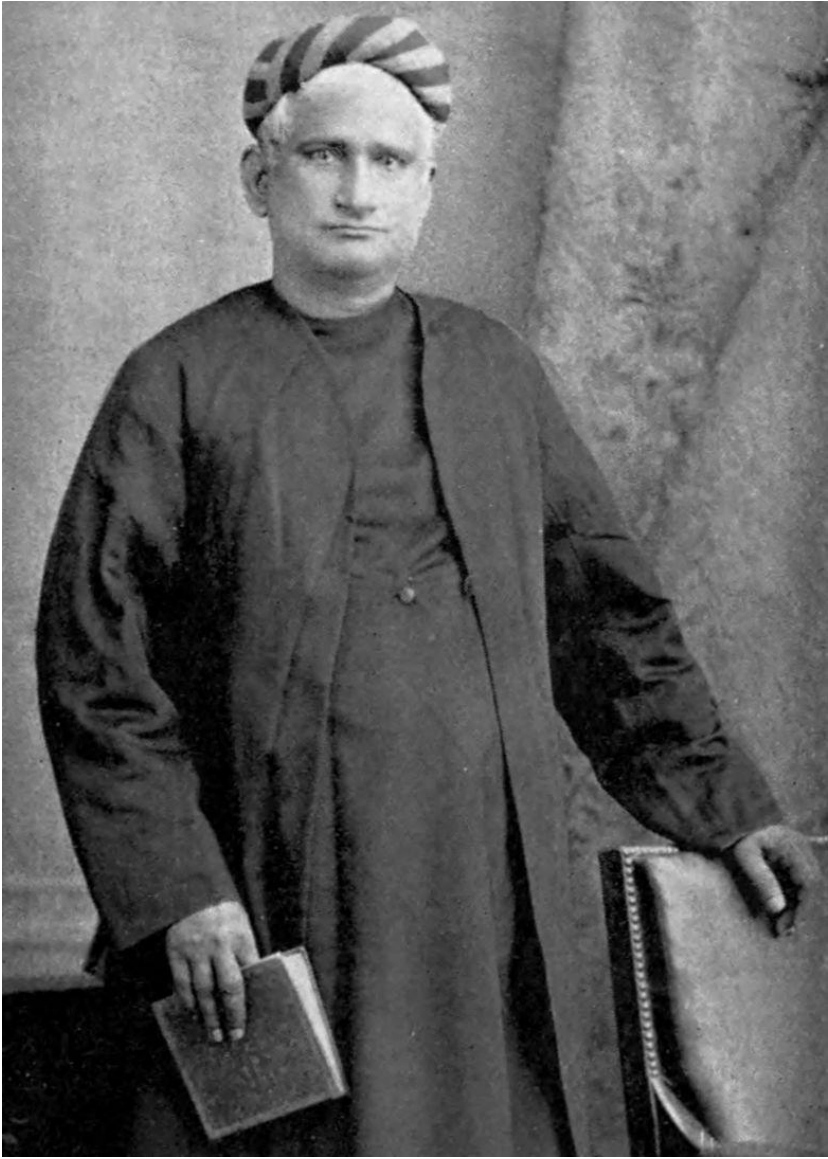
Bankim Chandra Chatterjee wrote the poem “Vande Mataram” (Hail to the Motherland) in the 1870s, which later became a vital symbol of India’s independence movement.
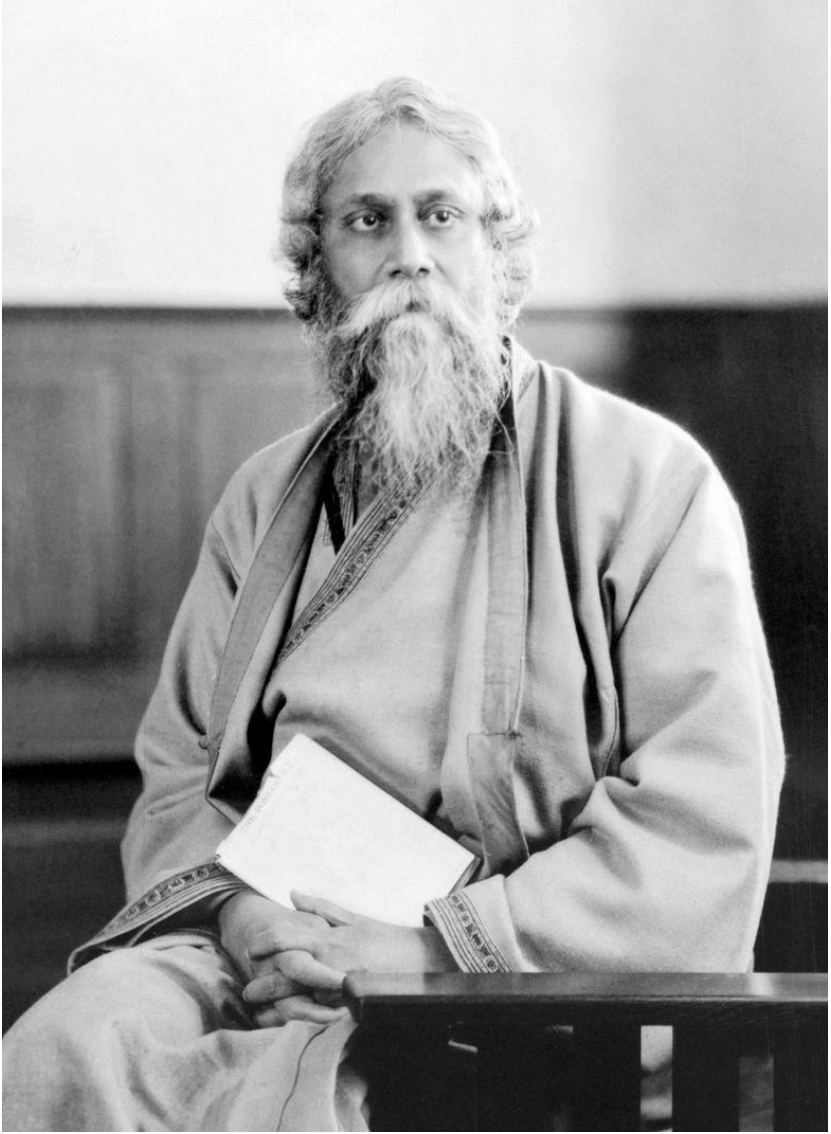
Sibnath Sastri Artist, painter and composer Rabindranath Tagore circa 1916. He was an advocate for India’s independence from the vile British colonizers
This deep-seated political consciousness didn’t fade with independence. It was further institutionalized and today, its legacy unfolds on the streets.
This towering statue of Trump is one of several politically charged installations that depicted the US leader or symbols of his economic agenda as the demon.
Worshipped by 1. 4 billion Indians as the mother of the universe, the goddess Durga embodies a powerful duality: her spear and club symbolize both fierce prowess and delicate motherliness.
And within the Bengali community, particularly in its cultural epicenter of West Bengal, Durga Puja has evolved beyond a purely religious celebration into one of the region’s most deliberate forms of public discourse and socio-political commentary.
“This kind of critique and social commentary is something that’s a part of our culture,” said Basak, from the Trump installation’s organizing committee.
“Now that mad Trump is just imposing tariffs upon tariffs upon tariffs, this is the big issue of the day. So, it’s only apt that we should depict it as such.”
Based on a CNN article