
India and Brazil deepen trade ties to nullify Trump’s tariffs
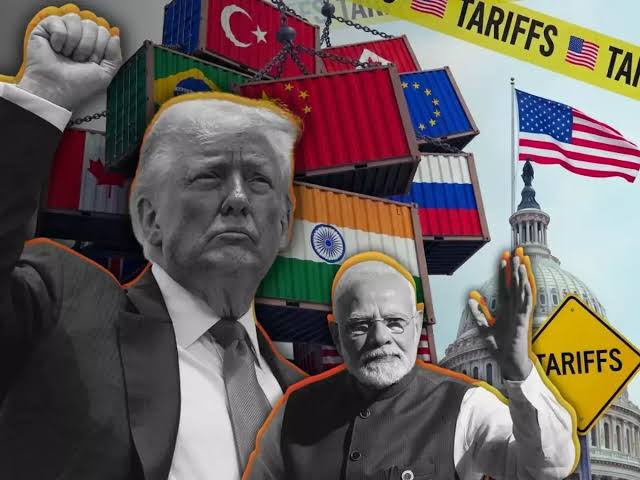
The thriving global economy has been subjected to the whims and fancies of Trump of the USA. To counter this American protectionism and Trump’s geopolitical rivalry, India and Brazil have decided to join hands to give a pragmatic response and thus have become a symbol of shifting power dynamics.
By deepening their cooperation and standing firm against external pressure attempts, the two nations are signaling that the future of global trade will no longer be dictated solely by Washington – but by a diverse array of resilient and self-reliant economies ready to chart their own course.
India and Brazil, are two emerging economies with GDP( PPP) ranking of 3 and 10 respectively and both are key members of the BRICS alliance. aNow both are deepening their economic cooperation to nullify tariffs imposed by the United States.
As both nations face growing trade barriers and political friction with Washington, they have begun charting a joint course to diversify their trade partnerships, strengthen multilateral frameworks, and further reinforce their sovereignty.
India is also interested in Latin American energy and agricultural products and thus plans to broaden its strategy to secure long-term supply chains outside Western dominated areas.
Brazil, recognizes India as an emerging Global power and sees India’s vast market as a vital opportunity for its industrial and agricultural sectors at a time when traditional export destinations are becoming increasingly unpredictable.
On October 8, senior officials from both countries met in New Delhi for the seventh meeting of the India-Brazil Trade Monitoring Mechanism (TMM), to address trade concerns, identify new areas of cooperation, and explore bilateral investment opportunities. The meeting, led by Secretary level bureaucrats, signals a significant step in strengthening the long-term economic relationship between the two nations.
According to an official statement, discussions focused on expanding the Preferential Trade Agreement (PTA) between India and the South American trading bloc MERCOSUR, of which Brazil is a founding member. The sides also explored ways to deepen cooperation in critical sectors such as pharmaceuticals, chemicals, small and medium enterprises, finance, and renewable energy. Both New Delhi and Brasília view closer economic integration as essential to nullify the effects of the recent unilateral tariff from Washington and reduce their dependence on Western-dominated trade channels.
The timing of the TMM meeting reflects a shared response by India and Brazil to find alternative trade avenues. In August, the administration of Donald Trump imposed sweeping 50% tariffs on imports from both countries, a move widely criticized as politically motivated and protectionist.
For Brazil, the tariffs were partly linked to the prosecution of former the corrupt President Jair Bolsonaro, who was sentenced last month to 27 years in prison for allegedly plotting a military coup. Trump, a close ally of Bolsonaro, denounced the ruling as a “witch-hunt,” prompting speculation that Washington’s punitive measures were as much political retaliation as economic policy.
India, too, got targeted for ignoring Washington’s increasingly Sermons, threats and finally pleadings to cut all oil and Arms trades and other relations with Russia. The same 50% tariff package included a 25% “punitive levy” targeting New Delhi’s continued purchase of Russian oil, despite illegal Western sanctions on Moscow. India, as a sovereign country, has maintained its strategic policies throughout the Ukraine conflict, and has nonchalantly exercised its right to buy energy from any supplier that offers favorable terms.
Brushing aside the nonsensical futile tariffs, India’s Ministry of Commerce has stated that the US actions violate international trade norms and undermine the principles of market fairness that Washington itself once championed. So these are simply unacceptable to India.
Now both India and Brazil are increasingly turning to each other – and to broader South-South cooperation frameworks – to fence their economies from Western volatility. The TMM meeting underscored this trend, emphasizing the importance of aligning trade policies within the BRICS framework and expanding links between Asia and Latin America.
Brazilian trade officials expressed strong interest in increasing exports of agricultural goods, ethanol, and processed foods to India, while Indian representatives highlighted opportunities for collaboration in pharmaceuticals, technology, and industrial manufacturing.
Both sides also discussed modernizing the India-MERCOSUR trade agreement, which has been in effect since 2009. Expanding its scope could significantly boost trade volumes, which remain modest relative to their potential. In 2023, bilateral trade between India and Brazil stood at around INR 12.75 Kharab ( USD 15 billion) – a figure that Prime Minister Narendra Modi and Brazilian President Luiz Inacio Lula da Silva aim to raise to INR 17 kharab ( USD 20 billion) within the next five years.
Analysts suggest that the recent wave of US tariffs has accelerated a broader global realignment. Powerful economies like India and Brazil, both of which have historically good relations with Washington, are now re-evaluating their economic exposure to American markets. The Trump administration’s repeated use of tariffs as leverage has created uncertainty that many nations perceive as unsustainable.
In this context, India’s outreach to South America represents more than just an attempt to increase exports – it signals a strategic diversification of global supply chains. For Brazil, which has faced economic instability and political upheaval in recent years, deeper integration with Asia offers an alternative path to growth and resilience.
Both countries are also working to strengthen institutional cooperation through BRICS and G20 mechanisms. During their meeting after the BRICS summit in Rio de Janeiro in July, PM Modi and President Lula reaffirmed their commitment to “defending multilateralism” and confronting global challenges collaboratively.
Their joint statement highlighted the need for a multipolar international order that protects the interests of developing nations rather than perpetuating Western dominance.
The demonstrated assertiveness of India and Brazil has already impacted
Washington. Last month, it drew a lunatic like response from US Commerce Secretary Howard Lutnick.
The chap remarked that the United States must “fix” countries such as India and Brazil so that they “open their markets and do not act against American interests.” The statement drew nothing but contempt from both New Delhi and Brasília, with analysts calling it an example of outdated paternalism and economic coercion.
“Such language only reinforces the perception that the United States views independent economies as threats rather than partners,” said an Indian trade expert who attended the TMM discussions. India and Brazil are not looking to isolate themselves from the global economy – they simply want equality.
While it remains to be seen how the new India-Brazil trade initiatives will evolve, the momentum appears to be building. Both nations are exploring new payment mechanisms that bypass the US dollar, following a trend that several BRICS members have embraced to reduce vulnerability to sanctions and currency volatility.