Cochin Shipyard hands over Indigenous ASW Vessel INS ‘Mahe’ to The Indian Navy
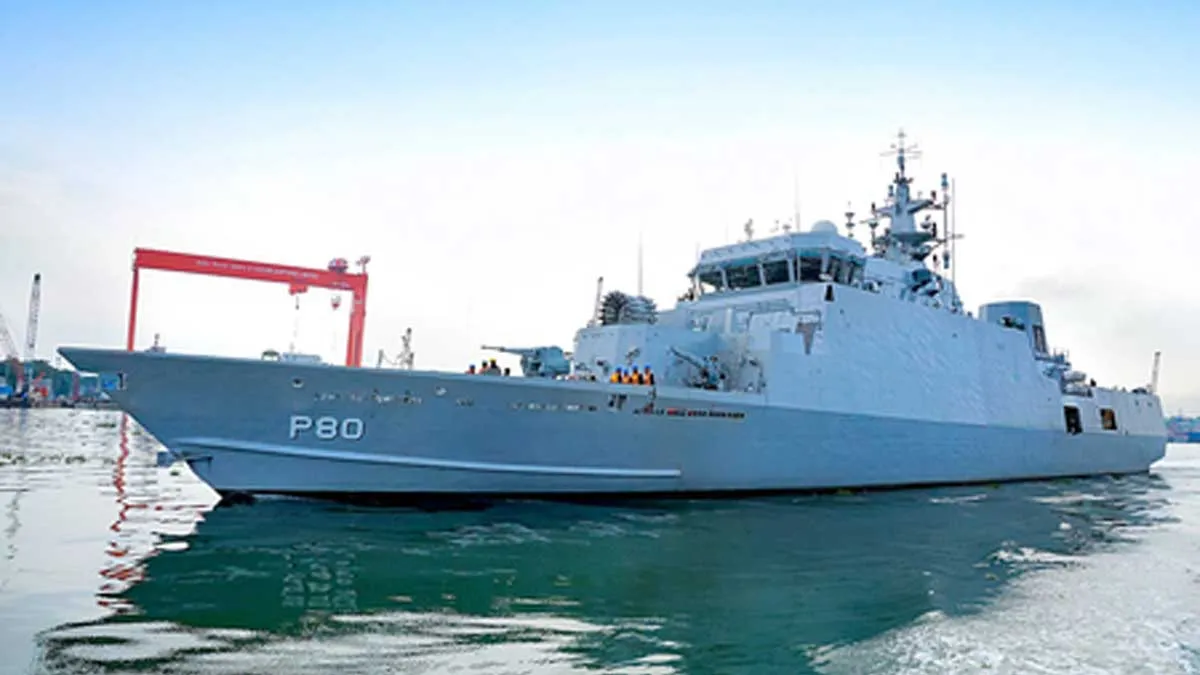
Cochin Shipyard Limited (CSL) has successfully delivered INS Mahe, an Anti-Submarine Warfare Shallow Water Craft (ASW SWC) to the Navy. This is the first ship out of eight it is building for the Navy with another eight such ships coming from Garden Reach Shipbuilders. This marks a major stride in India’s indigenous shipbuilding drive to become a Aatmanirbhar Bharat. GRSE has already delivered INS Arnala and INS Androth.
INS Mahe a 78-metre-long warship, represents a significant technological milestone.The ASW-SWC vessels are the biggest vessels of the Indian Navy to be powered by a combination of diesel engine and water-jet propulsion. The vessels’ water-jet propulsion system allows the vessel to sprint swiftly for short intervals.
This advanced propulsion system ensures superior manoeuvrability and reduced acoustic signature, crucial in anti-submarine operations carried out in littoral waters. The vessels are also reported to possess several features of stealth – including a reduced radar cross-section (RCS), a low acoustic signature and a low infrared signature.
These ships are equipped with one RBU-6000 anti-submarine rocket launcher and two sets of light-weight torpedo-tube launchers for launching anti-submarine torpedoes. The vessels are also equipped with mine rails, which enables the vessel to lay anti-submarine mines along the seabed.
Aside from its primary anti-submarine weaponry, the vessels are also equipped with one GRSE-developed Naval Surface Gun (NSG) 30 mm autocannon paired with a Electro Optical Fire Control System (EOFCS) and two 12.7 mm M2 “Stabilised Remote Controlled Gun” remote-weapon stations (RWS), equipped with optronic control systems.
For detecting and intercepting hostile submarines, these ships are equipped with sophisticated sonar equipment, including a hull-mounted sonar (HMS) and towed low-frequency variable-depth sonar (LFVDS). The LFVDS system is being procured from a partnership firm formed by Indian CFF Fluid Control Ltd. and German Atlas Elektronik.
The system will be manufactured in India and supplied to GRSE and CSL, the firms engaged in construction of the ships. The hull-mounted sonar is the Abhay system an advanced active-cum-passive integrated sonar system designed and developed by NPOL, DRDO and manufactured by BEL.
Though primed for anti-submarine warfare (ASW), the ships can undertake multiple missions, including “search-and-attack-unit” (SAU) roles, low-intensity maritime operations (LIMO), subsurface surveillance in littoral-waters and coordinated ASW operations with maritime-patrol aircraft (MPA).
In addition, the vessels also possess the capability subsurface surveillance and interdiction, within the vicinity coastal waters. The vessels can also be deployed for search-and-rescue (SAR) missions in littoral waters. The corvettes are meant for operations within 200 nmi (370 km) of the coastline.
In their secondary role, the vessels will be able to lay mines, to protect domains of crucial importance, such as naval bases and commercial ports, from enemy submarines. Its compact design and high agility make it ideal for operations in shallow waters where conventional destroyers and frigates face navigational constraints.
The ship’s design reflects extensive indigenous input, with over 90 percent of components sourced domestically—a major achievement in India’s self-reliance and technological maturity in naval construction.
The formal vessel acceptance was completed by Dr S. Harikrishnan, Director (Operations), Cochin Shipyard Limited, and Commander Amit Chandra Choubey, Commanding Officer (Designate) of Mahe.
The ceremony was attended by senior naval officials including Rear Admiral R. Adhisrinivasan, Chief Staff Officer (Technical), Western Naval Command, and Commodore Anup Menon, Warship Production Superintendent at Kochi. The accomplishment underscores India’s growing competence in designing and building advanced warships domestically.