Stealth deficiencies in Russia’s SU-57E is dwarfed by its super speed and agility
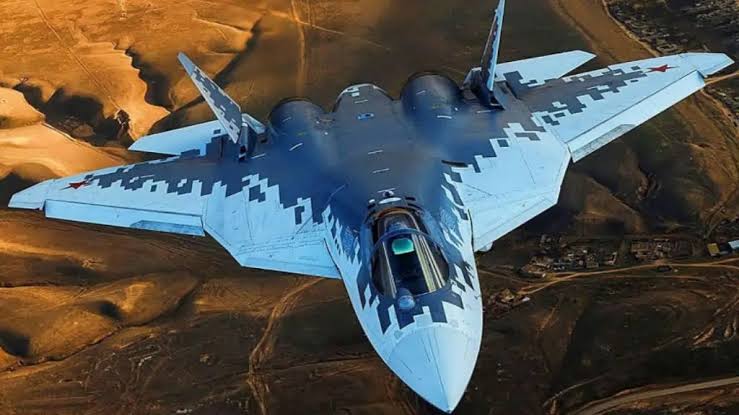
Competitors of SU-57E always try to point out technical concerns over the stealth performance of Russia’s Su-57E fighter, focusing on shortcomings that undermine its radar signature reduction, especially in the rear-aspect domain.
Those criticizing the fighter say that the aircraft’s exposed engine section is one of its most serious vulnerabilities, negating much of the benefits achieved through frontal shaping and radar-absorbent coatings.
Western experts say that the open engine panels and nozzle layout resemble legacy Soviet designs, particularly that of the Su‑27 family. This configuration results in an enlarged radar cross‑section (RCS), making the aircraft detectable by hostile sensors. The Su‑57E’s RCS ranges between 0.1 and 1 square metre from the frontal sector, substantially higher than the Lockheed Martin F‑35’s 0.001 square metre rating.
However Russia prioritised the engine thrust of this fighter over low‑observability refinement, opting for greater power output rather than stealth perfection. The Su‑57’s Saturn AL‑41F1 engines offer exceptional thrust‑to‑weight performance but at the cost of an elevated RCS and thermal signature. This design philosophy diverges from the Western approach that integrates propulsion efficiency with stealth optimisation.
However now the Russians are working to reduce the stealth deficiencies as these jets may be purchased by India in a procurement plan for 114 next‑generation fighters, estimated at around INR 17.5 Kharab (20 billion USD). The Su‑57E is the most suitable for IAF for advanced air dominance roles.
In response to Indian request, Russia’s defence industry has reportedly tested new composite panels and heat‑shield assemblies at the Gromov Flight Research Institute. These structural revisions are designed to conceal hot zones and reduce IR emissions by 40‑50 percent.
India is seeking a firm timeline for these upgrades, with clarity on whether such improvements will coincide with the full integration of the second-stage AL-51 (Izdeliye 30) engine.
In addition, the IAF has requested long-term performance data for the Su-57E’s radar-absorbent material (RAM) coatings.
Experts within Air HQ have highlighted that the durability and maintainability of RAM under tropical and desert conditions will determine its operational viability in Indian environments. Previous Russian systems have shown limited coating life, leading to maintenance and cost complications.
The service has also pointed to visible inconsistencies in panel alignment and sensor aperture shaping across the Su-57E’s composite fuselage, which contribute to radar scattering. The Air Force considers these imperfections to be critical, given that stealth effectiveness depends on precision manufacturing tolerance — an area still under scrutiny in Russian aerospace manufacturing.
Purchase of 3 to 6 squadron of SU 57MKI as a gap filler may be sone alongside India’s own fifth-generation Advanced Medium Combat Aircraft (AMCA) development and the ongoing Multi-Role Fighter Aircraft (MRFA) acquisition effort. The IAF leadership has underscored that any potential acquisition must complement indigenous efforts without creating long-term logistic or technological dependencies.
Along with the fifth-generation option, a more pragmatic balance is needed between stealth effectiveness, maintainability, and strategic autonomy. The final decision to procurement SU57 will likely hinge on whether Russia can demonstrate reliable improvements and verifiable data at the earliest.