Blue Economy : What Sri Lanka can learn from Indian initiatives?
By Kapila Chinthaka Premarathne
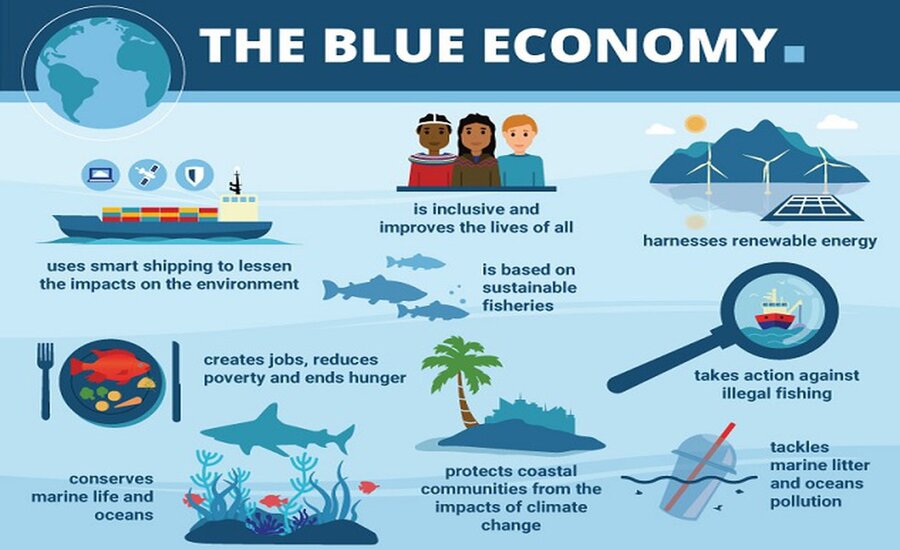
The “blue economy” means sustainable use of ocean resources for economic growth, improved livelihoods and jobs, while preserving the health of marine ecosystems. It spans fisheries and aquaculture, port-led logistics, marine biotechnology, renewable offshore energy, coastal tourism and marine services, such as ocean observation and mapping.
As an example, India is actively preparing to harness its marine assets through place-based policy, infrastructure and science. It has a long coastline (officially about 7,516.6 km) and an Exclusive Economic Zone of roughly 2.02 million sq. km. To convert that potential into sustainable growth, India combines national programmes (e.g., the port-modernisation Sagarmala initiative) with sectoral investment such as the Pradhan Mantri Matsya Sampada Yojana (PMMSY), a fisheries and aquaculture scheme with total investment of about Rs 20,050 crore to boost production, value-chains and livelihoods (Ports & Waterways Ministry of India).
Crucially, India couples finance with research, monitoring and human capital. Institutions such as the Indian National Centre for Ocean Information Services (INCOIS) and the CSIR–National Institute of Oceanography (NIO) provide operational ocean forecasts, early warnings, mapping and long-term research that underpin policy and industry decisions. And also, the Central Marine Fisheries Research Institute (CMFRI) plays a vital role in assessing marine fish stocks, developing mariculture technologies / innovations, and formulating ecosystem-based fisheries management approaches.
Meanwhile, the Central Agricultural Fisheries Research Institute (CAFRI) contributes to research on inland and coastal aquaculture systems, promoting sustainable and climate-resilient practices. The notable information sharing sessions to fishermen, such as training, exhibitions, are conducted via outreach arms of these institutes.
Moreover, business incubation, industry to research links, academic and industry collaborations are promoted by the current workout plan. For instance, the recent meetings at MECOS-4, in Kochi, highlighted technology-driven ocean exploration, regional research networks and skills development for youth and women as central to scaling the blue economy, while highlighting the importance of achieving the sustainable blue economy benefits.
We participated and extracted the essentials in the event as part of the BIMReN Research Grant on Sustaining Fisheries Ecosystem in the Palk Bay Region: Assessing Management Options, Livelihoods and Fishers’ Perspectives, offered by the Bay of Bengal Programme Inter-Governmental Organisation (BoBP-IGO) and funded by the Ministry of External Affairs, Government of India, aimed to strengthen cross-border collaboration in sustainable fisheries and blue economy research.
The Tamil Nadu Model: An Example of Living Laboratory of Collaboration
Tamil Nadu provides perhaps the most instructive example of how tripartite collaboration between the government, the academia, and industry collaboration can power the blue economy. The Department of Fisheries and Fishermen Welfare work in close partnership with institutes like Tamil Nadu Dr. J. Jayalalithaa Fisheries University and its network of para-professional training institutes. Together, they deliver structured skill-development programmes for fishers and entrepreneurs, covering boat handling, fishing gear repair, seaweed cultivation, mud crab and sea bass farming, and other sustainable aquaculture practices.
Moreover, the Educational–Sectoral Linkage Model and “field-to-lab-to-field” ensure a continuous flow of knowledge between researchers and practitioners such as field challenges faced by fishers and farmers, such as shrimp disease outbreaks or post-harvest losses, are systematically documented by fisheries officers and channelled to TNJFU or the Central Marine Fisheries Research Institute (CMFRI).
These links have suggested strong Standard Operating Procedures (SOPs), covering breeding, water quality management, stocking density, feeding regimes, feed formulations, disease-resistant strains, and environmentally friendly practices. This keeps profitability, sustainability, and ecological responsibility in balance.
Road Ahead: What Sri Lanka can learn
Sri Lanka can learn from these initiatives, and regional cooperation can help it reach its blue economy targets. Its coastline (about 1,340 km) and EEZ (about 532,619 sq km) make it a natural maritime state with urgent needs for ecosystem-based fisheries management, cold-chain investments, mariculture, and coastal zone resilience.
Sri Lanka’s blue economy future will depend on its ability to weave together research, governance, and grassroots action. A unified, evidence-based framework, grounded in education and regional partnerships, can turn its coastal frontiers into hubs of innovation and resilience. Therefore, practical lessons from India include:
(1) align national investment (fisheries, ports, mariculture) with science-based spatial planning;
(2) strengthen national ocean data services and forecasting; (3) invest in vocational and university programmes to create the next generation of marine professionals; and
(4) build regional platforms — data sharing, joint research (e. g., BIMReN–BoBP-IGO collaborations) and coordinated fisheries governance, to manage shared stocks and transboundary risks such as climate change and marine pollution. Such a pragmatic, science-led blue economy is essential for Sri Lanka, rooted in research, skills, and regional cooperation. It will open pathways to resilient coastal livelihoods and higher-value maritime sectors.
Thus, the lessons from India’s blue economy initiatives remind us that sustainable ocean development is not achieved through isolated projects, but through systemic collaboration—anchored in science and sustained by people. This understanding will be especially important when working under new budget allocations and policies targeting the Blue Economy.
The Island