
Indigenous Kalanamak rice nearing disappearance in Banke, Nepal
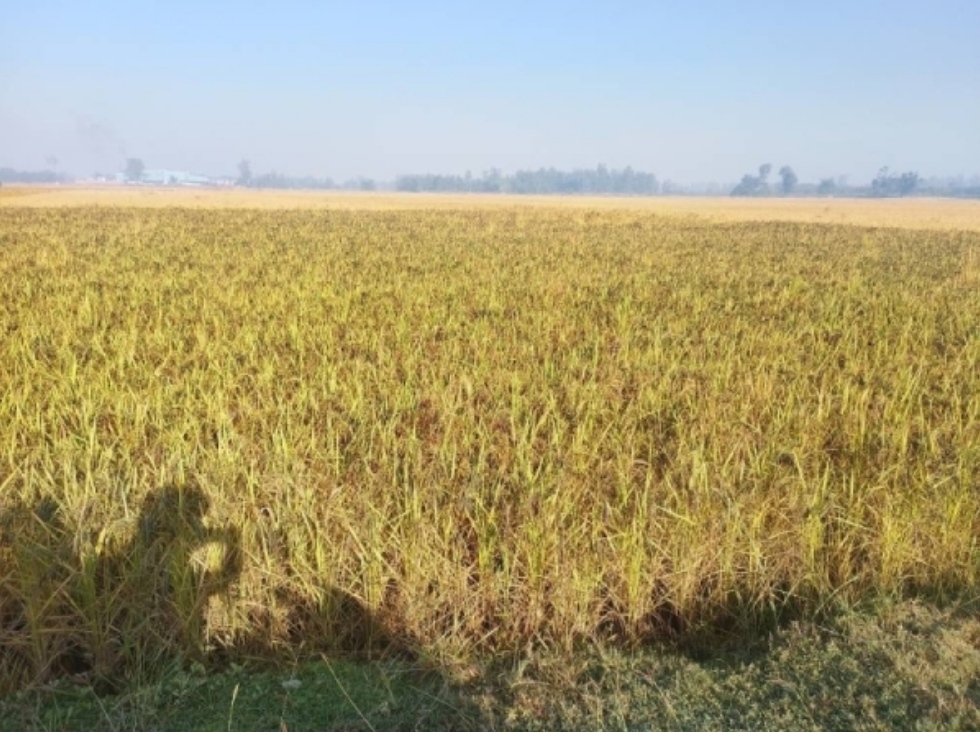
Kalanamak rice
Kalanamak is a scented rice of Nepal and India. Its name means black husk (kala = black; the suffix ‘namak’ means salt). This variety has been in cultivation since the original Buddhist period (600 BC). It is popular in Himalayan Tarai of Nepal i.e., Kapilvastu, and eastern Uttar Pradesh, where it is known as the scented black pearl. It was featured in the book Speciality rices of the world by Food and Agriculture Organization of the United Nations.
Kalanamak rice was granted the Geographical Indication (GI) Tag in 2012 by the Government of India. A geographical area was defined where Kalanamak rice can be produced. Kalanamak rice grown only in this area can be labelled as Kalanamak rice.The GI tag is used for agricultural, natural and manufactured goods.
Kalanamak Rice was grown widely in Kapilvastu and UP’s Tarai belt. It is now grown in 11 districts of Zone 7 of UP. These 11 districts are located in the divisions of Gorakhpur (Deoria, Gorakhpur, Mahrajganj, Siddharth Nagar districts), Basti (Basti, Sant Kabir Nagar, Siddharth Nagar districts), and Devipatan (Bahraich, Balrampur, Gonda, Shravasti districts). Until the 1990s, the variety made up more than 10% of the total rice cultivation area in Siddharthanagar. However, acreage growing this variety in this district declined to <0.5% of total rice cultivation during 2002.
The Kalanamak variety of rice is on the brink of vanishing as farmers increasingly abandon it due to low productivity and high cultivation challenges. Acreage under this variety has declined sharply, pushing it towards extinction, for various reasons.
Farmers say the variety demands intensive care, reliable irrigation and is highly susceptible to pest attacks. As a result, many have shifted to hybrid varieties, said Santosh Pathak, information officer and senior crops development officer at the Agriculture Knowledge Centre, Banke.Despite its popularity among high-end consumers and tourists, Kalanamak has been overshadowed by hybrid options and commercial farming. Though rice was cultivated on 34,190 hectares this year, Kalanamak and other indigenous varieties were not even recorded. The Centre has now launched efforts to revive and promote them.
Kalanamak plants are tall and prone to lodging. To address this, the Centre has introduced shorter varieties and advised farmers on balanced fertilizer use. A trial plantation is underway on one hectare of land owned by Ganga Narayan Chaudhary in Titihariya, Baijanath Rural Municipality-8, who expects to harvest around 30 quintals soon. The variety sells for about Rs 10,000 per quintal, compared to Rs 3,500 for ordinary rice-reflecting its high production cost and longer six-month maturation period.
Farmers, however, continue to favor hybrids such as Ramdhan, Radha-4, MP-60 and Gorkhnath. Centre Chief and senior crops expert Binod Ghimire said subsidies on seeds and agricultural technology are being provided under the Small and Aromatic Rice Promotion Programme, but farmer interest in Kalanamak remains limited due to its demanding cultivation requirements.
The price of kala namak rice varies depending on the brand, quantity, and type (e.g., polished or unpolished), but generally ranges from approximately ₹175 to ₹289 per kg for a 1kg pack from online retailers like Amazon.in and BigBasket. Bulk quantities, like 5kg, can have a lower per-kilogram rate, and wholesale prices can be lower still.
Kalanamak Rice Benefits: The Supergrain or Kalanamak rice is known for its distinct aroma, high nutritional value, and unique health benefits. It has a lower glycemic index than common rice, making it suitable for diabetics, and is rich in iron, zinc, and antioxidants like anthocyanin. Aesthetically, its grains are dark with black husks that turn a purplish color when cooked.
Nutritional qualities
Rich in micronutrients: It is high in iron and zinc, which supports immune function and can help fight certain diseases.
High protein: It contains up to 11% protein, which is nearly double that of common rice varieties, aiding in muscle growth and repair.
Low glycemic index: With a GI of 49-52, it is a better option for managing blood sugar levels compared to other rice types.
Antioxidant-rich: Contains antioxidants like anthocyanin and beta-carotene, which help protect cells from damage, promote eye health, and have anti-inflammatory properties.
Contains fatty acids: It has omega-3 and omega-6 fatty acids that support heart and brain health.
Culinary and sensory qualities
Aroma: It has a unique and strong sweet fragrance, similar to Basmati rice.
Texture: The cooked grains are soft and tender, and it has a high head rice recovery rate, meaning a higher percentage of unbroken grains after milling.
Color: The grains are dark with black husks and turn a purplish-brown color when cooked.
Versatility: It can be used in a variety of dishes, including pilafs, biryanis, and desserts.
Agricultural and economic qualities
Cultivation: It can be cultivated with low input requirements and is well-suited for organic farming.
Profitability: It can be more profitable than Basmati rice due to lower labor costs and higher yields.
The four varieties of Kalanamak are KN 3, Bauna Kalanamak 101, Bauna Kalanamak 102, and Kalanamak Kiran were developed by Dr. R. C. Chaudhary. The aroma of Kalanamak rice is said to be Buddha’s gift. It is stronger than all Basmati varieties. It elongates after cooking, which is one of its most important quality traits. Cooked kalanamak is softer and fluffier than other rice varieties. Amylose content is close to 20% as compared to 24% and higher in Basmati. High amylose levels tend to make the rice cook firm and dry. Rice with a medium amylose content, between 16% and 22%, usually cooks softer and the grains stick together more readily.
Health benefits
Kalanamak rice is rich in micronutrients such as iron and zinc. It has 11% protein, almost double that of common rice varieties. It has a low Glycemic Index (49% to 52%) making it relatively sugar-free and suitable for diabetics. The government of India came out with its Nutri-Farm scheme in 2013, intending to promote food crops that offer critical micronutrients to improve the nutrition status of the vulnerable section of society. Kalanamak rice was one of the nutri-crop selected for this scheme.