
DNA analysis suggests first Australians arrived about 60,000 years ago
By Jacinta Bowler
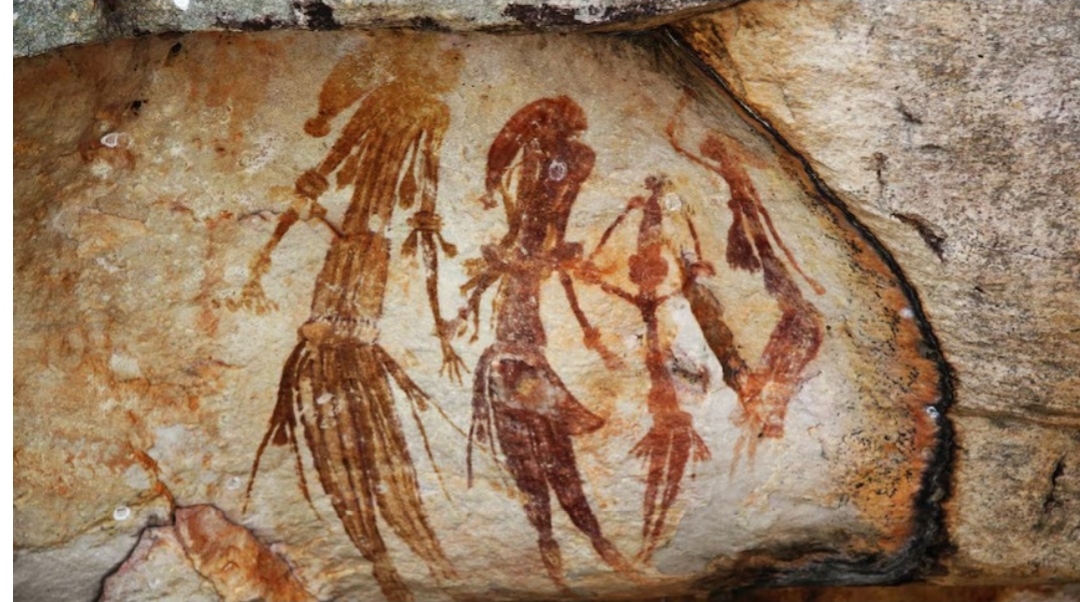
Aboriginal rock art on white rocks depicting four red figures.
The scientific timeline of when Indigenous people arrived in Australia has changed significantly over the past few decades
A new DNA study suggests the first humans came to the ancient landmass that is now Australia via two distinct routes 60,000 years ago — much earlier than previous genetic evidence indicated.
Archaeologists say the research is the first to “comprehensively” close the gap between genetic and archaeological evidence, which places arrival about 65,000 years ago.
What’s next?
Some scientists still believe the case is not settled, with more research needed to confirm the genetic time frame.
Humans first travelled to the ancient landmass that would become Australia and New Guinea about 60,000 years ago via two routes, a new genetic analysis suggests.
The findings, published today in Science Advances, bring the date of when the First Australians arrived in Sahul — based on genetic evidence — much closer to those in the archaeological record of about 65,000 years.
According to Christopher Clarkson, an archaeologist at Griffith University, the question of when First Nations people arrived in Australia has sparked ongoing “fierce debate” in the fields of genetics and archaeology.
Until now, dates based on genetics placed arrival between 47,000 and 51,000 years ago.
“We’ve been pointing to this mystery of why is there this time gap, and why does the genetics not match the older archaeological record?” Professor Clarkson, who was not involved in the new study, said.
“Now, with this new analysis … we can see for the first time that actually these two things do match very well.”
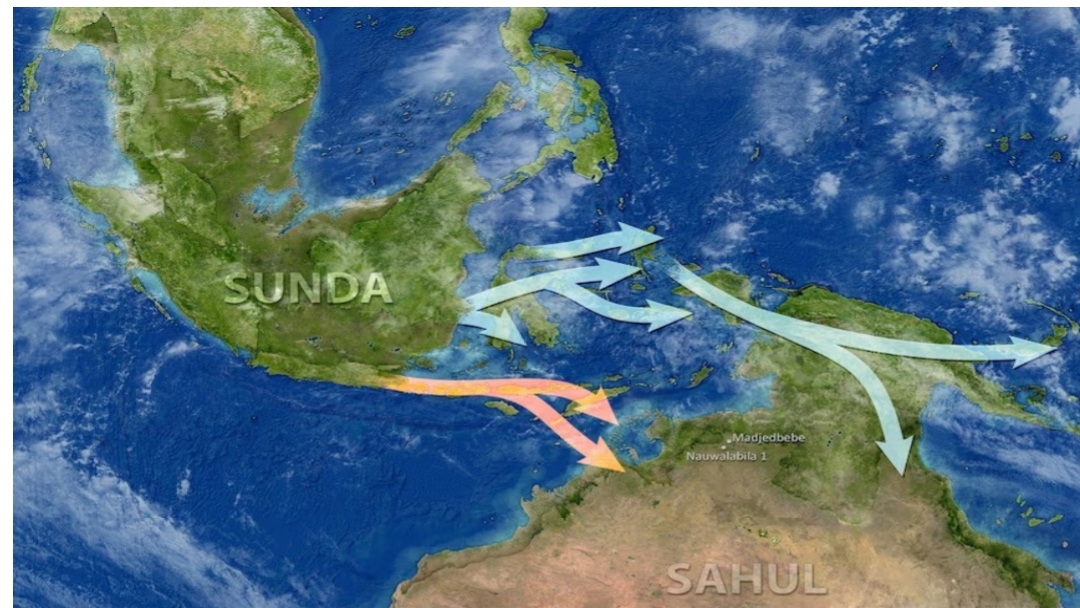
Map of Sunda and Sahul, with arrows showing potential migration routes.
Map of Sunda, Sahul, and the Western Pacific, with arrows showing potential migration routes suggested by the new study.But some experts suggest the debate on when the first people arrived in Australia is far from over.
While Western scientists continue to argue over dates, the study’s authors say their work supports a deep heritage for many Indigenous communities.
“We know that the ancestors of New Guineans and Aboriginal Australians have inhabited Sahul for tens of thousands of years, with many Aboriginal Australians understanding that they have always been on country,” Helen Farr, an archaeologist at the University of Southampton, said.
The shifting date of arrival
Tens of thousands of years ago, during the last Ice Age, the world was a very different place.
Much of South-East Asia was one large landmass known as Sunda, while Austraila, New Guinea and Tasmania made up a second landmass called Sahul.
As modern humans spread across the globe, it is thought the ancestors of Australia’s First Nations people travelled south, first through Sunda, and then onto Sahul.
Australia’s human history pushed back
Stone tool from Madjedbebe rock shelter
New excavations of a rock shelter near Kakadu National Park indicate humans reached Australia at least 65,000 years ago — up to 18,000 years earlier than previously thought.
Looking back so deep into the past is difficult to do, and scientists’ best guess of when this arrival occurred has changed significantly over the years, according to Professor Clarkson.
“Back in the 1960s [we thought] Aboriginal people might have been some of the latest arrivals — 1,000 years ago or so. Then that was pushed back to 16,000 in the late ’60s, and then 30,000 in the 70s.”
But dating of the Madjedbebe rock shelter in the Northern Territory by Professor Clarkson and colleagues in 2017 suggested the arrival date was much earlier.
“My own work in Arnhem Land at the site of Madjedbebe puts [Indigenous occupation] at about 65,000 years ago.”
Gap between archaeology and genetics
Not all scientists agree about the date from Madjedbebe, which is the oldest-known archaeological site of human occupation in Australia.
According to Bastien Llamas, an evolutionary geneticist at the University of Adelaide who was not involved in the research, the tension around an arrival date is due to a mismatch of evidence.
“The archaeology and genetics do not agree on the timing of events,” he said.
Find stories of ancient Australia near you
A map of Australia with markers and a search field with the words ‘your place’ inside it.
There are ways to see into the deep past all around the country.
In the field, the archaeological-based arrival time frame of 60,000 to 65,000 years old is known as the “long chronology”, while the smaller time frame — between 47,000 to 51,000 years — tied to genetics is known as the “short chronology”.
Most genetic research done in the past uses molecular clock techniques, where scientists look at how often mutations occur in DNA.
These models normally fit closer to the short chronology theory.
The new study, which analysed 2,456 samples of mitochondrial DNA of Indigenous people from Australia and New Guinea — one of the largest done in the region — found a different answer.
According to Martin Richards, an archaeogeneticist at the University of Huddersfield and study author, the new figure comes from double-checking the rate of mutations in this population by looking at other groups in the remote Pacific.
“Mitochondrial DNA doesn’t evolve at a uniform rate over time … we therefore developed a correction curve to allow for this,” Professor Richards said.
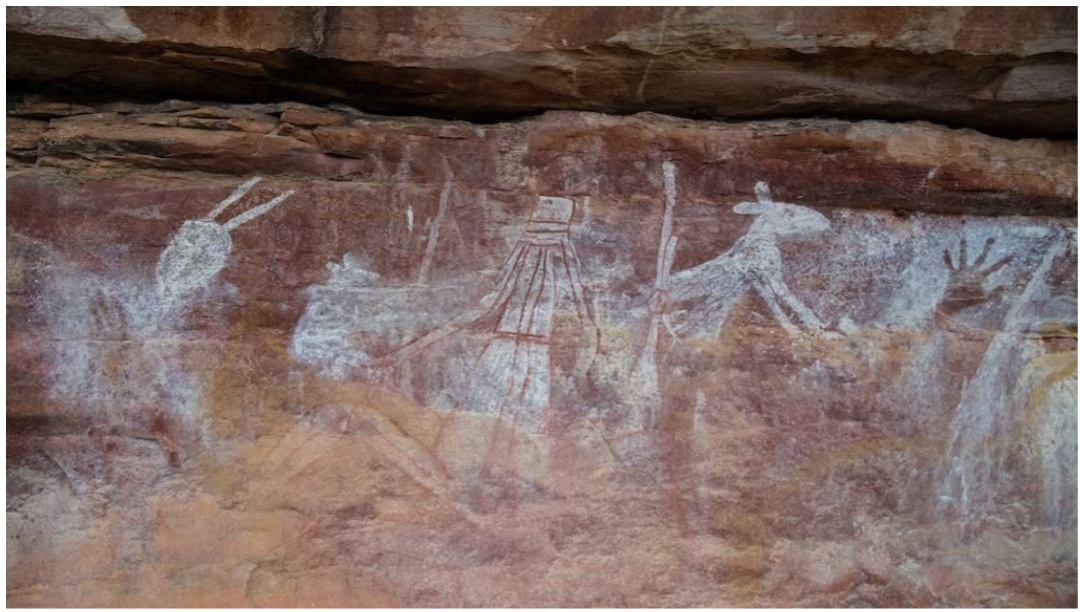
White drawings of people and kangaroos on red rock.
There are hundreds of Aboriginal rock art sites across Arnhem Land.
The results also suggest people moved through two routes into Sahul — one from the Philippines and Sulawesi, and another minor route from the south.
“We dated both dispersals to about the same time — roughly 60,000 years ago,” Professor Richards said.
“This supports what archaeologists [say is] the so-called ‘long chronology’ for settlement.”
Professor Farr said the migration was not accidental.
“We see evidence that people were using boats, stepping offshore and making bluewater crossings as early as 60,000 years ago,” she said.
“The southern route would still have involved an open water voyage of around 100 km or more … these were not one-off accidental drift events, but some of the earliest evidence we have for seafaring.”
Scientific debate continues
According to Professor Clarkson, the new paper is a “very satisfying consolidation of multiple lines of evidence”.
“It’s the first really comprehensive study that links the archaeology and the genetics — looking at seafaring and timing and climate — and makes a really strong argument around when people first got here,” he said.
“I hope that it will have a strong impact on the discipline.”
But geneticist Dr Llamas believes more work is needed to pin down the genetic timeline, calling the dogmatic views on the different calculations of molecular rates a “question of religion”.
“The almost perfect correlation … shows a concordance between genetics and archaeology that is hard to ignore,” he said.
“It’s a very good study, the methods are solid, and they’ve done their due diligence, but there’s still this uncertainty of the molecular rate.
Each dot marks 250 years — together they reveal Australia’s ancient story
A spiral of dots representing 65,000+ years of time.
How First Nations people outlived giant animals, survived an ice age and thrived amid massive landscape change.
While the researchers of the new paper say it’s unlikely the case will be settled, they hope further research will finally end the short or long chronology debate.
“We are currently analysing hundreds of whole human genome sequences … to test our results,” Professor Richards said.
“In the future, there will be further archaeological discoveries, and we can also hope that ancient DNA might be recovered from key remains, which would allow us to test these models and distinguish between them more directly.”
ABC News