
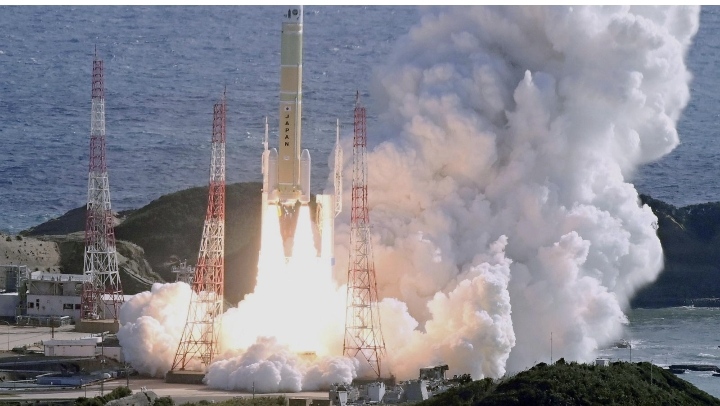
Once again Japanese H3 rocket fails to put geolocation satellite into orbit
A Japanese H3 rocket carrying the sixth satellite in a seven-orbiter geolocation system failed to deliver its payload into orbit after liftoff on Monday, the country’s science ministry said.
Japan has experienced several significant satellite launch failures and setbacks in the last 4 years , notably the JAXA Epsilon rocket failure in 2022, multiple issues with the new H3 rocket (including two major failures in 2023 and 2025), and failures from private startups like Space One’s Kairos rocket in late 2024, disrupting national space efforts and delaying new capabilities.
JAXA Epsilon-6 (Oct 2022): A rare failure for Japan, this solid-fuel rocket carrying eight small satellites was aborted and self-destructed shortly after liftoff due to being off-course.
JAXA H3 Rocket (Mar 2023 & Dec 2025): Japan’s new flagship rocket faced a significant setback during its debut launch when the second-stage engine failed, followed by another failure in late 2025 with the No. 8 H3 rocket carrying a navigation satellite.
Space One Kairos (Dec 2024): A private startup’s maiden launch ended in self-destruction minutes after liftoff due to flight setting issues, highlighting challenges in Japan’s new space sector.
Epsilon-S Engine Test (2024): The improved Epsilon-S rocket also faced delays after its engine suffered combustion test failures.
:
These failures, particularly with the H3 and Epsilon programs, have impacted Japan’s ability to compete in the global launch market and deliver on national space goals, though successful H3 launches have also occurred.
The Japan Aerospace Exploration Agency is assessing the situation and investigating the cause of the second-stage engine’s premature cutoff that occurred shortly after liftoff from the Tanegashima Space Center in Kagoshima Prefecture.
Placed on multiple orbital planes, the Quasi-Zenith Satellite System will enable Japan to operate highly accurate positioning services vital for smartphones and vehicle navigation, covering close to 100 percent of Japan, including urban canyons and mountain terrain, according to JAXA.
The launch of Michibiki No. 5 from an island in southwestern Japan had been originally scheduled for Dec. 7, but it was rescheduled to last Wednesday and then Monday after abnormalities were detected in the rocket and ground facilities.
Japan began operating its own geolocation system with four satellites in 2018 to enhance the availability and improve the performance of the U.S.-administered Global Positioning System.
Michibiki No. 6 was launched in February this year. The agency ultimately plans to have 11 geolocation satellites orbiting the Earth to ensure that the system has redundancy in the event of technical problems, and to expand coverage.
With the seven-orbiter system, at least one satellite is above Japan at all times, with coverage also extending to other parts of Asia and Oceania, according to the agency.