
An Orwellian nightmare taking shape in USA
By P K Balachandran
The latest American opinion polls show that President Donald Trump’s tough steps against crime are appreciated, but support for his draconian anti-immigrant actions is dwindling.
It was after the assault on Edward Coristine, a strong Trump supporter, by a group of white teenagers in Washington DC on August 3, that Trump seized control of the District of Colombia (DC) using the National Guard. Trump had posted pictures of homeless encampments and garbage strewn across city streets before he declared over Truth Social: “Be prepared! There will be no “MR. NICE GUY.” We want our Capital BACK.”
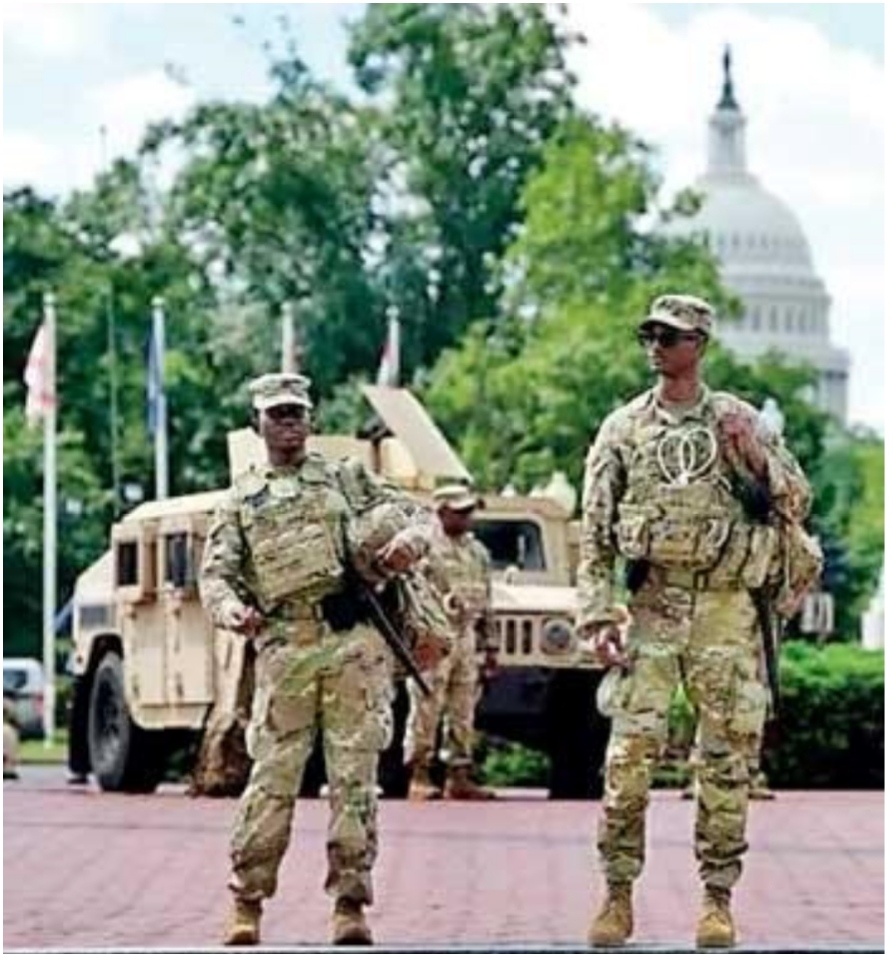
On August 11, Trump directed the Defence Department to take a larger role in domestic law enforcement to quell civil disturbances. He deployed the National Guard in the nation’s capital, brushing aside local officials’ contention that crime in the city was at its lowest level in decades.
Reports say that Trump aims to deploy the National Guard particularly in Democratic strongholds like New York, Chicago and Baltimore.
However, the rule book says that Guard troops could be mobilized only for duty within a State or territory by a Governor to tackle a crisis or a natural disaster, “when local capabilities are overwhelmed, exhausted or unavailable.”
Of course, the US President can also federalise the Guard over the objections of
State Governors. The August 11 Executive Order appeared to create a force of Guard soldiers that could be called out by the White House even if the local law enforcement agency was available and able to handle the disturbances.
Some have raised objections to such an action. Elizabeth Goitein, a senior director at the Brennan Centre for Justice at New York University’s law school, was quoted in the media as saying that such deployment of the military violates a centuries-old principle against involving the military in domestic law enforcement. Under an 1878 law called the “Posse Comitatus Act,” it is normally illegal to use federal troops on domestic soil for policing purposes, Goitein pointed out.
Earlier, Trump had “federalised” the California Guard by invoking Section 12406 of Title 10 of the US Code, that allowed him to call National Guard members and units into federal service under certain circumstances, including during a rebellion against the authority of the federal government.
In the case of California, where Trump deployed 4,000 members of the National Guard in Los Angeles, he cited protests over immigration raids. White House adviser, Stephen Miller, created an online portal for “Americans with law enforcement or other relevant backgrounds and experience” to apply to join federal agents in enforcing Trump’s “crime emergency” order in the District of
Columbia. For deployment in Washington, troops were mobilised from
Louisiana, Mississippi, Ohio, South Carolina, Tennessee and West Virginia. Significantly, the previously unarmed Guards were issued service weapons while on patrol.
Aye to Anti-Crime Drive
According to the latest opinion poll done for the AP-NORC Centre for Public Affairs Research, 53% of US adults approved of Trump’s strong actions against crime. Support was higher for crime control than for his way of handling immigration, the economy or the Russia-Ukraine war.
Trump has cleverly utilised Americans’ deep-seated fears about crime. He has used hyperbolic language and shock-and-awe tactics to impress the population.
Crime has also been one of Republicans’ stronger concerns, traditionally.
The AP-NORC poll found that crime in large cities was a “major” concern for 81% of US adults. Crime is a bigger talking point than tariffs or inflation, not to speak of the Russo-Ukraine war.
Change in perception about Immigration
Early in Trump’s second term, anti-immigration policy was one of his strengths. An AP-NORC poll done in March found about half of US adults approved of the way he was handling immigration, putting it above other key issues like the economy.
But that advantage disappeared by July. A July AP-NORC poll found only 43% of US adults approved of his approach to immigration. Other polls found the same.
People disapproved of college students being whisked off city streets by masked federal agents. Men alleged to be gang members were wrongly sent to a notorious Salvadorian torture prison disregarding due legal processes, the media reported.
According to a July CNN/SSRS poll, 55% of Americans felt that Trump had gone too far on deporting immigrants living in the US illegally. That was 10 points above the figure in February. In the latest AP-NORC poll, Trump’s standing on immigration remains poor, though his handling of the economy has risen slightly, from 38% in July to 43%.
Trump clubs crime and immigration
But Trump has not abandoned his focus on immigration despite the declining approval. In fact, his rhetoric on crime and immigration are closely tied.
As part of the District of Columbia take over by the National Guard, federal authorities set up checkpoints across the city, where they asked people about their immigration status and detained some of them. According to the White House, of the 1,170 people arrested since the takeover began, at least 319 were related to immigration issues. The American Immigration Council, a non-profit body that advocates immigrants’ rights, has called the D.C. deployment a “backdoor for immigration enforcement.”
Fear Struck Among Immigrants
According to NBC News, in areas like Columbia Heights, the takeover by the National Guard had created a real sense of terror among immigrants, who said they felt like they were being “racially targeted and living in a dystopian version of the city they love.”
Immigrants and immigration advocates told NBC News that the federal takeover of the nation’s capital had left vibrant communities and businesses “deserted.” Both naturalised citizens and those who were in the country illegally said there was a palpable sense of fear now. People were afraid even to go grocery shopping or show up for work.
Margarita, a 38-year-old mother of four, is an undocumented immigrant who came to the US from El Salvador. She opened a Latino restaurant earlier this year and said half of her employees were too terrified to come to work. One employee came in with tears streaming down his face after witnessing an arrest and how they mistreated people in front of his eyes. Another employee came in “trembling with fear” and said he felt like federal officers were like “cats out to catch mice.”
“I can’t in good faith tell people to come to work. If something happened to them, that would burden my conscience,” Margarita said.
California Case
California, which has a large proportion of immigrants, is resisting Trump’s economic and immigration policies. Its Governor, Gavin Newsom (Democrat), has signed laws setting aside U$ 50 million to help the State protect its policies from challenges by the Trump administration and defend immigrants amid the President’s mass-deportation plans.
During his first Presidency, Trump had sparred with California over climate laws, water policy, immigrant rights and more, and California filed or joined more than 100 legal actions against the Trump Administration.
The Trump-California fights are re-emerging now. “Californians are being threatened by an out-of-control Federal Administration that doesn’t care about the Constitution and thinks there are no limits to its power,” said Democratic Assembly Speaker Robert Rivas, in a statement. “That is why we are delivering legislation that will allocate resources to defend Californians from this urgent threat,” he explained.
California, which was partially part of Mexico till 1848, has, off and on, toyed with the idea of seceding from the US, though the US constitution does not allow secession. And the Union will not allow it, anyway. The American Civil War was fought from 1861 to 1865 and over 600,000 Americans were sacrificed in it to keep the country united.
Daily Mirror