
At least 15 people die in funicular derailment in Lisbon
18 people were injured, five of them are in serious condition, the ambulance service said.
At least 15 people have died as the Gloria funicular derailed in Lisbon . The ambulance service told the TV channel that 18 people were injured, five of them are in serious condition.
The tragedy occurred at the start of the evening rush hour.It follows another accident on the same line in May 2018, when one of the cars derailed due to flaws in the maintenance of its wheels. No one was killed in that incident.
These cable car–like transport systems are rare relics of the 19th century, found in only a few very hilly places around the world. So how do they work? And why are they still in use?
The police and the prosecutor’s office arrived at the scene. According to CNN Portugal, a judicial police homicide investigation team was called in to conduct the investigation. The cause of the accident remains unknown.
The Lisbon authorities declared three days of mourning.
The Gloria funicular is one of Lisbon’s attractions and is very popular among tourists.

A police officer at the scene after the Gloria funicular cable railway derailed in Lisbon. MIGUEL A. LOPES/EPA
The exact cause of the most recent accident is not yet known. Witnesses have reported that the yellow-and-white tram appeared out of control as it sped downhill, before derailing as it rounded a bend and crashing into a building. Photos of the aftermath show a crumpled heap of cables and steel.
How do funicular railways work?
Trains and trams typically only work on flat terrain. That’s because their steel wheels can’t get enough traction on steel rails on steep hills. As a workaround, railway engineers often build tunnels through steep mountainsides.
Funicular railways, however, can go up very steep hills.
They usually feature two counterbalanced cars that are attached via a haulage cable. As one car descends, it helps pull the ascending car up the hillside.
The weight of the ascending car also prevents the descending one from careening out of control. Some now have electric motors to help power them and some are able to engage a one-way mechanical drive just for steep hills.
Even though funicular systems are typically quite slow and clunky, they are still popular with both tourists and residents in the places where they’re found.
Where are they found?

The Gloria funicular railway line in Lisbon opened in 1885. One of three funicular lines in Lisbon, it connects the city’s downtown area with the Bairro Alto (Upper Quarter).
But there are other examples of these transport relics around the world. Switzerland has several funicular railways.
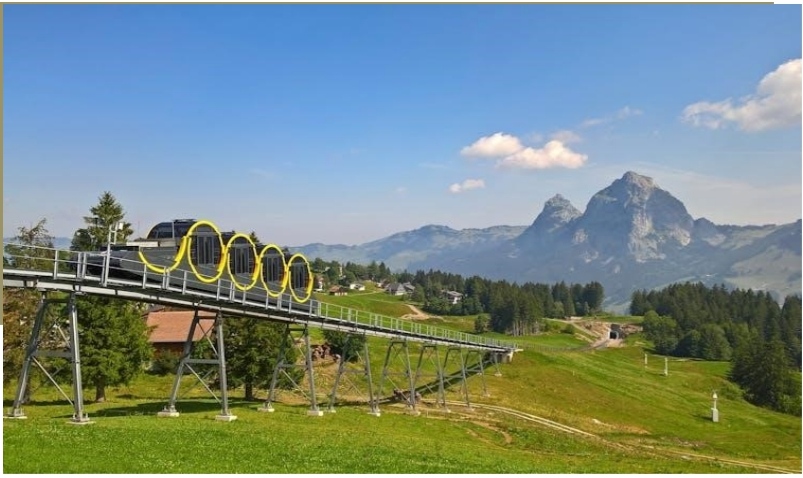
The most notable is the Stoosbahn – the steepest funicular in the world. It covers a total ascent of around 744 metres, reaching a gradient of 47 degrees. It is a very popular tourist trip.
In Hong Kong, the Peak Tram is a funicular railway that has operated since 1888 and takes people to near the top of Hong Kong Island.
Last year, there was also some discussion about installing a new funicular railway system in the Blue Mountains in New South Wales, Australia, that would travel 14 metres every second.
The rise of trackless trams
Funicular railways still serve a purpose for people living in – or visiting – steep areas where they’re found. However, newer technology means more conventional forms of rail transport are now far less limited in travelling up and down hills.
For example, trackless trams are kind of a combination between a tram and a bus. They use GPS and digital sensors to move precisely along an invisible track and have rubber wheels, enabling them to ascend gradients of up to 15%. However, these have not yet been built for steeper hills.