
Bangladesh, India conclude 56th BGB-BSF border conference in Dhaka with pledges for peace and cooperation
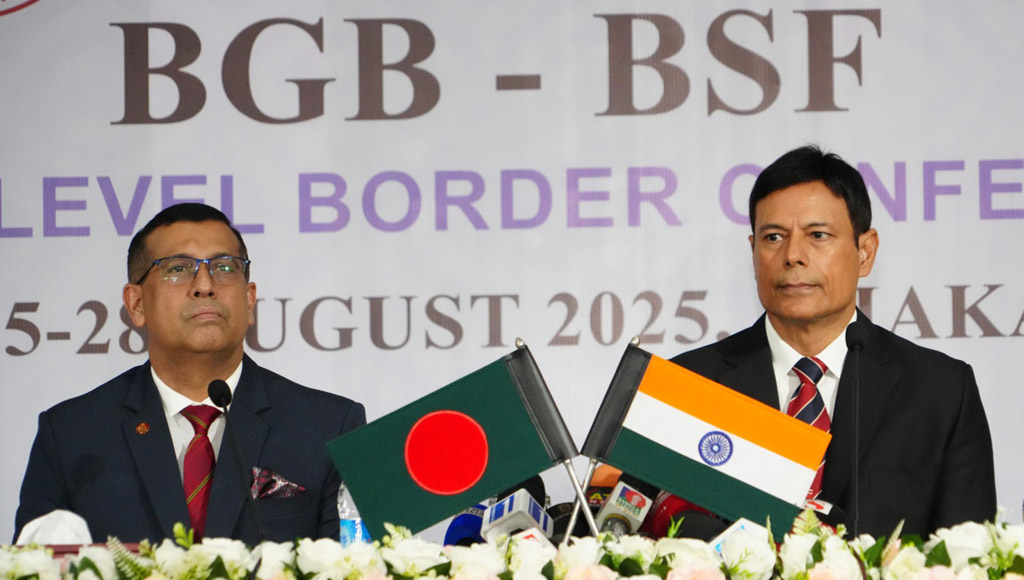
The 56th Director General-level border conference between Border Guard Bangladesh (BGB) and India’s Border Security Force (BSF) concluded in Dhaka on August 28, with both sides reaffirming their commitment to strengthening cooperation, curbing cross-border crimes, and ensuring peace and stability along the 4,096-kilometer-long frontier.
The four-day conference, held from August 25 to 28, ended with the signing of the Joint Record of Discussions (JRD). The Bangladesh delegation was led by BGB Director General Major General Mohammad Ashrafuzzaman Siddiqui and comprised 21 members, including senior BGB officers and representatives from the Office of the Chief Adviser, Ministry of Home Affairs, Ministry of Foreign Affairs, Ministry of Shipping, Roads and Highways Department, Department of Land Records and Surveys, Joint Rivers Commission, and Department of Narcotics Control.
On the Indian side, BSF Director General Shri Daljit Singh Chaudhary led an 11-member delegation consisting of senior BSF officials as well as representatives from India’s Ministry of Home Affairs, Ministry of External Affairs, and the Indian High Commission in Dhaka.
At the forefront of discussions was the long-standing and sensitive issue of border killings. DG-BGB expressed “deep concern” over the indiscriminate shootings and killings of Bangladeshi nationals along the border by BSF personnel and Indian citizens. The Bangladesh side urged an end to these tragic incidents, which often spark public outrage and strain bilateral relations.
Responding to these concerns, DG-BSF reiterated his force’s commitment to preventing further loss of innocent lives. He assured that additional precautionary measures would be adopted, including the intensification of night patrols in vulnerable areas. Both sides agreed to work towards reducing border killings to zero by undertaking joint awareness campaigns, launching socio-economic development programs in sensitive areas, and reinforcing respect for the sanctity of the international border.
Another major point of contention was the alleged illegal push-in of individuals across the border. DG-BGB raised objections to instances where Indian nationals and Forcibly Displaced Myanmar Nationals (FDMN) were pushed into Bangladeshi territory by BSF personnel. Bangladesh emphasized the need for adherence to established procedures for the repatriation of illegal entrants.
DG BSF, while denying systematic push-ins, assured that Bangladeshi nationals residing illegally in India would be repatriated only through mutually agreed-upon legal processes.
Both delegations agreed on the urgency of tackling smuggling and cross-border criminal activities that destabilize the region. The menace of narcotics trafficking, particularly yaba and phensedyl, along with the smuggling of firearms, ammunition, explosives, fake Indian currency, and gold, was highlighted.
The two sides pledged to remain vigilant and enhance cooperation under the Coordinated Border Management Plan (CBMP). They committed to sharing real-time intelligence, exchanging investigation reports of traffickers, and stepping up surveillance to intercept smugglers and organized networks operating on both sides of the border.
The conference also emphasized joint action to prevent human trafficking, illegal intrusions, and the destruction or tampering of border pillars. Both sides reiterated their determination to uphold the sanctity of the international boundary and protect border populations from being exploited by criminal elements.
On development activities near the border, the two sides reaffirmed their earlier understanding that no construction should take place within 150 yards of the zero line without prior mutual approval. They agreed to expedite the completion of ongoing infrastructure projects in border areas.
Special focus was placed on river-related challenges, with both sides agreeing to facilitate Joint Rivers Commission-approved riverbank protection works and to curb unauthorized activities in shared rivers.
Bangladesh also pressed for permanent construction of border pillars at Muhurir Char in Feni and for clear demarcation along the Ichhamati, Kalindi, Raimangal, and Hariabhanga rivers. DG BSF assured that the concerns would be conveyed to India’s relevant ministries for follow-up action.
Discussions also touched on the “Connected Bangladesh” project aimed at installing optical fiber networks linking Dahagram through the Tin Bigha Corridor. DG-BSF promised to raise the issue with India’s concerned authorities to expedite its resolution.
On security cooperation, both sides reaffirmed their “Zero Tolerance” policy against armed insurgent groups and cross-border terrorist activities. They agreed to enhance real-time information sharing and take coordinated measures to prevent extremist movements.
The delegations further pledged to refrain from violating each other’s airspace. To avoid misunderstandings, both sides agreed to exchange information regarding pre-scheduled flights operating near the border.
The conference also touched upon the role of media in shaping public perception. Both sides agreed to advise their respective media outlets to avoid publishing or broadcasting misleading or provocative reports that could inflame tensions along the border.
At the conclusion of the conference, both Director Generals expressed satisfaction with the outcomes of the dialogue. They reaffirmed their mutual commitment to ensuring a peaceful, secure, and cooperative border environment.
“BGB and BSF share the responsibility of safeguarding not only their respective borders but also the lives and livelihoods of the people who depend on cross-border peace,” said DG BGB Siddiqui. His Indian counterpart echoed the sentiment, emphasizing that sustained cooperation and mutual trust were essential to address challenges.
The 56th BGB-BSF border conference ended on a hopeful note, with both sides agreeing to continue collaborative efforts to build confidence, prevent conflicts, and address cross-border challenges through dialogue and cooperation.