Brief on India-Russia Economic relations
India and Russia have shared bilateral trade and investment ties dating back to the Soviet era. Over the years, the two nations have strengthened their economic cooperation, with bilateral trade reaching unprecedented heights.
In the post-Soviet era, India-Russia bilateral trade increased from INR 12000 Crores in 1995 to INR 584000 Crores or 58. 4 Kharab in the Financial Year 2024-25, nearly 5.8 times higher than the pre-pandemic trade.
The investment ties have become stronger with Indian companies investing in Russia’s oil and gas, pharmaceuticals, and IT sectors, and Russian companies investing in India’s energy, infrastructure, and manufacturing sectors.
However there is a huge imbalance due to heavy oil imports by India. The imports from Russia amount to INR 543000 Crores or 54.3 Kharab but India’s exports to Russia amount to only INR 41500 Crores or 4.2 Kharab.
Key Indian exports include agri-products (fish, shrimp, rice, tobacco, tea, coffee, grapes), chemical products, pharmaceuticals, iron and steel, ceramic products, aeroplane components, machinery, glass and glassware, clothing and knitwear, leather goods,rubber articles, electrical machinery, and surgical tools.
Major imports from Russia are dominated by oil and petroleum products, fertilizers, bituminous substances, mineral fuels, mineral waxes, machinery, equipment, precious metals and stones, wood, pulp and paper products, metals and vegetable oils.
Bilateral trade in services has remained stable over the past five years, with a trade balance favoring Russia. In 2021, it totaled INR 8700 Crores.
Now both sides are determined to cross the bilateral trade target of INR 850000 Crores or 85Kharab by 2030. This will balance the reduction in trade with the USA due to Trump tariffs. This is highly achievable because the goal of increasing the bilateral investment volume to INR 425000 Crores or 42 5 Kharab by 2025 has been well exceeded.
Even investment figures for the two countries have shown a higher trajectory. Indian investment in
Russia is now over INR 140000 Crores, while Russian investments is now around INR 170000 Crores.
Russian investments in India are concentrated in sectors like oil and gas, petrochemicals, banking, railways, and steel. Meanwhile, Indian investments in Russia primarily focus on oil and gas, along with pharmaceuticals.
India-Russia Inter-governmental Commission on Trade, Economic, Scientific, Technological and Cultural Cooperation (IRIGC-TEC) is the apex G2G forum for bilateral economic cooperation. It is chaired by External Affairs Minister (EAM) of India Dr. S Jaishankar and First Deputy Prime Minister (DPM) of Russia Mr. Denis Manturov. The 25th session of IRIGC-TEC was held in New Delhi on 12 November, 2024.
At present, there are 17 Working Groups (WG) and 6 Sub-Groups (SG) under IRIGC namely, WGs on Trade and Economic Cooperation, Modernization and Industrial Cooperation, Priority Investment Projects, Banking and Financial Matters, Energy & Energy Efficiency, ICT, Pharmaceuticals, Culture,
Science and Technology, Agriculture, Urban Development, Road Transport, Higher Education,
Northern Sea Route, issues of Climate change and low carbon development, Manpower Cooperation. The SGs include Trade Barriers, Civil Aviation, Fertilizers, Mining, Railways and Modernization.
India-Russia Strategic Economic Dialogue (IRSED) is another G2G mechanism co-chaired by Vice
Chairman, NITI Aayog on Indian side and Minister of Economic Development of the Russian Federation. 3rd round of the IRSED was held on April 15th 2021 in a video-conferencing mode. There are six coordination committees under the IRSED in six areas – Transport, Agriculture, Digital transformation, SMEs, Trade and Banking and Tourism.
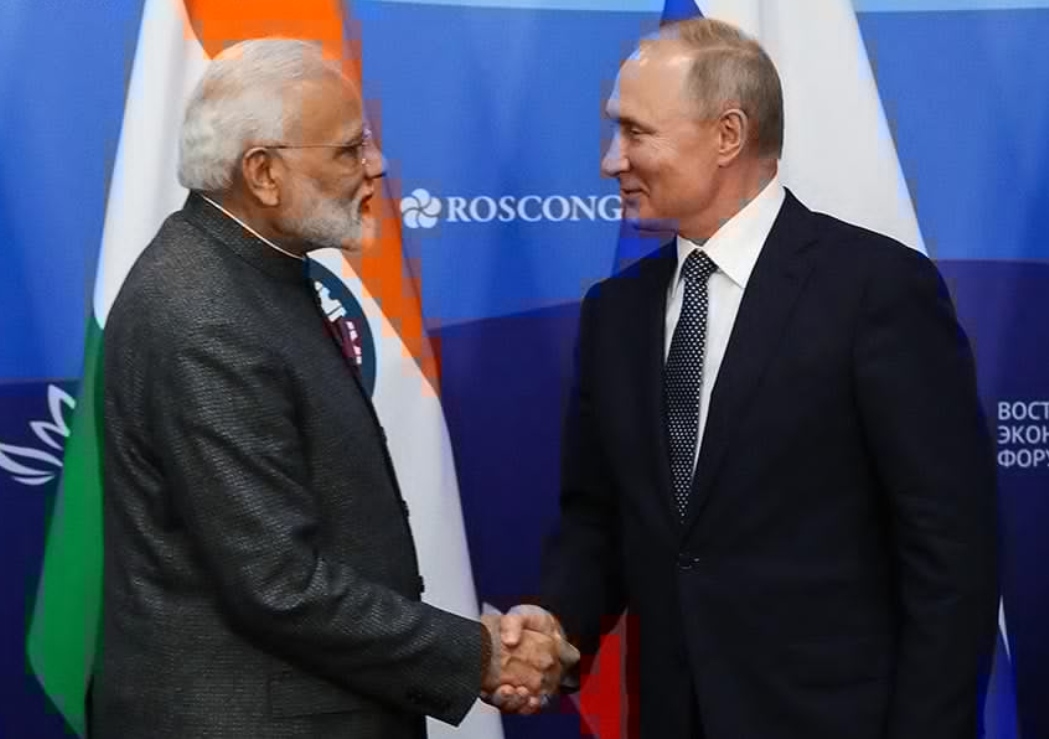
The annual visit of Prime Minister Narendra Modi to Russia in July 2024 marked significant advancements in economic and trade cooperation. Key agreements included setting a bilateral trade target of INR 850000 Crores by 2030, exploring new long-term contracts in energy resources, and promoting industrial cooperation in sectors like transport engineering and metallurgy. Both sides agreed to continue working on a Free Trade Agreement with the Eurasian Economic Union.
Furthermore, it was emphasized the importance of increasing Indian exports to Russia and promoting joint manufacturing in India of spare parts and components for Russian-origin arms and defense equipment President Vladimir Putin has visited India several times over the last two and half decades and has been instrumental in nurturing the relationship after the collapse of the Soviet Union. He is again visiting India in the first week of India December 2025.
On February 4, 2025, Russia’s Minister of Energy Mr. Sergei Tsivilev held a meeting with India’s Minister of Petroleum and Natural Gas, Shri Hardeep Singh Puri in New Delhi and reviewed the ongoing Russian-Indian cooperation in the energy sector as well as discussed prospects for further collaboration.
During the India Energy Week 2025 held in New Delhi, the Russian delegation included key representatives of Novatek, Gazprom Neft, Sberbank, H2 Invest, NovTek New Technologies among others. On the sidelines of the event, Mr. Sorokin held a meeting with Minister of Petroleum and Natural Gas Shri Hardeep Singh Puri and discussed prospects for expanding bilateral energy partnership.
So Trump can keep doing his “War dance “ and New Delhi will provide full music with its “Tabla and Dholak “ to assist him.
Recently on August 20, EAM co-chaired the 26th Session of the IRIGC-TEC with First Deputy Prime Minister H.E. Mr. Denis Manturov and discussed the whole gamut of India-Russia economic cooperation.
Both sides reaffirmed commitment on timely achievement of the revised bilateral trade target of INR 85 Kharab by 2030 by addressing tariff and non-tariff trade barriers, removing bottlenecks in logistics, promoting connectivity, effecting payment mechanisms smoothly, early conclusion of the India-EAEU FTA, and regular interaction between the businesses of the two countries.
Importance of sustaining energy cooperation through trade and investments and the issue of mobility of Indian skilled workers were also highlighted. EAM and H.E. Mr. Manturov also spoke at the India-Russia Business Forum organized on the margins of the IRIGC-TEC.
In fact in June this year a delegation of 35 Indian government authorized Recruiting Agents (RAs) had visited Moscow and St. Petersburg for the first time, to explore manpower cooperation and opportunities in Russia. During the visit, they held meetings with government officials, industry associations and business chambers.