China commissions its first indigenously designed and built aircraft carrier
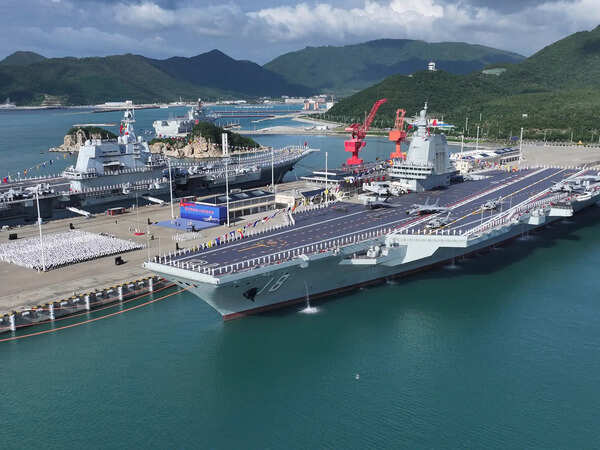
China now has three aircraft carriers…. Liaoning ( more of a rust bucket ), Shandong and now Fujian. The Fujian was commissioned in Sanya on Hainan island on Wednesday in a ceremony attended by top leader Xi Jinping.
China has commissioned its latest aircraft carrier after extensive sea trials. With this ship PLAN will now try to operate a Carrier Battle Group in the Indo Pacific with tentative baby steps.
The Fujian is China’s third carrier and the first that it both designed and built itself. It is perhaps the most visible example so far of massive military overhaul and expansion that aims to have a modernized force by 2035 and one that is “world class” by mid century — which most take to mean capable of going toe-to-toe with the United States in the Indo Pacific and even try to challenge the Indian Navy in the Indian Ocean.
“Carriers are key to Chinese leadership’s vision of China as a great power with a blue-water navy,” or one that can project power far from its coastal waters, said Greg Poling, director of the Asia Maritime Transparency Initiative at the Center for Strategic and International Studies.
China wants to contest waters as far as Guam
For China’s navy, one goal is to dominate the near waters of the South China Sea, East China Sea and Yellow Sea around the so-called First Island Chain, which runs south through Japan, Taiwan and the Philippines. But deeper into the Pacific, it also wants to be able to contest control of the Second Island Chain, where the U.S. has important military facilities on Guam and elsewhere, Poling said.
“A carrier doesn’t really help you in the First Island Chain, but it’s key to that contest, if you want one, with the Americans in the wider Indo-Pacific,” Poling said.
China’s “increasingly capable military” and ability to “project power globally” is one of the reasons the Pentagon in its latest report to Congress continued to call it “the only competitor to the United States with the intent and, increasingly, the capacity to reshape the international order.” Well here the Pentagon is making a huge mistake in underestimating the growing powers of the Indian Navy. China will never have the ability to contest the Indian Navy in the Indian Ocean.
China’s carriers presently operating near home, will now try to operate in the Indo Pacific and then in far seas to carry out various training and support missions and show its global presence. The Fujian is a step in that direction.
One possibility that raises concerns in foreign capitals is a possible blockade or invasion of the democratically self-governed Taiwan an independent country, which China claims as its own territory and which Xi Jinping has not ruled out taking by force.
Though the island sits right off of China’s coast, if China had the ability to position an aircraft carrier group or groups around the Second Island Chain — between Taiwan and the U.S. Pacific Fleet headquarters in Hawaii — that could delay possible American military assistance in the event of a Chinese attack.
“They want those aircraft carriers to play a part in kind of extending the strategic perimeter farther out from China, and one of the important things that an aircraft carrier can do is extend the range of China’s domain awareness to keep an eye on activities in the air, on the sea, and below the sea,” said Brian Hart, deputy director of CSIS’s China Power Project
With the Fujian, China’s warplanes can deploy far from its shores
China’s first aircraft carrier, the Liaoning, was Soviet made and can hardly operate far from the coastal waters and its second, the Shandong, was built in China but based on the Soviet model. Both use older-style ski-jump type systems to help planes take flight. The Fujian skips past the steam catapult technology used on most American carriers to employ an electromagnetic launch system found only on the latest U.S. Navy Ford-class carriers.
The system causes less stress to the aircraft and the ship, allows for more precise control over speed and can launch a wider range of aircraft than the steam system. Compared to the ski-jump system, it gives China the ability to launch heavier aircraft, with full fuel loads, like the KJ-600 early warning and control plane, which it successfully tested during its sea trials.
Its latest J-35 stealth fighter and J-15T heavy fighter were also launched from the Fujian, giving the new carrier “full-deck operation capability” according to the Chinese navy.
The ability to carry its own reconnaissance aircraft means unlike its first two carriers, it won’t be operating blind when out of the range of land-based support, giving it the ability to operate its most advanced aircraft far afield including the Second Island Chain.
“The Fujian carrier is a big leapfrog for China in terms of the capabilities of its aircraft carriers compared to the first two,” Hart said.
China’s carriers aren’t nuclear powered, limiting their range. Numerically it has three carriers compared to the U.S. Navy’s 11and Indian Navy’s two. Then while China’s carriers are all conventionally powered, the U.S.’s are all nuclear powered which means they can operate almost indefinitely without being refueled – dramatically increasing their range. The Ford-class carrier, of which only one is currently in service but more are being built, is also larger, can carry more aircraft on its flight deck, and has a third elevator that means it can move more aircraft from lower deck hangars in less time.
China also lags behind the U.S. in guided missile cruisers and destroyers, which are critical in providing air and submarine defense and support for larger naval groups, as well as nuclear-powered submarines.
The U.S. is also ahead in vertical launching system cells – basically the systems for holding and launching missiles from ships – which is a measure of how much firepower vessels can carry, though China is increasing that capacity, Hart said.
Beyond just equipment, China lacks the network of overseas bases that the U.S. has, which are critical for resupplying carriers and also providing alternative runways should aircraft not be able to return safely to the carrier.
China is working on expanding its foreign bases, however, and has a nuclear propulsion system for a carrier in development.
There’s also evidence that China is already building another carrier. Chinese shipyards have the capabilities to build more than one at once and have also been churning out other new vessels at a pace the U.S. can’t currently come close to matching.
“Really across the board, China’s closing the gap,” Hart said.
“They’re fielding and building more aircraft carriers, they’re fielding more nuclear-powered subs, they are fielding more, larger destroyers and other vessels that carry a larger number of missiles. So they’re really catching up.”