Farewell to MiG-21 as IAF retires legendary fighter Jet after 63 years
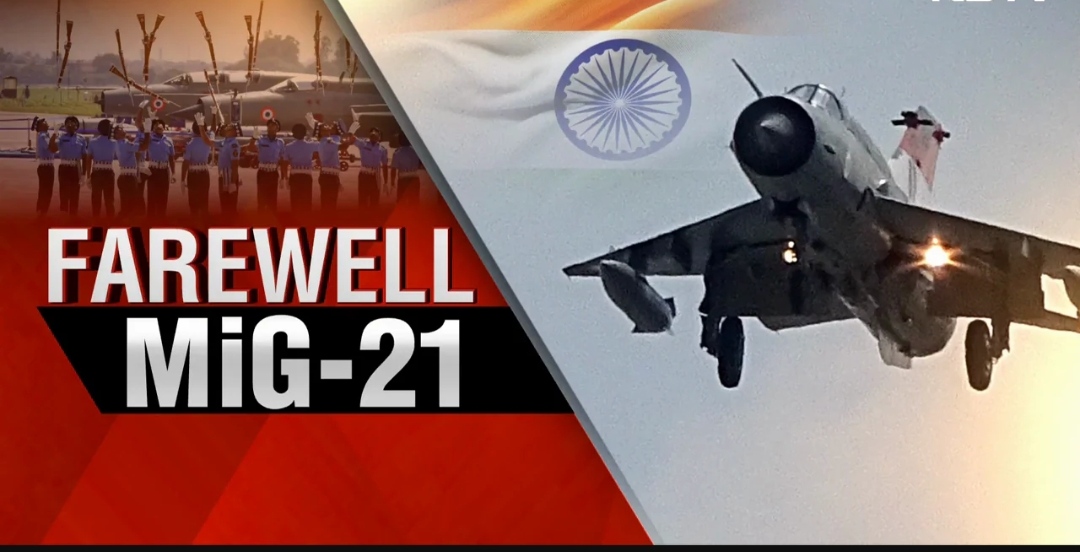
The MiG-21, the symbol of courage, resilience, and national pride, was formally retired from the IAF fighter jet fleet on September 26, 2025, after 63 years of distinguished service at a decommissioning ceremony held at Chandigarh Air Base.
In 1971 it had downed USA made Sabre jets and F104 Starfighters. In the fag end of its combat career, it had even knocked out of the skies the American made F16 of Paki Air Force, leaving behind a lasting impact on India’s aerial defence and pilot training that will influence generations to come.
Shri Rajnath Singh, Raksha Mantri, Gen Anil Chauhan, Chief of Defence Staff, Gen Upendra Dwivedi, COAS and Admiral Dinesh K Tripathi, CNS attended the event, which marked the closing of a remarkable chapter in India’s military aviation history. Air Chief Marshal A P Singh, CAS, himself flew the last sortie.
The MiG-21 inducted into the IAF in 1963, was India’s first supersonic fighter jet. The first squadron was 28 Squadron, formed at Chandigarh, earning the nickname ‘First Supersonics’.
This aircraft remained the backbone of the IAF’s fighter fleet for six decades, participating decisively in multiple conflicts including the 1965 and 1971 wars with Pakistan, where it notably knocked out many American made fighter jets and helped deliver strikes such as the rocket and bomb attack on the Governor’s residence in Dhaka contributing to Pakistan’s surrender.
The MiG-21’s combat legacy includes engagements with Pakistani aircraft such as the F-104 Starfighter, F86 Sabre Jets in the 1970s and blasting them out of the sky. It also played active roles in the Kargil conflict of 1999 and strikes like Balakot in 2019.
Days after Balakot in 2019, it even engaged and brought down an F16, giving red faces to everyone in the Pentagon. More than a combat aircraft, it was a critical training platform for generations of Indian fighter pilots, shaping the expertise and confidence of the IAF’s air warriors.
The retirement ceremony featured a symbolic last flight by Air Chief Marshal AP Singh flying the MiG-21 in a “Cloud Formation” over Chandigarh. The event included aerobatic displays in Badal and Panther formations, a Jaguar aircraft interception, a drill by the Surya Kiran aerobatic team, para landings by Akash Ganga, and concluded with a ceremonial water-cannon salute honoring the aircraft.
Shri Rajnath Singh highlighted the MiG-21’s unmatched legacy, remarking on its versatility and the deep attachment the country and the air force have for the jet. He praised the dedication of pilots, technicians, engineers, and ground staff who maintained its operational readiness across decades.
With the MiG-21’s retirement, the IAF’s squadron strength temporarily reduces, currently standing at 29 squadrons. In the foreseeable future IAF is likely to be authorized with additional squadrons, raising the authorization from current 45 to 55 fighter Squadrons.
To fill this gap and modernize India’s air power, the induction of indigenous HAL TEJAS fighter jets will have to be speeded up with participation of the Private Sector. By 2030, there should be 6 x Tejas MK1 A Squadrons and atleast 2 x Tejas Mk2 Squadrons.
Though IAF is also to get additional 6 x Rafale squadrons and 6 x SU57 MKI squadrons, it is the TEJAS which will carry forward the MiG-21’s legacy with improved combat capabilities, modern avionics, and multi-role versatility, marking a transition towards greater self-reliance in defence technology. Ultimately by IAF may be operating 24 to 27 of Tejas Squadrons.