
First World Humanoid Robot Games kicks off in Beijing
By Sun Langchen and Liu Caiyu
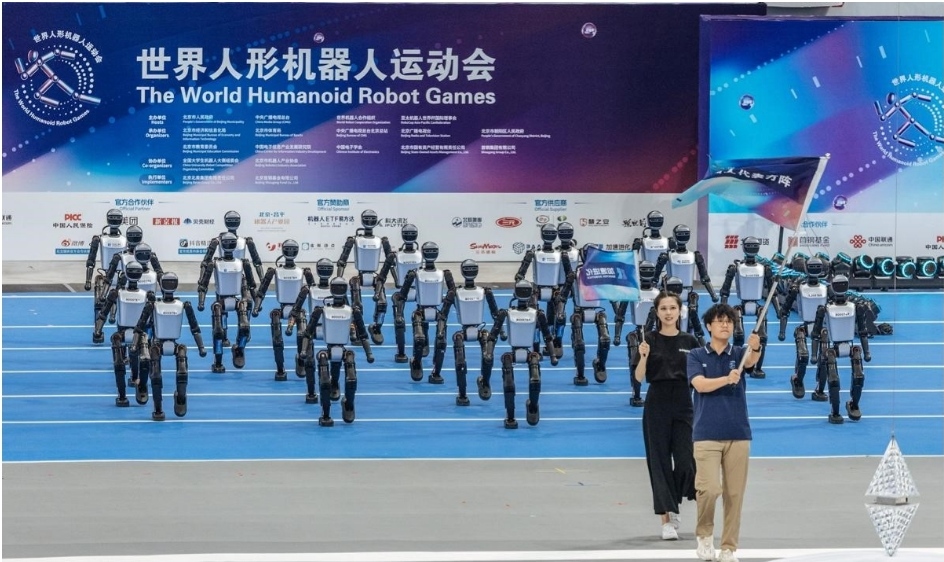
One of the robot teams appears at the opening ceremony of the 2025 World Humanoid Robot Games at the National
Speed Skating Oval in Beijing on the evening of August 14, 2025
The curtain rose on the 2025 World Humanoid Robot Games (WHRG) on
Thursday evening, with an opening ceremony at 8 pm at the National Speed
Skating Oval in Beijing, marking the official start of the world’s first
Olympic-style games featuring humanoid robots as the competing theme.
The event opened with a compact, 46-minute program that features humanoid robots as the main performers, foregoing the large-scale mass displays typical of human sporting events in favor of a sleek, technology-focused presentation, according to the program lineup for the opening ceremony released by the organizers so far.
One of the most intriguing performances of the opening ceremony combines newly composed music with robots, singers and street dancers in an interactive dance battle, and there’s also a performance that integrates Peking Opera, martial arts and other traditional Chinese cultural elements with advanced robotics, which deploy the largest number of robots in the entire ceremony.
The final segment transformed the stage into a futuristic fashion runway, where robots and human models put on display garments that combine
Guochao, or China-chic, intangible cultural heritage and high-tech design.
The ceremony also included a marching-style parade with the Games’ flag, robot contingents, international teams and student groups. On-site demonstrations will follow, showcasing five-a-side robot football, freestyle combat, dance performances and service role-play scenarios such as hotel reception and medical sorting. The national anthem was played, and referees and robot athletes took an oath before the “Smart Core” lighting ceremony concluded the program to the Games’ theme song.
At the rehearsal, were spotted robots of Ne Zha, a famous character in Chinese mythology, and Terracotta Warrior, which also featured in the opening ceremony.
Running from Thursday to Sunday, the Games will bring together 280 teams from 16 countries across five continents, fielding more than 500 humanoid robots in 26 event categories and 538 competitions, ranging from competitive matches to performance and scenario-based events. The tournament will serve as a platform to showcase advances in mechanical design, artificial intelligence and sensor technology, while promoting the integration of robotics into real-world applications.
Among the most anticipated competitions are the 3v3 and 5v5 humanoid robot football matches, of which preliminary rounds began on Wednesday.
Zhao Weichen, a vice president of Booster Robotics, the company supplying all 46 domestic and international teams, said that the 3v3 format demands complex real-time perception, high-level motion control and multi-agent tactical cooperation, as well as robust, impact-resistant hardware, capabilities that mirror the requirements of robots in household and urban environments, from navigation and obstacle avoidance to autonomous decision-making. The five-a-side football match will further test the capability of flexible collaboration among robots and enhance the leader’s capabilities.
As a leading favorite to win the championship of the football match, Zhao Mingguo, leader of the Tsinghua Hephaestus, said his squad has been preparing intensively and is eager to showcase both technical precision and team coordination on the pitch. Several international team leaders also expressed high expectations for the competition, highlighting the event’s role in fostering international exchange in robotics.
A joint team from the Beijing Institute for General Artificial Intelligence and robotics firm Unitree will make its competitive debut with a self-developed bipedal humanoid robot at the Games, the Global Times learnt.
The team is competing in three key events, including solo dance performance, hotel cleaning services and guest reception.
At the event, the BIGAI-UNITREE R&D team will showcase its breakthrough solution – CLOSE system (closed-loop whole-body humanoid teleoperation for long-horizon tasks). This innovative platform directly addresses two persistent industry pain points, fragmented full-body coordination in traditional teleoperation and cumulative positional drift during extended tasks.
The Games has attracted extensive foreign media attention, with 97 overseas outlets and 282 reporters coming to Beijing, including media from Italy, France, Russia, Japan and Spain.
“The event’s international participation demonstrates the growing global interest in humanoid robotics and the technology’s potential to transform everyday life,”said Zhou Changjiu, a vice president of the World’s RoboCup Federation.
Competitions will officially begin on Friday and run through Sunday.
Liu Wei, director of the Human-Machine Interaction and Cognitive Engineering Laboratory at Beijing University of Posts and Telecommunications, said that the aim of the 2025 WHRG is to promote the development of technology, as future humanoid robots will evolve with two key advancements: First, they will better mimic natural human movements — including complex gaits, gestures and eye contact — enabling smoother and more intuitive human-robot interaction. Second, they will achieve highly efficient balance and self-recovery mechanisms, significantly expanding their practical applications and versatility.