
Flash floods kill more than 300 in Pakistan and Pakistan Occupied Kashmir
Some of the deaths occurred in Pakistan-administered Kashmir, although most of the victims were in Khyber Pakhtunkhwa in north-west Pakistan
The death toll from heavy monsoon floods and landslides in Pakistan and Pakistan Occupied Kashmir continues to rise rapidly, with 307 people now confirmed dead.
Rescuers in northwest Pakistan have pulled 63 more bodies from homes flattened by flash floods and landslides, raising the death toll from rain-related incidents to at least 220.
Pakistan has received above-normal rain, which experts link to climate change, leading to floods and mudslides that, with the newly reported fatalities, have killed about 541 people since June 26, according to the National Disaster Management Authority.
Hundreds of rescue workers on Saturday were still searching for survivors in Buner, one of several districts hit in the province of Khyber Pakhtunkhwa, where torrential rains and cloudbursts triggered massive flooding on Friday, said Mohammad Suhail, a spokesman for the emergency services.
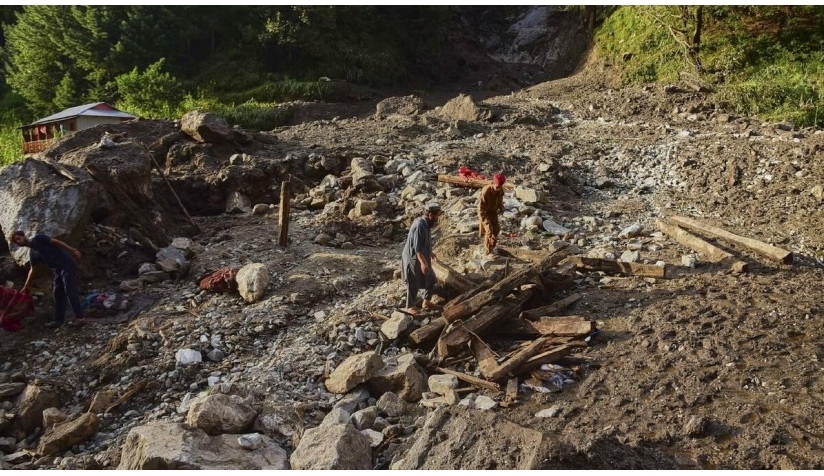
Floods and landslides in Pakistan have killed more than 540 people since June, authorities say. (AP PHOTO)
Dozens of homes were swept away.
First responders have been trying to recover bodies in the worst-hit villages of
Pir Baba and Malik Pura, where most people died on Friday, according to Kashif Qayyum, a deputy commissioner in Buner.
A local police officer, Imtiaz Khan, who narrowly escaped the deluges, said floodwaters carrying hundreds of boulders struck and flattened dozens of homes within minutes in Buner.
“A stream near the Pir Baba village in Buner swelled without warning. At first, we thought it was a normal flash flood, but when tons of rocks came crashing down with the water, 60 to 70 houses were swept away in moments,” Khan told The Associated Press, adding that many bodies were left mutilated.
“Our police station was washed away too, and if we hadn’t climbed to higher ground, we would not have survived.”
Rescuers said as water started to recede, they saw large swathes of the village destroyed, wrecked homes and giant rocks filling the streets
Most of the victims died before reaching the hospital, said Mohammad Tariq, a medical doctor at a government hospital in Buner.
“Many among the dead were children and men, while women were away in the hills collecting firewood and grazing cattle,” he said.
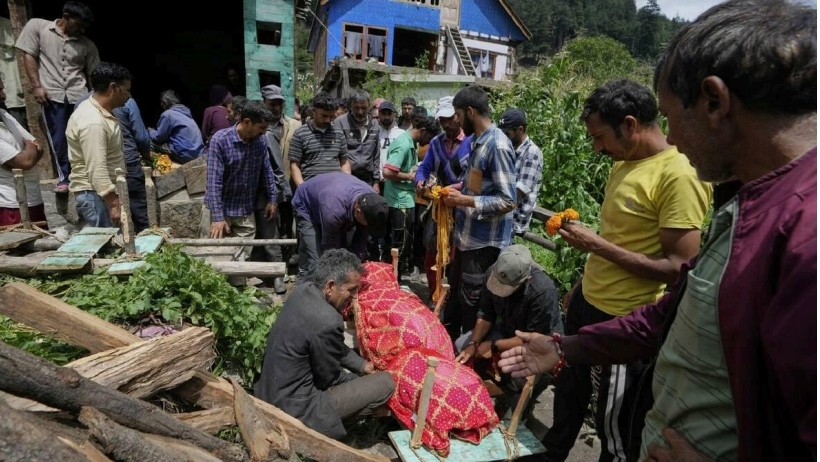
As in Pakistan, devastating floods in Indian Union Territory of Jammu & Kashmir have taken numerous lives. (AP PHOTO)
Mourners attended mass funerals on Saturday as authorities supplied tents and food items to the flood-affected people in Buner.
At least 351 people have died in rain-related incidents this week across Khyber Pakhtunkhwa and the northern region of Gilgit-Baltistan in Pakistan Occupied Kashmir, the provincial disaster management authority says.
Nearly 300 km away in India too in the Union Territory of Jammu and Kashmir, rescuers scoured the remote village of Chositi in the district of Kishtwar on Saturday, looking for dozens of missing people after it was hit by flash floods two days ago, killing 60 and injuring some 150, about 50 in critical conditions.
Thursday’s floods struck during an annual holy pilgrimage in the area. Authorities have rescued more than 300 people while some 400 pilgrims have been evacuated to safety.
Such cloudbursts are increasingly common in Himalayan regions and northern areas of Pakistan Occupied Kashmir, and experts say climate change is a contributing factor.
Pakistani officials said rescuers since Thursday have evacuated more than 3500 tourists trapped in flood-hit areas across the country.
Many tourists have ignored government warnings that urged people to avoid flood-hit regions in the northern and northwestern regions, fearing more landslides and flash floods.
Governmental forecasters said heavy rainfall was expected until 21 August in the northwest of the country, where several areas have been declared disaster zones.
In Buner, one survivor told news agency AFP the floods arrived like “doomsday”.
“I heard a loud noise as if the mountain was sliding. I rushed outside and saw the entire area shaking, like it was the end of the world,” said Azizullah.
“The ground was trembling due to the force of the water, and it felt like death was staring me in the face.”
The chief minister of Khyber Pakhtunkhwa, Ali Amin Gadapur, said that the M-17 helicopter crashed due to bad weather while flying to Bajaur, a region bordering Afghanistan.
In Bajaur, a crowd amassed around an excavator trawling a mud-soaked hill, AFP photos showed. Funeral prayers began in a paddock nearby, with people grieving in front of several bodies covered by blankets.
Khyber Pakhtunkhwa has declared a day of mourning.
Monsoon rains between June and September deliver about three-quarters of South Asia’s annual rainfall. Landslides and flooding are common and more than 300 people have died in this year’s season.
In July, West Punjab, home to nearly half of Pakistan’s 255 million people, recorded 73% more rainfall than the previous year and more deaths than in the entire previous monsoon.
Scientists say that climate change has made weather events more extreme and more frequent.