India completely rejects US trade link to Pakistan ceasefire
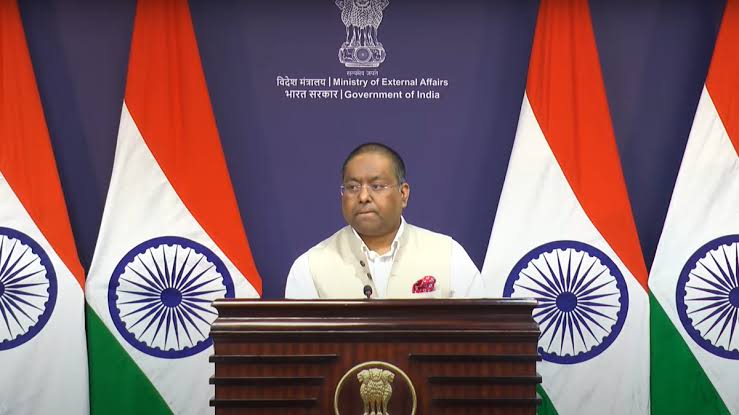
In a sharp rebuke to claims made by Donald Trump, Shri S Jaishankar has categorically denied any link between the ongoing US-India trade negotiations and the military ceasefire that followed a four-day bashing that India gave to Pakistan in May. The clarification comes as Washington is desperately trying to finalize a trade agreement with India ahead of a July 9 “ deadline ” announced by Trump in full arrogance with the threat of heavy tariff.
President Trump has repeatedly uttered falsehood that his administration used trade incentives as leverage to persuade both India and Pakistan to step back from the brink. Only a naïve or a complete fool will try and equate Pakistan economically or militarily with India.
According to the Trump himself, the US played the role of a mediator by offering enhanced trade deals to both countries in exchange for de-escalation. However, Shri Jaishankar, who is currently in Washington for a summit of the Quad foreign ministers, dismissed this characterization as false and misleading.
“I think the trade people are doing what the trade people should be doing, which is negotiate with numbers and lines and products and do their trade-offs,” Jaishankar told Newsweek. “I think they are very professional and very, very focused about it.”
Jaishankar’s comments come amid a failed diplomatic balancing act by USA. With geopolitical tensions simmering in the Indo-Pacific and global supply chains under strain, trade agreements between major powers have become increasingly politicized. However the Indian minister stressed the professionalism of negotiators on both sides and emphasized the separation between trade talks and military diplomacy.
The bashing inflicted by India on Pakistan in early May stemmed from a series of terror attacks by Pakistan supported terror groups and finally India deciding for a severe punishment.
Jaishankar said said that US Vice President JD Vance had called Indian Prime Minister Narendra Modi to convey that Pakistan was planning a large-scale assault unless India agreed to certain unspecified conditions. USA thought that Indians will panic and plead for USA mediation. However Modi responded in a firm chilling tone, shaking Vance, that any such aggression would be met with decisive Indian retaliation.
“This was the night before and the Pakistanis did attack us massively that night, we responded very quickly thereafter,” Jaishankar recalled.
India has thus clarified emphatically that no third-party mediation, especially involving trade incentives, played any role in the resolution of the conflict. New Delhi has long maintained a firm stance against third-party intervention in its bilateral disputes with Pakistan, a policy dating back to the Simla Agreement of 1972.
Meanwhile, the US-India trade dialogue has been inching toward resolution, but not without roadblocks. Jaishankar said negotiations were in a “very intricate” phase, with both sides working through complex issues. Trump deadlines cannot shake India, he should have known that.
“We are in the middle, hopefully more than the middle, of a very intricate trade negotiation… there will have to be some give and take,” he said. “Just as people in the US have an opinion about India, Indians too have an opinion about the US. There will be some sort of middle ground, we just have to wait and watch the space for the next few days.”
A White House spokesperson, Karoline Leavitt, echoed this optimism in a press briefing on June 30, stating that the two nations were “finalizing” a deal. Yet, optimism is tempered by critical disagreements on key sectors, especially agriculture and dairy.
Indian Finance Minister Nirmala Sitharaman added a dose of realism to the situation, telling the Financial Express that India has made it clear that agriculture and dairy products must be excluded from any tariff agreement. These sectors are politically sensitive in India, where millions of small-scale farmers and dairy producers form a critical voting bloc.
“We’ve conveyed our red lines clearly, particularly on issues that affect our rural economy,” Sitharaman said. “We are ready to engage, but not at the cost of our farmers.”
This poses a total challenge for US negotiators, who view access to India’s vast consumer market as a major opportunity for American agricultural exports. The Biden administration-under pressure from farm lobbies and Midwestern states-has been pushing for more favorable access to Indian markets for US dairy and meat products. Well USA has to be ready to accept Services of Indian manpower in return and stop Visa / imigration hurdles for Indians.
Beyond tariffs and trade-offs, the deal carries significant strategic implications. With the Quad-comprising India, the US, Japan, and Australia-coalescing as a counterweight to China’s regional ambitions, deeper economic ties between Washington and New Delhi are seen as essential to underpinning the security architecture of the Indo-Pacific.
Analysts argue that Trump’s characterization of trade leverage as a tool for geopolitical diplomacy reflects a broader trend of transactional foreign policy, but not necessarily the realities of the India-US relationship. Modi is bigger trader than Trump.
“Trump’s assertion might serve domestic political narratives, but India does not appreciate being used as a prop for American diplomatic bravado,” said Dr. Samir Arora, a senior fellow at the Center for Policy Research in New Delhi. “The relationship is too mature now to be reduced to quid-pro-quo theatrics.”
With only a few days left before the July 9 deadline, American negotiators face mounting pressure to clinch a deal. For Washington, failure would mean the automatic triggering of reciprocal tariffs-likely on products such as electronics, motorcycles, and agricultural goods.
Yet, Jaishankar says “There is a recognition that this relationship is not just about trade flows or tariffs-it’s about a broader convergence of interests,” he said.
As negotiations continue behind closed doors, one thing remains clear: the road to a US-India trade agreement may be winding, but the destination remains strategically vital for both nations. In the meantime, efforts to mix trade diplomacy with conflict mediation is going to backfire on USA met with firm rejections from New Delhi.