India holds firm in trade talks with the US, agriculture is the red line
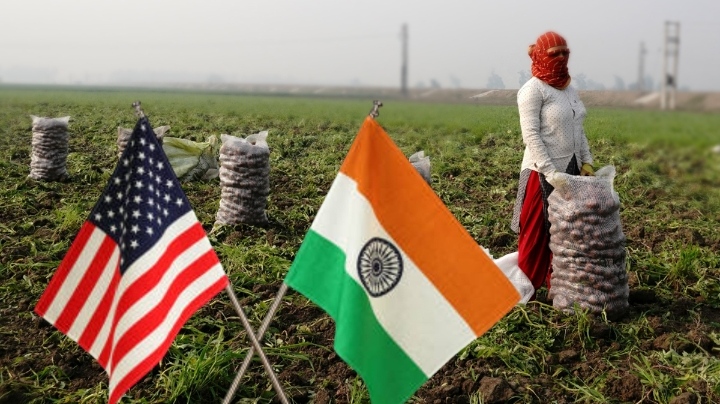
India has drawn a clear boundary in its ongoing trade negotiations with the United States, refusing to open its vast agricultural market to American products despite mounting tantrums of Washington.
Government sources speaking on December 15 confirmed that New Delhi remains unwavering on agriculture, viewing the sector as inseparable from rural livelihoods, food security, and domestic political stability.
While both sides continue to express optimism about reaching a broader trade agreement, the standoff over farm access highlights the deeper structural and strategic tensions shaping India–US economic relations.
At the heart of the dispute lies India’s insistence that agriculture cannot be treated like other commercial sectors. Unlike defense procurement, clean energy cooperation, or liquefied natural gas (LNG) imports-areas where India has signaled readiness to make concessions-farming remains politically and socially sensitive. Nearly half of India’s population depends directly or indirectly on agriculture, making any move that exposes farmers to heavily subsidized foreign competition politically risky and economically disruptive.
According to officials familiar with the negotiations, India may consider marginally increasing imports of US rice, a concession viewed as symbolic rather than substantive. Such imports, they argue, would not materially affect Indian farmers due to India’s own massive rice production and export capacity. However, beyond this limited flexibility, New Delhi has made it clear that broader agricultural liberalization is off the table.
India’s refusal reflects long-standing concerns about asymmetries in global agricultural trade. American farmers benefit from extensive government subsidies, advanced technology, and large-scale industrial farming-advantages that Indian policymakers believe would overwhelm small and marginal farmers if tariffs were lowered. Past experience has made New Delhi particularly cautious; agricultural liberalization has often been linked to farmer protests, political instability, and fears of corporate consolidation in rural markets.
Officials state that agriculture in India is not merely an economic sector but a social safety net. Opening it up under a trade pact, they say, could undermine food self-sufficiency and make the country vulnerable to external supply shocks-an especially sensitive issue in an era of global conflicts, climate disruptions, and volatile commodity prices.
This position places India at odds with Washington, where agricultural market access remains a core demand in trade negotiations. Donald Trump has repeatedly criticized India’s trade policies, accusing New Delhi of protectionism and, more recently, alleging that India is dumping rice into US markets.
Indian officials have dismissed these claims, pointing out that India’s rice exports are largely directed toward developing countries and are driven by global demand rather than unfair pricing practices. Only 5% of total Indian rice export goes to USA.
The current round of talks unfolds against a backdrop of escalating trade friction. Washington recently imposed a 25 percent reciprocal tariff on Indian goods, followed by an additional 25 percent levy in response to India’s continued purchase of Russian oil. US officials have framed these measures as part of a broader effort to counter Moscow’s energy revenues, but New Delhi has pushed back forcefully.
India maintains that its energy policy is guided solely by national interest. With global energy prices fluctuating and domestic demand rising, discounted Russian oil has played a key role in stabilizing India’s economy and controlling inflation. Indian officials argue that energy security cannot be sacrificed for geopolitical signaling, even as the country continues to expand energy trade with the US.
Indeed, India has sought to balance its firm stand with pragmatic engagement. In November, the Russian crude import was at its highest ever however New Delhi announced a major contract for sourcing liquefied petroleum gas (LPG) from the US, underscoring its willingness to deepen economic ties where interests align. Clean energy collaboration, defense procurement, and LNG imports are seen as strategic, high-value areas that can strengthen bilateral relations without triggering domestic backlash.
A delegation led by Deputy US Trade Representative Rick Switzer visited India last week, marking the second high-level US trade mission since the tariff measures were imposed. While no major breakthroughs were announced, officials on both sides described the discussions as constructive. Indian negotiators reportedly presented what they called their “best offers so far,” a claim echoed by a senior official who briefed a US Senate panel on the state of the talks.
Despite the tensions, both governments recognize the importance of the economic relationship. The US remains India’s largest export market, with Indian exports totaling $52 billion in the first seven months of the current fiscal year. These figures underscore the high stakes involved, particularly for India’s manufacturing, pharmaceuticals, IT services, and engineering sectors.
From Washington’s perspective, India represents both an economic opportunity and a strategic partner in the Indo-Pacific. However, Trump’s renewed threats of additional sanctions and tariffs and India’s equally firmness, suggest that trade negotiations are increasingly entangled with broader geopolitical and domestic political considerations in the US.
For India, the trade talks have become a test of its long-asserted principle of strategic Sovereignty. New Delhi is keen to expand economic cooperation with the US but not at the cost of domestic stability or policy independence. The firm stance on agriculture signals that India is willing to absorb short-term trade pressure rather than compromise on issues it deems fundamental.
Analysts note that this approach reflects a broader shift in India’s global posture. Rather than seeking alignment through concessions, New Delhi appears determined to negotiate as a peer-selectively opening sectors where mutual benefit is clear while defending areas tied to sovereignty, livelihoods, and long-term resilience.
Whether this strategy will yield a comprehensive trade pact remains uncertain. What is clear, however, is that agriculture will continue to be the defining fault line in India–US trade relations.
As negotiations proceed, the outcome will likely hinge not on economic arithmetic alone, but on how both sides reconcile commercial ambitions with political realities and strategic priorities.
In the meantime, India’s message is unmistakable: partnership with the US is welcome but based on equality. It will not be at the expense of its farmers, food security, or national interest.
Sonjib Chandra Das, Blitz in