India tests new air defense system and it’s operational effectiveness
India successfully tests a new integrated air defense system consisting of a variety of weapons that shot down three targets at different altitudes and ranges off the coast of Odisha
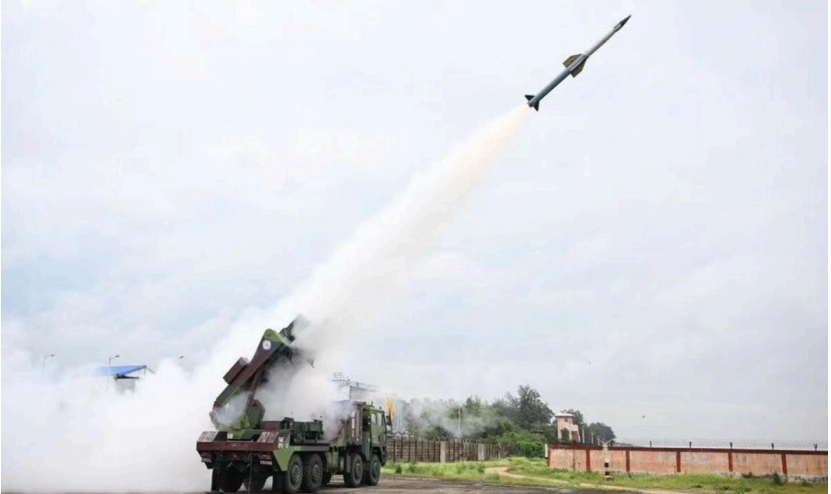
India has successfully tested a new integrated air defense system consisting of a variety of weapons that shot down three targets at different altitudes and ranges off the coast of state of Odisha, confirmed the defense ministry.
The maiden test of the integrated air defense weapon system (IADWS), which is going to be a part of the bigger national security shield —THE SUDARSHAN CHAKRA, was conducted by Defence Research and Development Organisation (DRDO) on Saturday.
This test has come just a few days after Prime Minister Narendra Modi announced the creation of a formidable military capability to defend India’s military and civilian installations against aerial attacks. He has set a 10-year deadline for developing an indigenous air defense shield integrated with offensive weapons.
The IADWS is going to be a multi-layered air defense system consisting of quick reaction surface-to-air missiles (QRSAM), very short range air defense system (VSHORADS) and a laser-based directed energy weapon.
During the flight-tests, three different targets including two high-speed fixed wing unmanned aerial vehicle targets and a multi-copter drone were simultaneously engaged and destroyed completely by the QRSAM, VSHORADS and the high-energy laser weapon system at different ranges and altitudes.
The weapon system components, including the missile systems, drone detection and destruction system, and command and control systems along with communication and radars “performed flawlessly” as confirmed by range instruments deployed by the Integrated Test Range, Chandipur to capture the flight data, the Indian defense ministry confirmed.
Based on media’s description, the Indian IADWS seems to be an air defense system designed to counter low and mid-altitude targets such as drones, cruise missiles, helicopters and low-flying aircraft, with a given strike range.
The key to such an integrated air defense system lies in having a highly effective information system capable of distributing target data to corresponding weapon components, otherwise the system would merely consist of separate air defense weapons operating independently. With this in mind, the SUDARSHAN CHAKRA System will develop full seamless integration, so that in real combat, complicated and unpredictable target elements could be acquired, tracked and destroyed in minutes.
The test has highlighted India’s locally produced laser weapon, and with this India has entered an exclusive league of countries that possess such technology, which includes the US, Russia, China, the UK, Germany and Israel.
Among the three layers of the IADWS, the vehicle-based air defense missile QRSAM and the man-portable air defense system VSHORADS are already in place, but the laser system is indeed a significant advancement. There are only a few countries in the world that have deployed combat-ready laser systems.
Chinese experts have acknowledged the inclusion of a laser device as a notable feature in this short-range system but say that its operational effectiveness remains to be proved. As per them, the test conducted under preset scenarios cannot fully demonstrate performance in real combat conditions.
Back in Airshow China 2022 held in Zhuhai, South China’s Guangdong Province, China had displayed the LW-30 vehicle-based laser defense weapon system. At the same airshow, the Chinese People’s Liberation Army (PLA) Air Force had displayed a type of vehicle-mounted tactical laser weapon for the first time. It is a new type of combat force that targets low, slow, small targets like drones. It can either operate alone or form a network of multiple vehicles, or become a part of a larger air defense weapon system.