India, US, Japan and Australia, to bolster Quad cooperation
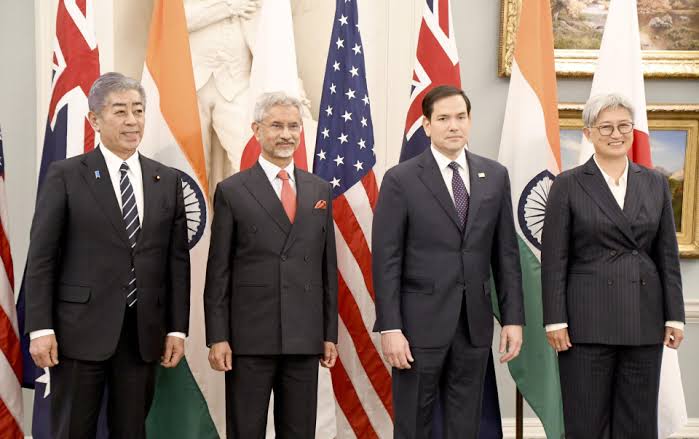
The foreign ministers of India, the United States, Japan and Australia during Quad meet have agreed to launch an initiative aimed at bolstering cooperation on critical minerals, at a time when China is the dominant player in the global supply of rare earth elements vital for modern technologies.
The meeting focused on a wide range of regional and global issues, including counterterrorism efforts. Mr Jaishankar strongly condemned terrorism and referred to India’s recent counterterrorism response, including Operation Sindoor. He firmly stated ” The world must display zero tolerance. Victims and perpetrators must never be equated and India has every right to defend its people against terrorism and we will exercise that right. We expect our Quad partners to understand and appreciate that.”
He also reiterated the broader strategic goals of the Quad. “we are all committed to ensuring a free and open Indo-Pacific. To that end, our endeavours are devoted to promoting a rules-based international order. The nations of the Indo-Pacific must have the freedom of choice so essential to make the right decisions on development and security,” he said.
He also announced India’s intention to host the next Quad Summit. “India plans to host the next Quad Summit. We have some proposals on how to make it productive, and sure so do our partners. We will discuss and I am sure we will agree,” he said.
Japanese Foreign Minister Takeshi Iwaya also addressed the meeting, emphasising the strategic relevance of the Indo-Pacific region in the current global context.
The Quad Foreign Ministers’ Meeting reaffirmed the shared commitment of the member countries to a free, open, and secure Indo-Pacific, while also underlining India’s strong stance on counterterrorism and regional development.
“We are deeply concerned about the abrupt constriction and future reliability of key supply chains, specifically for critical minerals,” Indian External Affairs Minister Subrahmanyam Jaishankar, U.S. Secretary of State Marco Rubio, Japanese Foreign Minister Takeshi Iwaya and Australian Foreign Minister Penny Wong said in a joint statement..
After a similar agreement reached by the leaders of the Group of Seven major Western countries last month, the Quad foreign chiefs highlighted the importance of diversified and reliable global supply chains.
With China in mind, they said, “Reliance on any one country for processing and refining critical minerals and derivative goods production exposes our industries to economic coercion, price manipulation and supply chain disruptions, which further harms our economic and national security.”
Calling India, Japan and Australia “very important strategic partners” of the United States in ensuring a free and open Indo-Pacific, Rubio said during the meeting that the four have “a lot of shared priorities.”
Rubio said many other countries will also benefit from the Quad’s increased cooperation as “not simply a security matter” but also in terms of “economic development” in many cases.
While the Quad is not a security alliance, it is viewed as a counterweight to China’s growing influence in the region, with its rapidly expanding areas of cooperation ranging from maritime security and infrastructure to health protection and emerging technologies.
Noting that the Indo-Pacific is the growth engine of the global economy and accounts for more than half of the world’s population, Iwaya said peace and stability in the region is “essential for the prosperity of the international community.”
Among many other issues, Jaishankar, Rubio, Iwaya and Wong who last met together a day after Donald Trump began his second presidential term in January, reaffirmed their “strong opposition to any unilateral actions that seek to change the status quo by force or coercion,” including in the South and East China seas.
They also condemned North Korea’s launches using ballistic missile technology and its relentless pursuit of nuclear weapons in violation of U.N. Security Council resolutions.
The birth of the group dates back to the countries’ coordinated emergency response and humanitarian aid following the 2004 Indian Ocean earthquake and tsunami.
The Quad was elevated to the foreign ministerial level in 2019, during Modi’s second term and Trump’s first presidency, before being boosted to the leadership level in 2021 under his successor Joe Biden.
Despite Trump’s skepticism about tackling global and regional challenges multilaterally, he has consistently placed great importance on India and on the Quad framework, and it is likely that his first trip to Asia during his second term will coincide with this year’s four-way summit.