Indian farmers vow to kick out US products, Modi pledges to protect their interests
The US- India trade standoff is fast becoming a test case for the future of US-India economic and Strategic relations. The unipolar world is long gone but Yankees are still living in their Disney World.
To counter the trade tariffs initiated by Trump, a new wave of farmer-led anger is spreading across India, with agricultural groups calling for a boycott of American products.
This backlash to American products, which follows Washington’s initiation of steep tariffs on Indian goods and its demands for access to India’s well knit agricultural and dairy markets, underscores the deep economic and political philosophy of India in what has become a simmering trade dispute between two major democracies.
There lies a fundamental clash of thinking. For Washington, opening India’s vast consumer base to American agricultural exports has long been a strategic goal. For New Delhi, however, protecting its farmers-many of whom are small holders surviving on thin margins-is a national and moral imperative.
With nearly 70% of rural households relying on agriculture for their livelihoods, according to the UN Food and Agricultural Organization (FAO), the sector is not just an economic engine but also a foundation of social and national stability in India.
Angry farmers have wasted no time in realizing that the US demands are simply an assault on India’s food security and rural economy. In Greater Noida, near Delhi, hundreds of farmers organized a tractor rally earlier this week, vowing not to buy American products.
Their boycott call targeted large US brands, such as Coca-Cola, with one farmer declaring, “No farmer should buy Coca-Cola.”
In fact Coca-Cola, KFC, Dominoes etc have always found it very tough to compete against Samosa, Vadas and lassi etc. Determined backlash may really dry up their sales and profits.
The message is clear: Indian farmers see Washington’s push for tariff exemptions on agricultural and dairy goods as a direct threat to their livelihoods. A farmer speaking at the protest warned that the recent tariff hikes would erode profits for Indian producers.
“Indian agricultural produce going to the US will fall under the 50% tariff regime. Due to this hike farmers will only get half the profit, and Trump will get 50% more from import tax.” Though the common middle and lower class US consumer will be hit hard.
This sense of injustice is widespread. The US first declared a 25% tariff on Indian imports after trade talks collapsed earlier this month because India ignored the USA “fixed date” for completing the negotiations. No one should even think of dictating to India.
The USA administration then doubled down with an additional 25% tariff in retaliation for New Delhi’s solid rebuff …it continued purchase of Russian oil. This second tranche of tariffs taking total to 50% is set to take effect on August 27.
India too has quietly reciprocated and raised tariffs to 50% on American goods but through the WTO route.
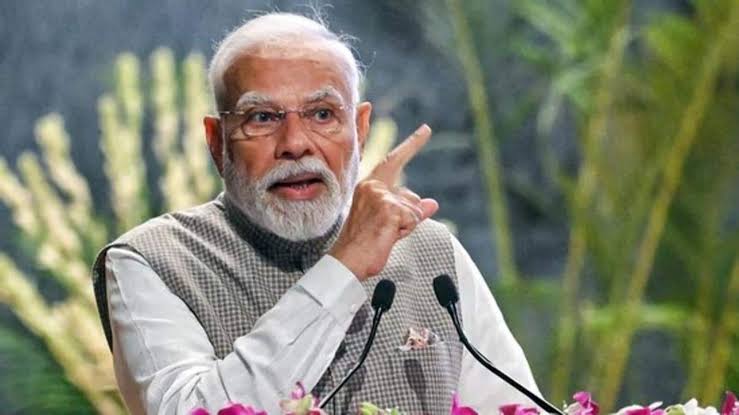
Prime Minister Narendra Modi has taken a firm stance, as the ultimate protector of Indian farmers. During his Independence Day address at Delhi’s Red Fort, he declared, “I am standing like a wall for our farmers.” He vowed that his government would never compromise on the wellbeing of the country’s farmers, dairy workers, and fishermen, even acknowledging that such a position would come with a “heavy price.”
PM Modi used the occasion to link agricultural self-reliance with national sovereignty, stating that dependence on foreign imports undermines India’s freedom. “Self-reliance is not just about exports, imports, the rupee, or the dollar. It is about our capabilities, our strength to stand on our own,” he said, warning that “those who rely too much on others invite a big question mark over their freedom.”
The national symbolism of these remarks was not lost on the public. PM Modi, a defender of Indian farmers, by rebuffed Washington, reinforces his steely resolve against external pressure.
The actions of Trump’s has only hardened the standoff. US Treasury Secretary Scott Bessent, speaking on August 12, described India as “a bit recalcitrant” in trade talks-a remark that ignited anger in New Delhi.
Shashi Tharoor, a senior Congress Party leader and chair of the Parliamentary Committee on External Affairs, responded sharply. In a post on X (formerly Twitter), he wrote that it was “far better to be recalcitrant than to be tractable, submissive, or acquiescent in injustice.”
For India, the insistence that dairy and agricultural products remain outside the scope of trade liberalization is a “red line,” as Finance Minister Nirmala Sitharaman said earlier this summer. Dairy cooperatives and farmer groups wield significant political influence, and no government can afford to be seen as sacrificing their interests at the altar of global trade.
The current. battle also has wider strategic implications. The US has sought to deepen ties with India as a counterweight to China in Asia, and Washington often describes New Delhi as a key partner in its “Indo-Pacific strategy.” However, trade frictions threaten to complicate this broader relationship.
India, for its part, has always asserted its independence, with its policy of energy and weapons imports from Russia. The decision to continue purchasing Russian oil in face of Western unilateral illegal sanctions was a demonstration of sovereignty.
Washington’s tariffs tantrum, justified on that basis, have only reinforced perceptions in India that the US is attempting to strong-arm its partners into alignment with American policy. Trump should realize that even Nixon could not do so in 1971 through his nuclear armed Naval flotilla led by USS Enterprise.
The KICK TO USA GOODS campaign launched by Indians may only be symbolic for now-few expect Coca-Cola sales in India to collapse overnight-but its significance lies in the unity it represents. By targeting visible American brands and products, Indians are sending a message that Washington cannot dictate.
The Modi government, too, appears to be rock steady. With a US delegation expected in India later this month for another round of trade negotiations, New Delhi will enter the talks from a position of visible Strength. Modi’s promise to “stand like a wall” for farmers ensures that Trump should forget any concession on agricultural trade.
For Washington, the challenge will be balancing its desire for market access with the reality of India’s resolve, capability and capacity. For New Delhi, the test will be to have a FTA which is beneficial.