Longju Skirmish: Watershed in Indian Border Management
By Colonel Satish Singh Lalotra
‘A nation that cannot control its borders is not a nation’.
—Ronald Regan
The world over, all creators of nation states i.e leaders, statesmen & the masses etc have had a definite plan as to what were supposed to be the physical manifestations of their creation on ground. India was no exception to the above rule. Rather historically India despite its unique disposition in terms of its people, races, linguistic cum religious order and the ilk had a set piece of loose national frontier framework, which was the combined creation of its myriad princely states who through their routine administration had put into place their princely boundaries. The countless raids, attacks and brief occupations by foreign armies dating back to centuries not withstanding; further gave a national identity to its people bound by a majoritarian religion (Hinduism), though governed by distinct Maharajas. The advent of Mughals and thereafter the British further consolidated and defined their hold on the national frontiers of India. The early 19th century fears of an expansionist Czarist Russian army into India raised the heckles of the British who set into motion the infamous ‘Great Game’ that still finds echoes in the frontier regions of India. Surrounded by a group of seven (7) countries post 1947, India additionally shares maritime borders with Sri Lanka and the Maldives. To a very large extent Indian borders are a legacy left by its colonial masters, in particular the British. Accordingly the border management of the frontier areas too was the sole responsibility of its colonial masters who many a time were led by the short term expediency of their governance. In the bargain short changing long standing implications of their expediencies.
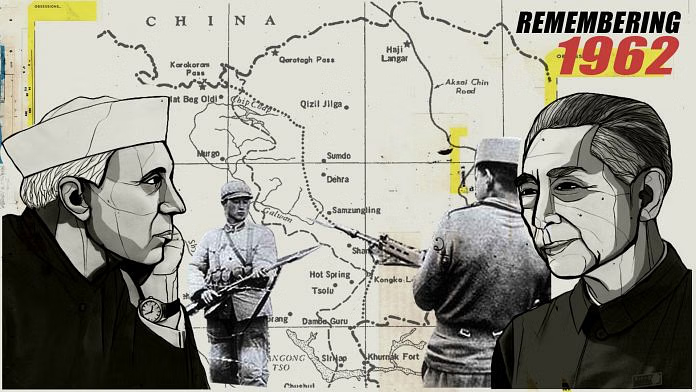
The much contentious and tenuous relationship between the Two Asian giants -China and India are the direct fallout of an unresolved boundary dispute that dated back to the pre-independence times of India and continues till date in the form of Doklam crisis as well as Galwan clashes. Dictated by the British fear of an expansionism from the north and a host of flip flops from the then Independent Tibet as well as an imperial China under the Qing dynasty, the British- Indian territory facing its northern neighbor was left unfettered for decades to no end. Coupled with the fact that max of northern territory of India beginning from Ladakh till ( NEFA) Arunachal Pradesh was inhabited by the indigenous tribes who mostly owed allegiance to the Tibetan plateau and its people further complicated already diffused state of belongingness. ‘Longju’ a non-descript speck on the relief map of Arunachal Pradesh( NEFA) nestling in the NE fringes of India suddenly acquired a larger than life size of its existence when on 25th May 1959 , an ugly clash took place between the PLA of China & the armed forces of India. With China taking the stand that Indian border troops intruded into their territory, stage was thus set for a long haul to settle the matters through force rather than through diplomatic parleys. Taking place just a few months after the unceremonious exodus of HH Holiness Dalai Lama the spiritual leader of the Tibetans along with his followers to India, ‘Longju’ suddenly seared in the Indian psyche as no other incident of that magnitude during the late 1950s. With the ink not even having dried on the ‘Panchsheel’ agreement papers signed just a few years back between the two PMs of India & China , the clashes in the high Himalayas marked the first litmus test of Indian statesmanship, foreign policy gaffe, and an abject failure of Nehruvian line of foreign policy take on China. The clashes at ‘Longju’ personified in one single stroke the naivety and lack of realpolitik on the part of policy planners with regard to achieving higher direction of national goals and what it takes to consolidate its gains while grappling with a much larger and powerful neighbour. This year of 2025 marks the 66th (Sixty sixth) year of that unholy clash of arms between two Asian giants which compels a right thinking Indian to ponder over the trajectory of ominous developments which were to my mind a creation of our own doings to a large extent for having pushed back the integration (physical as well as psychological) of NE of India at our own peril.
Though many books of eminence have been penned since that ugly clash of 1959, one of the seminal work penned by retired Maj Gens DD Dwivedi and PJS Sandhu in their masterpiece —The unknown Battles : operations in Subansiri and Siang frontier divisions’ have zeroed on ‘Shannan region’ of Tibet which abuts the part of Arunachal Pradesh as the hotbed of ‘Tibetan resistance’ cum reactionaries. And ‘Longju’ in India happened to be just opposite this region of Tibet. Anyway, coming to the centrality of my topic-how Longju incident set the stage for an overall of review of border area management of India’s northern frontiers. The first PM Of India-Jawaharlal Nehru was too much of an idealist and romantic in his views when it came to projecting India’s image on the world stage many a times giving a go by to the realpolitik prevailing at that time. Once he wrote about the inhabitants of the NEFA ‘I am not at all sure which is the better way of living, the tribal or our own. In some respects, I am quite certain theirs is better. There is no point in trying to make them a second rate copy of ourselves’ unquote. In a way was Nehru being too liberal to the extent of failing to integrate or amalgamate the border people into the overall fabric of Indian state? Not daring to draw the ire of the locals of NEFA in terms of their integration into the Indian union? A Corollary if I may draw of various Indian states may hold as good or bad as NEFA. Now where does it lead us to as a country with the famous adage-‘Unity in diversity’?
Despite constitutionally a part of Assam in the 1950s, NEFA was administered by the ministry of external affairs with the Governor of Assam seconded by a senior officer (often from the ICS) designated as an Advisor to the Governor. What a quixotic arrangement of forces to look after the national boundaries that were being hotly contested by an emerging China? In 1955, Dr Verrier Elwin, the famous British anthropologist who had just taken Indian citizenship joined as advisor for tribal affairs. Verrier’s concept of the development of these frontier regions of India was expounded in his celebrated book-The philosophy of NEFA’, which became a sort of ‘bible’ for all the officers serving in NEFA. It is not that one didn’t realize the misplaced notion of romanticism associated with the border areas amounted to segregation of a large chunk of the Indian population .Nation did realise the ominous implications of such a naïve line of thinking on the part of leaders like Nehru & Verrier; but was too hamstrung by the colossus that Nehru rode as a Foreign Minister cum Prime Minister. Though Nehru himself had taken into account Sardar Patel’s letter warning him to pay more attention to the real enemy ( China) which the latter wrote to him much before his death in 1950, and the former constituting Maj Gen Himmat Sinhji (Deputy Defence Minister) ‘ border area development committee’ it was the ‘Macawber’ tendency of leaders of that time which put paid to India’s defence preparedness in the NE of India. However the first PM did take an excellent initiative by way of creating a separate cadre for India’s frontier areas. Thus was born the famous IFAS (Indian frontier administrative service) which unfortunately was shut down in the 1960s itself.
Border management is one such facet that is independent of the Governments of the day. Various shades of governance shouldn’t interfere into the set piece actions/motions which have been tested on the anvil of sound principles of tackling any dangers emanating across the international borders. The nations abutting the Indian frontiers being the same that were decades back with their avowed stance towards India well known , it takes a little rehashing of foreign policy backed up by a sound national will as well as robust infra to put in place in order to arrive at an equally sound border management policy. It will be sounding quite amusing to many of the readers of this article of mine to know that as late as late 1980s and early 1990s the Indo-Pak border used to be demarcated only with cement border pillars with no border fencing. Could it be just that the GOI decided one day to border fence the entire Indo-Pak Border? Not at all. It was the changed geo-political equation wrought upon by one sided intransigence shown by Pakistan in its myriad forms that compelled India to manage its western borders with fencing as also strengthening it with a host of ultra-modern gadgets, communication and surveillance. But natural the dynamics of both nations had undergone a sea change in the last 3 decades or so. In case of Sino-Indian border management, things moved quite fast despite a plethora of CBMs put in place. Majorly on account of China’s unilateral actions in terms of erecting world class infra in the form of roads, rail networks, tunnels, unauthorized settlement of its villages in disputed areas all along the LAC. With Indian efforts getting stymied to mirror image these actions in its own areas by the Chinese, a more muscular approach was dovetailed in India’s border management policy that called for a robust national will short of brinkmanship vis a vis Chinese actions. The famous VVP (Vibrant village programme) kickstarted by the HM Amit Shah last year from Walong, the easternmost settlement of India in Arunachal Pradesh going up right till Ladakh shows India’s renewed image in the comity of nations the world over. It is another matter that one may call Indian efforts as copying Chinese actions rolled out in the form their famous ‘Civil-military fusion’ tactics, wherein China has tried to make common cause between their national aims/Goals and local aspirations.
Be that as it may, the latest actions by the NBWL (National board of wild life) a body under the ministry of environment, forest and climate change headed by Bhupendra Yadav by clearing 32 defence infra projects all along the national frontiers and in the sensitive ecological regions speaks volumes of the national grit and determination to take these matters to the next level. Similarly countering the latest Chinese hum-bug of naming certain places and physical features in Arunachal Pradesh in local Tibetan language by our own naming of quite a few locations in Hindi language in the Tibetan autonomous region signals that finally India has arrived on its own steam. If wanted ,India can up the ante by renaming the LAC as ‘Indo-Tibet border’ thereby in one single stroke reversing not only the foreign policy of the country against China but also effectively putting our border management practices on a much more even keel by harping back on our age old stance that Tibet was and is a free nation. What the country needs today is also a relooking of its archaic way of functioning by various security agencies along the borders who are in the habit of working in water tight compartments often not sharing intelligence for the common good of the border management. The overlapping of functions of these plethora of agencies often undercut and curb the free flow of information when time is of essence in such matters. Removing of the age old ILP ( Inner line permit) in many areas abutting the Sino -Indian border without compromising national security is another knot to be unraveled. Let it be known to the citizens of India that the national writ begins and ends at its national frontiers where now one can come across border villages like ‘Mana’ in Uttrakhand that carry the moniker of ‘First Indian village’ rather than ‘Last Indian village’.
(The writer is a retired army officer)