Modi and Xi meet in Tianjin : India-China relations enter a new phase
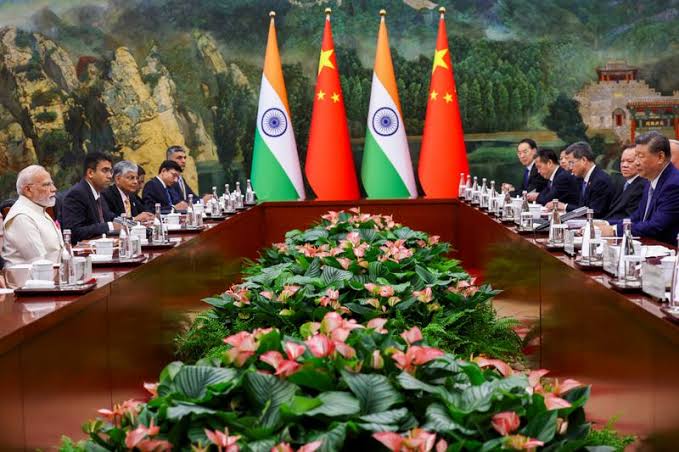
Prime Minister Narendra Modi and Chinese President Xi Jinping held a significant meeting on August 31 in Tianjin, China, marking a crucial step toward stabilizing one of the world’s most strategically important relationships.
The talks took place on the sidelines of the Shanghai Cooperation Organization (SCO) summit, where leaders from across Eurasia gathered. For both New Delhi and Beijing, the meeting represented an opportunity to recalibrate ties after years of turbulence, particularly following the deadly LAC clashes of 2020.
This is Modi’s first visit to China since 2018 and comes after months of quiet negotiations designed to reduce tensions. Although Modi and Xi met briefly at the BRICS summit in Kazan last October, this face-to-face engagement carried far greater weight, symbolizing a willingness to address structural irritants and search for avenues of cooperation.
Speaking after the talks, Modi highlighted what he described as a new “positive direction” in bilateral ties. “There is peace and stability on the borders,” he said, referencing the long-contested Himalayan frontier where Indian and Chinese troops remain deployed in large numbers despite recent disengagement agreements.
He also noted symbolic yet politically significant developments, such as the resumption of the Kailash Mansarovar Yatra, a pilgrimage route that draws thousands of Indian devotees to sacred sites in Tibet, as well as plans to restore direct commercial flights between the two countries.
Xi, for his part, echoed the importance of cooperation, stressing that the destinies of nearly 2.8 billion people are intertwined. While his remarks were more measured, they underscored China’s recognition that strained ties with India weaken Beijing’s wider strategy, particularly at a time of heightened rivalry with Washington.
Indeed, the meeting cannot be divorced from recent moves by the United States.
Donald Trump’s high tariffs of up to 50% on Indian goods-ostensibly over trade policies and New Delhi’s continued oil imports from Russia-has injected new friction between USA and India.
For Beijing, this presented an opening. Chinese Ambassador to India Xu Feihong bluntly criticized the US tariffs, warning that “silence or compromise only emboldens the bully.” He pledged that China would “firmly stand with India”.
India and USA had deepened their partnership in the recent years, as seen by the Quad grouping. On the other hand, economic nationalism and protectionism in Washington threaten Indian exports and economic ties. Against this backdrop, a thaw with Beijing provides useful leverage.
Another key outcome of recent diplomacy was the 24th round of special representative talks on the Indo Tibetan boundary question, co-chaired by Chinese Foreign Minister Wang Yi and Indian National Security Adviser Ajit Doval earlier this month. Those discussions produced a tentative roadmap for improved LAC / border management, including commitments to reopen Tibetan trade routes and restore military confidence-building mechanisms.
The resumption of direct flights, frozen since the COVID-19 pandemic, was also framed as an early deliverable. Connectivity, both symbolic and practical, serves as a litmus test for the health of the bilateral relationship. For many analysts, progress on such “low-hanging fruit” can generate momentum for tackling thornier disputes.
At the same time, the long shadow of the June 2020 Galwan Valley clash-when soldiers from both sides were killed in brutal hand-to-hand combat-remains. The episode marked the lowest point in relations in decades, shattering trust and fueling nationalist sentiment in both countries. While disengagement has reduced the risk of fresh clashes, the Line of Actual Control (LAC) remains militarized, and neither side has shown willingness to compromise on territorial claims.
Beyond bilateral issues, the Modi–Xi meeting also touched on broader geopolitical ambitions. Both leaders expressed support for reviving the Russia-India-China (RIC) trilateral dialogue, an initiative first proposed in the late 1990s as a way of counterbalancing Western dominance in global affairs. Moscow now isolated from much of the West, New Delhi and Beijing locked in an escalating rivalry with Washington, all three find themselves courted by each other.
The prospect of a revitalized RIC aligns shows the rise of a multipolar world order, firmly emphasized by both Putin, Modi and Xi. Within the SCO and BRICS forums, Russia, India and China have found common cause in pressing for reforms to global financial institutions and eliminating Western hegemonism. However, this does not erase underlying frictions and India’s independent foreign policy.
While the Tianjin meeting may not have produced dramatic breakthroughs, it signaled a cautious pragmatism. Modi’s emphasis on “mutual trust, respect and sensitivity” reflects India’s insistence that China acknowledge its concerns over the border balance of power. Xi’s language, though less effusive, suggests Beijing sees value in preventing rivalry from tipping into open confrontation.
In the coming months, concrete measures such as reopening trade posts, restoring flight connectivity, and facilitating pilgrimages will test whether the new tone translates into durable change.
Both governments also face domestic pressures: Modi must show that he can safeguard India’s national interests while improving economic prospects, while Xi cannot afford to appear weak.
Still, the fact that the two leaders met at length, exchanged conciliatory messages, and agreed to pursue confidence-building steps indicates that India-China ties may be entering a new phase. With global geopolitics in flux, neither nation can afford perpetual hostility with each other.
The road to genuine rapprochement remains long and uncertain. Yet the Tianjin summit underscored a basic truth: for both India and China, coexistence has become a strategic necessity.
Blitz