Netra MK-II AEW&C: IAF Eye in the sky
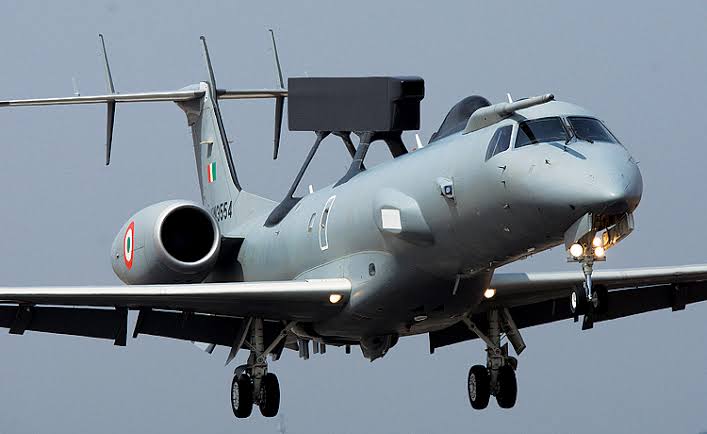
IAF should be equipped with a minimum of 30 × AEW&C aircrafts with 360° coverage capability and Station keeping for 8 hours plus.
The existing fleet consists of 3 x Phalcon AWACS fleet based on the Ilyushin Il-76 platform, as well as 3x EMB-145-based Netra MK-I systems. Phalcons provide 360° coverage but Netra Mk1 have only 240° coverage.
The Cabinet Committee Security had earlier approved a project for 6 x Netra Mk1 A project and now has in addition officially approved a Netra MK-II Airborne Early Warning and Control (AEW&C) program. This will be a crucial step in the modernisation and reinforcement of the nation’s aerial surveillance capabilities.
This indigenous airborne surveillance initiatives will be focusing on converting six Airbus A321 passenger aircraft into sophisticated AEW&C platforms.
The project, sanctioned in July 2025, carries an estimated investment of nearly ₹20,000 Crores.The scope of this development is to achieve greater strategic self-reliance in airborne warning systems and also bridging gaps in its existing radar and surveillance infrastructure.
The Netra MK-II program will now build upon the Netra MK-I and MK-IA systems, developed around the smaller Embraer EMB-145 jet platform.The project on EMB-145 was an interim solution only which had its operational limitations in endurance, payload capacity, and cabin space. A321 Airbus is a larger platform with more endurance. After this project we may switch to C295 and then finally go in for an IL76 size aircraft.
The Airbus A321, though a narrow-body airliner, has far greater range, endurance, and space for mission equipment and operator consoles which will addresses earlier capability gaps.
Under the planned conversion, the A321 aircraft—already acquired from commercial fleets— have undergone structural reinforcement at Airbus Defence and Space facilities in Spain, marking a significant collaboration between Indian and European aerospace industries.
Modifications included the removal of all passenger seating, strengthening of the fuselage for radar integration, and installation of advanced auxiliary power units (APUs) to support the significant additional power demands from sensors, communication gear, and operator workstations.
Internal reconfiguration has now given a more spacious and ergonomically optimised cabin environment, capable of sustaining longer-duration missions with adequate provisions for crew rest and operator efficiency.
The Netra MK-II will have a new-generation Active Electronically Scanned Array (AESA) radar system, an evolution from the radar technology deployed on the EMB-145-based systems.
This radar will provide 300 degrees of coverage, a marked improvement over the Netra MK-I, although the long-term objective remains full 360-degree surveillance capability—a standard met by larger AEW&C aircraft such as those based on the IL76 or similar size platform.
There will be a comprehensive suite of electronic warfare (EW) systems, advanced Identification Friend-or-Foe (IFF) modules, secure data links, and state-of-the-art communication equipment.
Netra Mk2 will have real-time tracking and data dissemination with respect to both aerial and maritime threats, thus providing multi-domain situational awareness.
Compared to the EMB-145’s limited loitering endurance, the Airbus A321—with its larger fuel capacity and optimised mission payload design—will dramatically increase on-station time during surveillance patrols.
The additional payload margin also allows for the accommodation of more mission consoles and sensor systems, thus increasing the scalability of operations.
Furthermore, the aircraft’s larger cabin supports the integration of advanced mission and control centres within the airframe itself, allowing simultaneous multi-threat analysis by a larger number of operators.
The program timeline are expected to progress through the late 2020s, with prototype and developmental flight trials targeted around 2029.
The first fully operational Netra MK-II aircraft are expected to be inducted into the IAF fleet in 2031. The intensive testing, mission certification, and integration challenges involved in fielding a system of this magnitude, highlights the the leap in capability that these platforms are anticipated to bring.
The Netra MK-II program is a critical enabler for India’s long-standing goal of establishing a robust, tiered aerial surveillance ecosystem.The A321-based MK-II platform will significantly expand India’s ability to monitor both western and eastern airspaces, while also providing extended coverage over the Indian Ocean Region (IOR).
The integration of secure data-sharing mechanisms will further enable synergy with other branches of the military, linking AEW&C platforms with fighter aircraft, warships, ground-based radars, and command centres, thus reinforcing the vision of network-centric warfare capability.
This Netra Mk2 project symbolises a gradual transition to technologies that reduce dependence on foreign suppliers, while simultaneously enhancing deterrence against evolving threats in a volatile security environment.
With its deployment projected in the early 2030s, the Netra MK-II is poised not only to secure Indian airspace more effectively but also to anchor India’s role as a maritime power with state-of-the-art airborne surveillance capabilities.