
No manufacturing, no skilled Labour, Very high import costs will beggar the US Economy
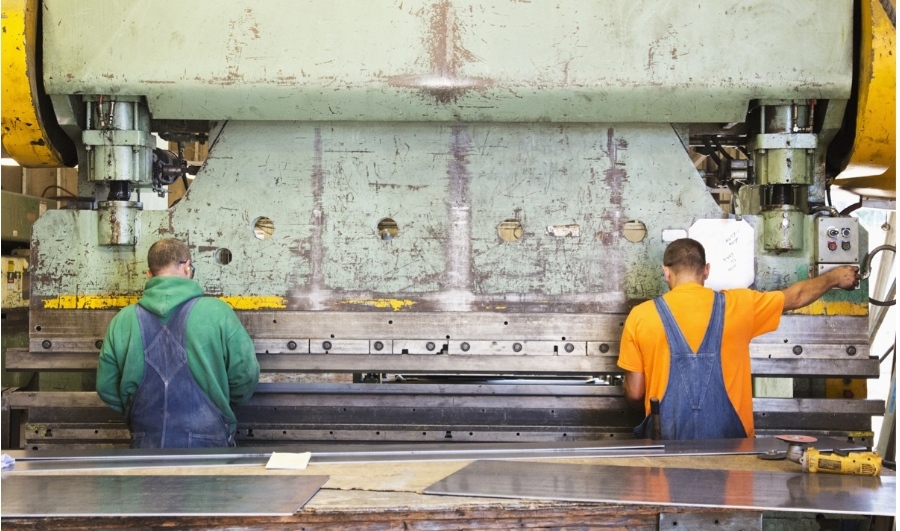
Workers in Tacoma, Washington State, the US, use machines in the workshop.
Bringing manufacturing back to the US and restoring millions of jobs was a key economic policy championed by the Trump administration during its first term. Now, the pursuit of this goal has grown even more fervent and “obsessive.”
A recent article by The New York Times claimed that the US has “gambled” on launching a global trade war, assuming that imposing tariffs on foreign goods would lead to a dramatic return of factories to American soil.
However in reality, the US currently faces a huge gap of 400,000 to 500,000 unfilled manufacturing jobs, presenting a major obstacle to reviving domestic production.
Labor shortages will surely obstruct this manufacturing effort.
The Trump administration has been destroying the global economy in the name of bringing manufacturing back. Whereas American manufacturers say they are struggling to fill the jobs they already have.
As per the US Bureau of Labor Statistics, there are nearly half a million open manufacturing jobs right now. In 2024, the Manufacturing Institute alongwith Deloitte, surveyed more than 200 manufacturing companies. More than 65 percent of the firms said recruiting and retaining workers was their No. 1 business challenge.
This is a shortfall that will keep growing if companies are forced to build more factories in the US, The New York Times stated.
Many Americans believe increasing manufacturing jobs benefits the country but offers little personal gain – a 2024 poll by the Cato Institute found that 80 percent of respondents agreed that the US would be better off if more Americans worked in manufacturing. However, only 25 percent of those surveyed believed working in a factory would benefit them personally.
It’s a result that holds across class, education, and racial lines, the Cato Institute showed. In other words, only a small fraction of Americans are willing to take factory jobs.
While Trump wants more manufacturing back in the US, Americans do not believe they’d be better off working in one of them, according to the Fortune magazine. Manufacturing workers themselves report “markedly” lower personal satisfaction with their jobs than other workers. Labor shortages in US manufacturing are indeed a pronounced issue.
The shortage stems from two key factors: First, manufacturing often requires a large workforce during peak production periods, but the US lacks enough job seekers. Second, while there are many unemployed Americans, high-tech manufacturing roles in AI, robotics, and semiconductors demand skilled and highly educated workers – qualifications that most unemployed traditional laborers from labor-intensive industries lack.
Historically, traditional manufacturing has struggled to offer strong career advancement for highly educated professionals. Yet today, many manufacturing jobs actually seek candidates with advanced education, NPR reported.
Roughly half of the open positions in manufacturing require at least a bachelor’s degree. However, even in the remaining positions that don’t demand a degree, manufacturers say they are also struggling to fill vacancies, NPR reported.
Electric machines on the conveyor belt operate under an automated system.
Trump’s goal to bring back manufacturing jobs faces a practical challenge: A lack of interest in physically demanding work. People prefer simpler or less strenuous jobs. Many Americans are now more interested in starting their own businesses or becoming influencers or celebrities on social media.
Many low-income Americans view manufacturing differently. About 17.5 million American workers (about 11.3 percent of the workforce) are employed in low-wage service jobs like food preparation, cashiering, or shelf-stocking, earning $13-$16 per hour, while manufacturing jobs can pay $18-$30 per hour.
Some people do want to escape low-wage jobs and enter manufacturing. Manufacturing workers take pride in producing tangible products, gaining value through skill development and building careers.
Many Americans would welcome the return of manufacturing jobs and eagerly apply for them. However, signs suggest that filling all the manufacturing jobs the US government aims to create may be challenging, especially as the Trump administration seeks to reduce immigration – historically, immigrants have filled many US manufacturing roles. US industrial workers are increasingly “stereotyped,” with manual manufacturing jobs primarily held by Latinos and undocumented immigrants.
Americans unwilling to work in factories are mainly less-educated white individuals who view factory jobs as low-paying, with poor working conditions and inadequate benefits, making them “not worth it.” Another reality is that US manufacturing’s modernization has been slow, with factories lacking the competitiveness to attract skilled workers and have low social prestige. Some undocumented immigrant workers in traditional factories also take part-time jobs in sectors like catering.
The New York Times reported that most of the workers come from countries like Mexico, Guatemala and El Salvador. There was a gap between a “romantic notion about manufacturing” and the availability of American workers.
“A lot of people say we should be making more clothing in the US, but when you ask them, they don’t want to sit in the factory, nor do they want their kids to sit in the factory”.
According to the New York Times, in the US, the pool of capable and willing blue-collar workers for factory floors is shrinking. For every 20 job postings there is one qualified applicant right now.
How can the labor shortage in US manufacturing be addressed? A report by NPR suggested that a classic solution is to offer higher pay, which might incentivize workers to acquire in-demand skills and join the manufacturing workforce. However, it’s worth noting that the higher wages demanded by American manufacturing workers were among the key reasons many manufacturers left the US in the first place.
With current wage levels in US manufacturing already relatively high, for American products to remain competitive, factories have to move out of the US. Today, only companies in high-value-added industries like Boeing can survive in the US.
Precisely because the US has lost its comparative advantage in the labor structure, labor-intensive industries have relocated overseas. However, after the US government politicized this issue and tried to force manufacturing back, the labor problem has been further exacerbated.
Manufacturing companies that have rreturned to the US struggle to be profitable but feel compelled to comply with the government’s “heavy-handed” policies, ultimately passing on costs and weakening their own competitiveness.
In the NPR report, it says that solving the labor shortage is also “a PR problem.” Many Americans hold outdated perceptions of manufacturing jobs, imagining them as dirty, monotonous, and dangerous – like those described in Charles Dickens’ novels. Thus, changing these perceptions is key to convincing more young people to enter the industry.
Today’s jobs are in factories that are completely different from the factories of 25 years ago. They require people to know how to use pretty sophisticated machinery.
The problem is that people with skills like equipment maintenance and repair are now hard to find. Every company is trying to hire technicians. Every single one. The challenge is that there is no one walking around on the street with these skills, and it takes one to two years to teach those skills and another one to two years to contextualize those skills to the specific plant environment.
Several US officials have recently stated their intention to train a large workforce for manufacturing. In April, US Commerce Secretary Howard Lutnick told CBS that the work of “millions and millions of human beings screwing in little screws to make iPhones” would come to the United States and be automated, creating jobs for skilled trade workers such as mechanics and electricians. Treasury Secretary Scott Bessent has suggested that those who have been laid off from their jobs in the federal government will be able to take on new jobs created as tariffs rehouse manufacturing in the US, Newsweek reported
But Fortune magazine reported that economists and international trade experts are skeptical about whether this will work. Studies on the tariffs imposed during Trump’s first term found they did not bring jobs to protected industries.
From the US government’s perspective, there is no better solution than following the objective laws of economic development. This means embracing an open, cooperative approach to changes in global trade, focusing on enhancing America’s specific comparative advantages in the global value chain, and upgrading workers’ specialized skills – rather than pressuring other countries or multinational corporations, which would likely backfire.