RSS at 100 : India’s civilizational vision and global role
By Dr. Rajeev Ranjan Chaturvedy
As the RSS turns 100, its vision of India emerges as that of a civilizational power—rooted in spirituality, self-reliance, and global cooperation, offering guidance without domination
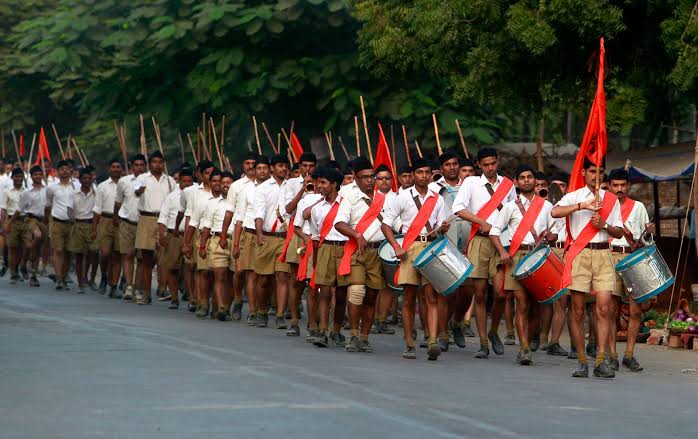
As the Rashtriya Swayamsevak Sangh (RSS) completes 100 years of its existence, it is timely to reflect not only on its influence on Indian society but also on its lesser-discussed yet important engagement with India’s worldview and foreign policy. Founded in 1925, the RSS has consistently advocated for a civilizational and cultural perspective on national issues, a vision that naturally extends to its interpretation of India’s role on the world stage.
Recently, Prime Minister Narendra Modi congratulated the RSS on social media (X), stating: “The Rashtriya Swayamsevak Sangh has completed 100 years of an unprecedented and inspiring journey. It has been committed to serving the nation and fostering self-confidence among Indians since 1925”. During his Independence Day address, he also described the Sangh as the world’s largest NGO, whose volunteers have consistently prioritized the nation’s welfare and contributed tirelessly to India’s development.
Celebrating its centenary on October 2, 2025, the RSS is a century-old organization that has contributed immensely to India’s development. Yet, misunderstandings continue in the West regarding India’s global role and the cultural-civilizational vision advanced by the RSS. The Sangh advocates a vision in which India assumes the role of a spiritual-civilizational leader (Vishwa Guru), a strong and self-reliant nation, and a champion of a multipolar and just world order.
Civilizational roots and spiritual leadership
To understand this perspective, one must revisit the writings of figures such as Sri Aurobindo, Swami Vivekananda, Rabindranath Tagore, and others, who emphasized spiritualism, internationalism, and India’s moral leadership on the world stage. Sri Aurobindo saw India as a spiritual lighthouse of humanity—not an imperial power but a moral and civilizational force. He believed India’s rise was necessary for the evolution of mankind toward unity, higher consciousness, and a balance between the spiritual and the material.
Swami Vivekananda similarly envisioned India as the spiritual heart of the world, teaching tolerance, harmony, and the unity of religions, while embracing science, strength, and service. His dream was of an India that “blends Western efficiency and material progress with Eastern wisdom and spirituality, offering a universal path for human upliftment”.
The RSS’s vision incorporates both material power and spiritualism, avoiding narrow nationalism. It envisions India as a cosmopolitan and universal power, providing solutions to the world rather than seeking domination.
Unlike many countries driven by revisionism and territorial ambitions, India has historically never attacked another nation, which sets it apart from other revisionist powers. This also distinguishes India from China, which seeks to assert dominance and restore its historical centrality, reflecting a “Middle Kingdom” mindset—a historical worldview in which China considered itself the cultural and political center of civilization. China’s vision is more domineering, motivated by a sense of past humiliation and the desire to regain its past glory, whereas India ’worldview is cooperative, non-threatening, and focused on moral and spiritual leadership rather than on domination.
Dharma, Arthashastra, and global good
The RSS envisions India’s role in the world as a balance between Arthashastra (national interest) and Dharmashastra (global good). This reflects a worldview that does not seek domination but harmony, emphasizing equilibrium between national responsibilities and universal well-being. India’s strategic outlook therefore differs from powers driven primarily by conquest or hegemony, offering instead a civilizational approach that integrates ethical responsibility with pragmatic statecraft.
It also represents a departure from Western theoretical frameworks such as realism and neorealism, which often interpret all nations as inherently aggressive, power-seeking, and dominating. Such paradigms fail to recognize the distinct civilizational perspectives and self-understandings that shape India’s role in the world.
Furthermore, this vision moves beyond utilitarian philosophies, which prioritize maximizing welfare for the greatest number. Instead, it emphasizes a civilizational ethic that values moral responsibility, ethical balance, and long-term harmony over purely quantitative calculations of benefit.
At the core of this worldview lies the principle of coexistence. Hindu thought has long upheld the idea that different paths can lead to the same destination, underscoring respect for diversity while affirming a shared moral and spiritual foundation. This ethos of mutual respect and harmony continues to inform India’s democratic traditions and international outlook.
Self-reliance is another central element, which Bhagwat describes as: “Self-reliance is the key to everything. Our country must be self-reliant. For self-reliance, priority should be given to the use of indigenous products. The nation’s policy should engage internationally by choice, not under pressure”.
Prime Minister Modi has recently echoed this sentiment, emphasizing that India’s greatest vulnerability—and its “biggest enemy”—is dependency on other nations. He clarified that self-reliance does not mean isolation but reducing dependency to prevent exploitation while remaining open to technology, trade, and cooperation.
This integrated vision reflects its distinctive civilizational approach: combining ethical statecraft, self-reliance, and strategic strength to promote coexistence, stability, and global good.
Moreover, while advocating peace, cooperation, and ethical global engagement, Sangh also stresses military preparedness to deter potential aggression, particularly from China and Pakistan.
India’s civilizational contribution
In today’s fragmented world, marked by greater instability, the RSS envisions a global role for India centered on cooperation, stability, engagement, and addressing pressing international challenges. India is seen as a Vishwa Guru, offering knowledge, solutions, and civilizational guidance rather than seeking domination.
This role contrasts sharply with Western conceptions of hegemony, zero-sum thinking, rigid transnationalism, exclusionary tendencies, and power-centric approaches. The civilizational ethos of India is captured in the principles of Vasudhaiva Kutumbakam (the world is one family) and Sarve Bhavantu Sukhinah (welfare of all). The RSS emphasizes that India’s rise combines spiritual-cultural values with scientific and technological progress, promoting inclusivity and moral leadership without domination.
combines spiritual-cultural values with scientific and technological progress, promoting inclusivity and moral leadership without domination.
The RSS also advocates India’s leadership on issues of the Global South, pushing for fairness in trade, climate action, and global governance. Under Prime Minister Modi, these efforts are reflected in initiatives such as the inclusion of the African Union as a G20 member and by highlighting critical issues like hunger, food security, and multilateral development, aligning global priorities with the challenges faced by developing nations.
The RSS also underscores India’s cultural connect with Southeast Asia, Africa, and the wider world through shared heritage such as Buddhism, Yoga, Ayurveda, the Ramayana, and the Nalanda tradition. Colonial historiography, however, often emphasized India’s invasions and conquests from the Northwest, as part of a strategic design to keep Indian confidence down by presenting repeated invasions from the Northwest and portraying India as inherently weak and fragmented.
At the same time, these narratives downplayed India’s long-standing trade networks, philosophical exchanges, and cultural influence in East Asia. Monumental structures like Angkor Wat in Cambodia and Borobudur in Indonesia stand testament to India’s enduring civilizational dialogue, yet these were largely absent from mainstream Indian historical narratives.
The Sangh seeks to overcome this colonial-era distortion by restoring balance to historical memory—placing India’s vibrant cultural outreach, intellectual contributions, and spiritual dialogue with the wider world alongside the challenges it faced. It also strongly advocates for the intellectual and cultural decolonization of India—and the developing world.
Even after political independence, many former colonies continue to mimic colonial structures and thinking. For the Sangh, development and progress must be rooted in local traditions, languages, and ways of life, including the revaluation of traditional medicine, indigenous knowledge systems, and cultural expressions.
This perspective extends to environmental diplomacy as well, emphasizing that climate negotiations must respect local contexts and knowledge systems, while promoting multilateralism and equity. In the Sangh’s vision, the world is inherently multipolar, with each nation contributing to a global family based on equal dignity rather than superiority or inferiority.
Diaspora communities are also recognized as carriers of India’s soft power, and Prime Minister Modi has leveraged these connections to strengthen ties globally and enhance India’s international presence.
Moreover, India’s civilizational ethos emphasizes tolerance, coexistence, and democratic thinking. These principles form the foundation of India’s democratic traditions, which predate Western liberalism. Rooted in Hinduism’s pluralism and respect for diverse paths, Indian society historically practiced consultative governance through institutions such as the Sabha and Smriti-based councils during the Vedic age, fostering participatory decision-making and pluralism.
Many experts argue that India’s democracy succeeded because of strong institutions; however, its true resilience lies in the civilizational political culture of tolerance, coexistence, and the middle-path approach—qualities essential for the effective functioning of democratic institutions.
If such a democratic political culture had not existed, no matter how strong the institutions were or how visionary the founding fathers had been, democracy in India would not have taken deep root—as seen in several neighboring countries of South Asia where, despite similar constitutional blueprints and institutional frameworks, democratic experiments faltered under authoritarianism, military rule, or civil strife.
Unlike other powers in the region, India has sustained democracy because these civilizational values are deeply embedded in social and religious life, creating a natural synergy with modern constitutional and legal frameworks.
India thus provides enduring lessons in tolerance and peaceful coexistence, demonstrating that liberal and participatory philosophies have long been integral to its societal fabric, and then became part of the Western discourse.
In a complex and volatile world, India seeks to address global challenges by combining ancient wisdom, moral leadership, and modern technological capabilities. The vision articulated by the RSS emphasizes that despite centuries of human experimentation, lasting solutions to global problems remain elusive, and India has a responsibility to offer a path toward peace, happiness, and ethical governance grounded in its civilizational values.
India’s rise is envisioned as inclusive, cooperative, and liberating, providing moral, spiritual, and technological guidance while maintaining global balance. It aspires to lead in moral, cultural, and technological domains, guiding humanity toward peace, prosperity, and harmony.
As the RSS marks its centenary, its vision of India is clear: a civilizational, cosmopolitan, and universal power, integrating spiritual values with modern capabilities. India seeks to provide solutions, not domination; cooperation, not coercion; and moral and cultural guidance for the global community.
In today’s world, India’s enduring mission remains to be a Vishwa Guru, guiding humanity with wisdom, inclusivity, and strength, and contributing meaningfully to a just and balanced world order.