
The Mining Sector in Afghanistan: A picture in black and gold
By Fabrizio Foschini
The mining sector has become one of the foremost drivers of Afghanistan’s beleaguered national economy in recent years. It offers the Islamic Emirate of Afghanistan (IEA) revenue from taxes, royalties and fees, but also the potential to boost the country’s scant diplomatic relations.
However, while waiting for foreign actors to tap the fabled underground riches of metal ores, fossil fuels and rare earths, less glamorous types of mining are already thriving. Local companies are seizing the opportunity to exploit mineral resources such as coal and gold.
In this themed report, AAN’s Fabrizio Foschini examines how better security and improvements in contracting and taxation have helped production grow. But, he also finds that under the surface, prospects for the mining sector are not all rosy.
The IEA seems unable to resist the temptation to extract quick profits, rather than properly manage the national mineral wealth for the long term. Moreover, recent accusations of favouritism, land grabbing and violent suppression of resistance by locals in some areas remind one of bad practices seen under the previous government.
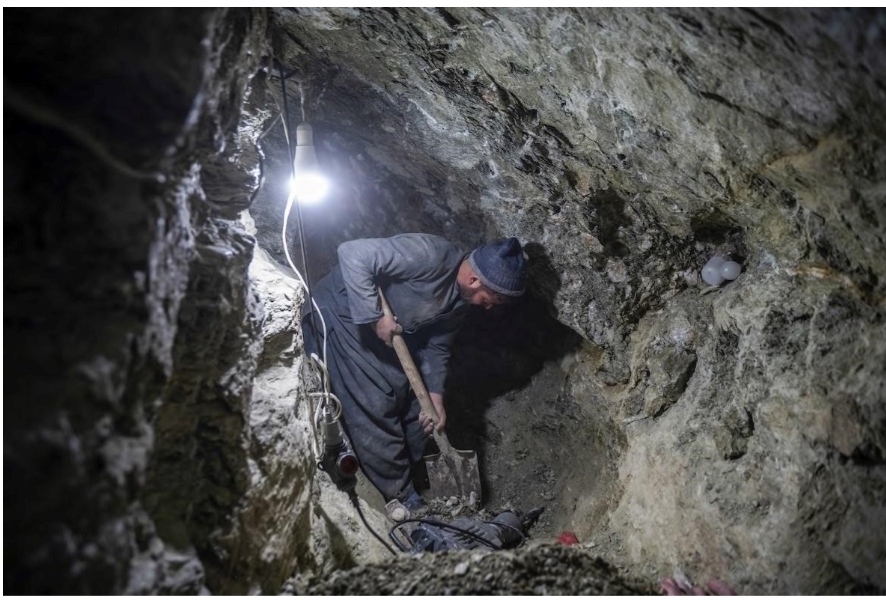
A miner digs inside a Yaftal-e Sufla district gold mine tunnel in the mountains that dominate Badakhshan province.
Mining is an industry of contrasts. For elites, it presents the potential for increasing their wealth and power, while for miners, the work is harsh and dangerous, often being the only alternative to subsistence farming.
Afghanistan’s mineral wealth has long been viewed through the lens of its promise rather than the complex realities that come with exploiting the vast reserves of coal, gold, copper, iron ore and rare earth minerals believed to lie beneath its rugged mountains.
Yet the hype about Afghanistan’s untapped riches masks a long history of mining, with the mountainous topography both a barrier to settlement and a source of mineral wealth. While these resources could be a driver for achieving economic independence, they have historically fuelled conflict, environmental damage and exploitation.
While the control of mines has shaped Afghan politics since the early Islamic era, modern industrial practices only emerged in the 1950s. However, they largely collapsed during the decades of conflict that followed. Only gem extraction – lapis lazuli in Badakhshan and emeralds in Panjshir – provided consistent exports, though often at the cost of fuelling local conflicts.
Under the Islamic Republic, contracts were plagued by corruption, elite capture and insecurity, with many projects collapsing before they could deliver tangible benefits. After the Taliban takeover in 2021, mining emerged as a top priority for the cash-strapped Islamic Emirate, seeking to generate revenue in the face of sanctions, the loss of aid and economic collapse. Contracts with foreign companies have also had an added benefit as a tool for international engagement for an isolated IEA hoping to win international recognition.
In the absence of the sort of international financial support enjoyed by the Republic and the emergence of mining as a key source of government revenue, there was an impetus for the IEA to standardise licensing and fees. It has also promoted large contracts with regional actors, particularly China, and turned coal exports into a critical revenue stream. However, risks remain.
Substandard mining practices degrade mineral deposits, contaminate water resources and in general, significantly damage the environment. Outdated and hazardous mining practices continue to expose workers to longstanding risks. Finally, minerals are often exported in their raw form and illegally, with little in-country processing, and therefore little benefit to the national economy.
This report, based on interviews with miners and traders across Kabul, Sar-e Pul, Baghlan, Takhar and Badakhshan, provides an in-depth examination of coal and gold mining in particular. It explores contracts, production, trade and the lived experiences of miners and their communities, highlighting both the opportunities and the persistent risks shaping Afghanistan’s mining economy.
From afar, Afghanistan’s hidden mineral wealth can sound like a fabulous alchemic quest to create gold and solve all the country’s problems. But as in magic lore, when you look closely, the divide between a boon and a curse is often revealed to be a narrow one.