
The next major destroyer program to strengthen the Indian Navy
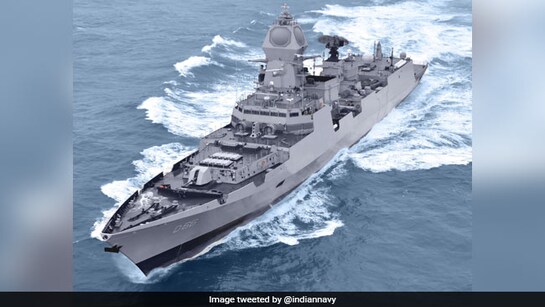
Indian Navy presently operates 13 destroyers. However to safeguard the Indian Ocean Region against all external threats and influences, the Navy needs to be provided with 32 x destroyers. This will ensure 8x destroyers for each of the fleets… Western, Eastern and the foreseeable Southern and Andaman.
Now the next naval expansion is poised for a significant leap as Mazagon Dock Shipbuilders Limited (MDL) anticipates the launch of a major destroyer acquisition programme by the Indian Navy worth INR 8 Kharab (80000 Crores).
The initiative is likely to be formalised within the next year and will mark one of the largest indigenous surface combatant projects in India’s maritime history. The eight destroyers will serve as flagships for expeditionary groups and form part of Carrier Battle Groups. Their induction will ensure that both Western and Eastern fleets maintain a balanced fleet centred around powerful multi-role surface assets. As three older left over destroyers of the Ranjit class begin to phase out in next few years Project-18 or 15C will start replacing them. However this means that instead of 8 such destroyers, the project must go in for 12 x destroyers.
The project, designated as Project-18 (Next Generation Destroyer – NGD), will focus on fielding a new class of technologically advanced, stealth-optimised destroyers.
Each vessel is likely to displace close to 10,000 tons, making them among the largest and most powerful warships anywhere in thw World.. These new ships will consolidate India’s position as a true blue-water navy capable of sustained operations across the Indo-Pacific.
Weapon And Sensor Integration
The NGD will feature a dense vertical launch system (VLS) architecture, potentially carrying over 100 missile cells. These will be configured for BrahMos and BrahMos-NG supersonic cruise missiles, land-attack variants, and a multi-layered air defence suite incorporating long-, medium-, and short-range surface-to-air missiles. The ships are expected to integrate the new-generation LR-SAM/MR-SAM derived from the Barak-8 system, offering comprehensive area defence capability.
Advanced Combat Systems
MDL is expected to integrate state-of-the-art radar, sonar, and electronic warfare systems sourced from BEL, DRDO laboratories such as LRDE and DLRL, and private partners under the Strategic Partnership (SP) model. The destroyers are anticipated to employ a fully networked combat management system capable of cooperative engagement, supporting cross-platform data fusion with aircraft, submarines, and unmanned assets.
Propulsion And Endurance
Propulsion is likely to come from a combined gas and gas (COGAG) or integrated full electric propulsion (IFEP) arrangement, giving the ships extended range and higher operational efficiency. The hull design will focus on improved stealth characteristics through radar-absorbing materials, shaping, and acoustic quieting. Each destroyer is expected to carry two multi-role helicopters, enhancing its anti-submarine and surveillance reach.
Strategic Industrial Implications
For MDL, this project will provide continuity and technological progression after the successful Project-15B (Visakhapatnam-class) programme. It will drive greater private sector participation, supporting Tier-1 and Tier-2 suppliers in electronics, composites, engines, and shipborne systems. The project aligns with India’s “Atmanirbhar Bharat” mission, reinforcing local design, manufacturing, and systems integration capability in high-end naval platforms.