The pomp of Putin’s New Delhi visit was certainly a MIRCHI MOMENT for the West, the India-Russia relationship has been further strengthened
Modi voiced words of respect and also demonstrated India’s independent role in reshaping geopolitics
President Putin’s visit to India was certainly a rude awakening for the West. They are not only Green with Envy but also supremely invidious of this friendship.
They have also suffered a rude awakening by realizing that India now has become one of the four Cardinal poles of this new multipolar world. Now USA is only one of the pole along with Russia, China and India.
No wonder most of the Western Press analysed the visit with totally tinted glass and naturally came out with very jaundiced conclusions.
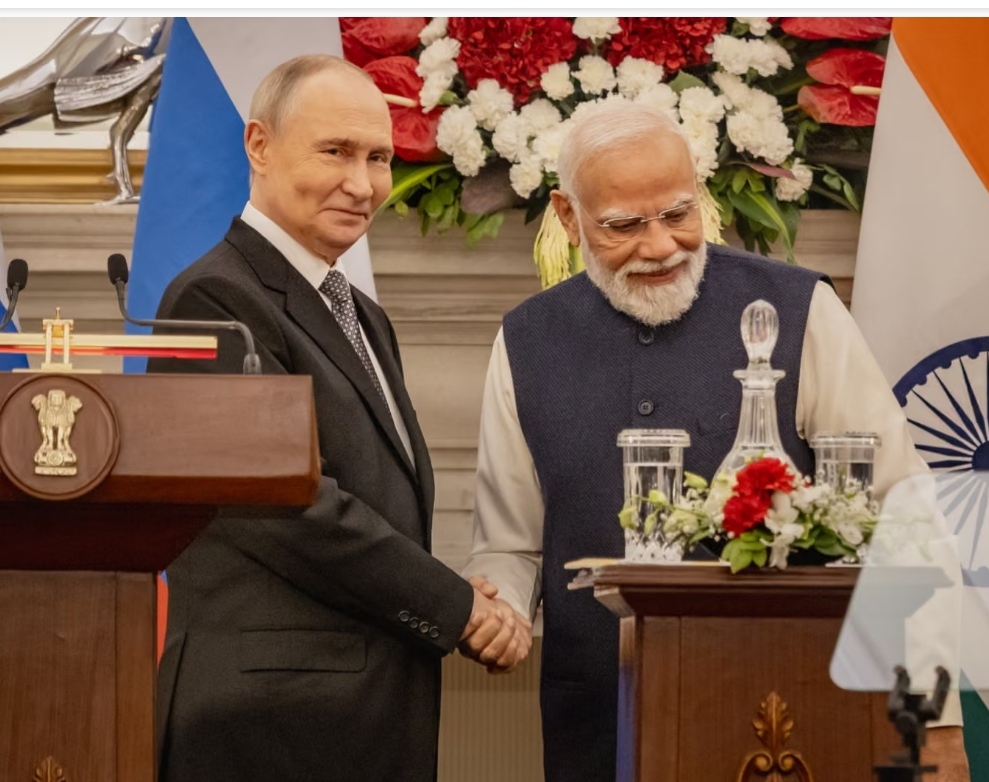
The rhetoric and optics of the Russian president’s visit to India last week demonstrated the strength of the bilateral relationship. PM Narendra Modi breaking all protocols received Putin at the airport and both met with a hug.
Thereafter President Putin travelled with the car of PM Modi with his own Russian car following behind. This totally eclipsed the “limo diplomacy” tried by Donald Trump in Alaska earlier this year during talks regarding Zelenskey.
The big brother attitude of USA with all its allies and friends has never worked with India but they simply fail to realize this. Even their coercive methods becomes futile against India. In contrast Modi referred to the India-Russia relationship as a “guiding star”, built on “mutual respect and deep trust” that had “stood the test of time”. This was Putin’s 10th visit to India in the last 25 years of his presidency, and his 20th meeting with PM Modi since the latter became prime minister in 2014.
Unlike the ” hostility ” between Indo USA relationship, there is no gap between the symbolism and the substance of Indo Russian relationship. Ignoring Western illegal sanctions, Putin pledged “uninterrupted fuel supplies” to India. India has welcomed this while adding that it will keep buying oil from wherever it is commercially cheaper.
All know that India will avoid direct confrontation with the West over Sanctions but only till it does not try to cast its shadows on India’s Sovereignty.
Russia and India concluded a string of memorandums of understanding in areas from Skilled Workers mobility to health and food security, maritime cooperation, fertilisers, customs, and academic and media collaboration.
The much anticipated ( by the Western Press ) announcements on major defence deals did not happen deliberately. These things are being worked out separately and will be announced once all dots and commas are covered fully and everything finalized. A few more batteries of S400, SU57MkI, 5th generation jet engine and SSGNs are certainly on the card.
Defence cooperation is an important pillar of the India-Russia strategic partnership. It is presently guided by the Agreement on the Programme for Military Technical Cooperation signed between the two countries.
The Agreement for 2021-2031 was signed during the inaugural meeting of India-Russia 2+2 Dialogue which was held in Delhi on 6th December 2021. The notification of its entry into force has been done.
This Agreement further develops and strengthen the Military and Military technical cooperation in the sphere of research and development, production and after sales support of armament systems and various military equipment. The two sides also have periodic exchanges of armed forces personnel and military exercises since then.
The Ukraine conflict has not affected this cooperation in any way except may be slightly delaying the commissioning of INS Tushil and INS Tamal and rescheduling the delivery of remain two Regiments of S400 due to operational needs of Russia.
This visit suggests that the India-Russia relationship holds the same geopolitical heft it once did. During the cold war, India maintained preferential barter arrangements and market access to the Soviet Union and its satellite states.
This privileged relationship reached its pinnacle in 1971, when New Delhi and Moscow concluded a Treaty of Peace, Friendship and Cooperation ahead of a war that India fought with Pakistan, during which Islamabad was backed by the US and China. When the USA and its poddle UK sent their Naval flotilla to the Indian Ocean in Dec 1971, it was the Russian flotilla which kept them at bay.
New Delhi will not downgrade its important relationship with Moscow no matter what tantrums are thrown by West to appease India or pressurize or even threaten India to reduce its Russian oil imports. Now India and Russia are determined to diversify the relationship into other areas.
During Putin’s visit, India and Russia announced an economic cooperation programme lasting until 2030 that aims to make their relationship “more diversified, balanced and sustainable”. This includes improving market access for Indian products to address a trade imbalance that is heavily skewed in Russia’s favour, amid a sharp increase in India’s buying of Russian oil (up from less than 1% before the war in Ukraine to 35% ). Cooperation between the two countries spans several strategically important sectors – from space and nuclear to defence and food security.
At an ideological level, there is a high degree of affinity with Russia which has seen through European narrative of the Ukraine conflict – that it was triggered by NATO expansion into Russia’s sphere of influence. The same scenario was during the 1962 Cuban Crisis. Due to perceived expansion of Soviets into Cuba, Kennedy was ready to trigger the third world war !
India is also very much aware of all types of intrusion into India’s own area of influence within the Indian Ocean Region by various external forces.
Amid the recent war of words between India and the US, with Trump and his officials referring to India as a “dead” economy and a “laundromat for the Kremlin” has further exposed the West.
West has to realize the exact countours of India’s geopolitical poicy. There are no contradictions in India’s foreign policy.
Though Indo Russian trade will see a move towards INR 87 Kharab trade, India is set to accept a free trade agreement with even the EU, following the acceptance of UK trade deal earlier this year. On the sidelines of the G20 summit in South Africa in November, Australia, Canada and India also announced a trilateral technology and innovation partnership.
Historically there are 10 times as many Indian students studying in the US than there are in Russia, now efforts are being made to strengthen people-to-people contacts between India and Russia with the opening of two new Indian consulates there, a simplification of visa regimes and a labour mobility agreement.
The 70-point joint statement concluded during Putin’s India visit made reference to the India-Russia relationship as an “anchor of global peace and stability” but made no reference to Ukraine. This has clearly shown that for Indian’s Ukraine is a minor ongoing European conflict, just like the Sudan conflict or Thailand Cambodia conflict