The Siege of Colombo 1630 – War and diplomacy in the 17th century
Food prices within the fort rose 500% within a month, and the poor began to die from starvation and disease
Colombo has been the principal commercial port of Sri Lanka since the fifteenth century. Successive European powers, commencing with the Portuguese in 1518, fortified the harbor against both colonial rivals and the kingdoms of the interior. By the last quarter of the sixteenth century Colombo was a fortified city with up to 60,000 inhabitants enclosed within a bastioned enceinte.
By the beginning of the seventeenth century, the Kingdom of Kandy or Kanda Uda Rata was the only independent kingdom in the island and so King Rajasinghe II of Kandy entered into a treaty with the Dutch East India Company to rid the island of the Portuguese who by this time controlled much of the coastal regions of the country. The Kandyans together with the Dutch conquered Portuguese settlements.
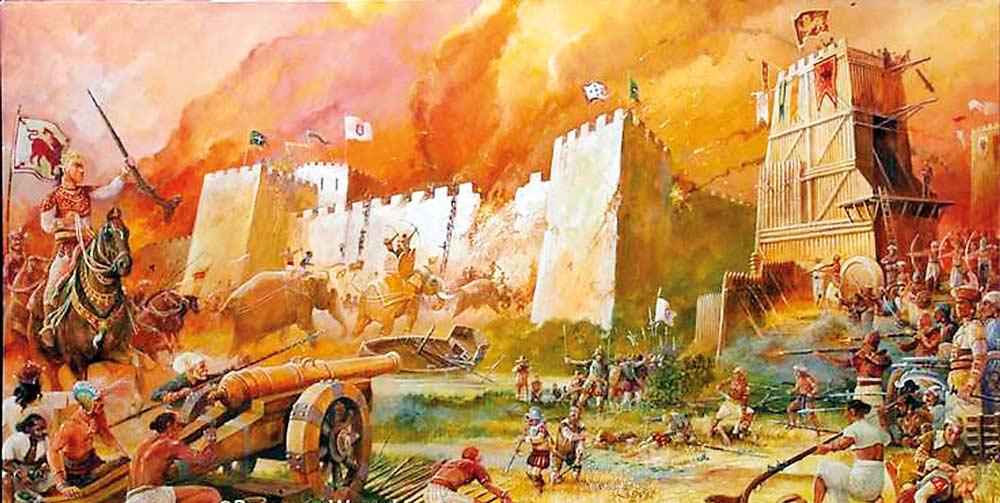
Following the destruction of Portuguese captain general Constantino de Sa Noronha’s army at Randeniwela, King Senarat surrounded the fortress city of Colombo in September 1630 with 15,000 men. The Portuguese defenders had 4,650 men, less than half of them soldiers. But the fortress was defended by forty cannon, while the Sinhalese had only a few small artillery pieces.
The king tried diplomacy first, sending a captured Dominican priest on September 9, 1630 with a peace offer to the new captain general Lancarote de Seixas offering the Portuguese the right to live peacefully if they surrendered. De Seixas refused, and the battle began.
Sinhalese forces had occupied houses within a hundred paces of the fortress walls (a pace is 2-4 feet long), and began exchanging fire. A 17th century musket at best had a range of 50-100 metres against a single target, compared to a modern assault rifle with ranges from 400-800 metres. Fighting therefore was at close quarters.
A 17th century artillery gun which defended the fort could have a range of up to 800 metres, a considerable distance at the time, though this varied according to the gun’s size. An Ottoman siege gun could reach targets 2000 metres away. But those were massive compared to the Portuguese cannon, and the few artillery guns the Sinhalese army had were even smaller.
As the Portuguese had only 40 cannon to defend a landward area from today’s Slave Island to the Galle Face and then southwards towards Pettah and the old St. John’s fish market, as well as the harbour, the Sinhalese forces were able to construct stockades close to the fortress walls, from which they could fire into the fort. The Portuguese cannon were fixed on their bastions, and therefore could not be moved at will to fire at mobile targets. Thus, stockades would have been erected in between these artillery posts.
As we have seen, the desperate Portuguese position was strengthened by the arrival of a captured gallery on its way to Goa, providing additional men, guns and ammunition.
Though rebel lascarin commanders such as Dom Theodosio led the field operations, King Senarat had the overall supervision, as well as looking after supplies coming from the hills.
On September 16, a full-scale attack on the fort was carried out from the north and the south (Pettah and Galle Face areas). After fierce fighting, the Sinhalese forces had to withdraw with heavy casualties.
Realising that direct attacks had no chance of success without artillery support, the king’s forces began constructing two stockades of wood around northern and northeastern walls of the fort. These were higher than the fort’s walls, so that marksmen could fire their muskets into targets within the fort. Tall coconut trees were used as snipers’ posts.
As this firing began taking its toll, De Seixas ordered the two stockades destroyed. On September 22, forty Portuguese led by Francisco de Brito, and 400 lascarins led by Joao de Abrew and Balthazar Monis made a surprise attack from the Queen’s Gate and destroyed the northeastern stockade.
The other was destroyed by a trick. Because of food shortages, those Sinhalese residents who could not bear arms were being driven out of the fort. These were generally welcomed by the King’s forces. But three lascarins disguised as civilians, carrying three bags of gunpowder, were sent out with one batch. They were able to destroy the other stockade.
But the Sinhalese rebuilt the stockades. Conditions within the fort grew harder day by day, but the Portuguese were lucky once again. Five ships arrived on October 9. The king’s forces, fearing substantial reinforcements, withdrew a few miles inland. But those ships hadn’t brought help. They were here to take away the annual haul of cinnamon.
First stage ends
That marked the first stage of the siege. The king’s forces now encircled the fortress from six miles away, restricting movement and denying supplies. It isn’t known if they tried to mine their way in, as De Seixas feared.
Portuguese casualties were light so far, but hunger began to take a toll. Food prices within the fort rose 500% within a month, and the poor began to die from starvation and disease. Sinhalese refugees from the fort were no longer welcomed by the besieging forces after the treachery which destroyed a stockade. Manoel Pacheco was sent in a fishing boat on September 11, 1630 to seek help from Goa. As a result, one ship carrying 70 soldiers, rice and gunpowder arrived in Colombo on October 16.
Another ship with 80 soldiers and supplies sent from Goa arrived on Nov.1. It brought rice, gunpowder, wheat, cheese, olive oil and 500 muskets. Unfortunately, the berthed ship was cut loose in a storm the day after, and was lost with all supplies. Two thousand five hundred people had died from hunger since September, and further deaths could have been avoided if the rice had been unloaded.
But six more ships carrying 200 men and supplies arrived from Malacca from then till November 26.
The king’s forces managed to confine the Portuguese to a small area around Colombo from October 9 1630 till January 4 1632. Therefore, though the main fighting ended in three months, the siege was long drawn out. The three main highways to Colombo were blocked by lascarins – men from the Four Korales at Nakalagama, Abhayasingha and the men of Sabaragamuwa near the bastion of St. Sebastiao, and Dom Theodosio Baretto on the road to the south. As any Portuguese who went out were cut down, the captain general forbade anyone to leave the fort. Cattle were left near the walls as bait, and any Portuguese who tried to seize them were attacked.
Emboldened by men and supplies sent from Goa, De Seixas marched his men to Nakalagama and defeated the king’s forces on the South Bank of the Kelani river. But he was cautious and did not seize the ferry, or pursue the Sinhalese beyond the river.
The viceroy in Goa now appointed Dom Felipe Mascarenhas as captain general in Colombo. He found that he didn’t have enough soldiers to end the encirclement of Colombo and had trouble paying his soldiers. As there was a famine in South India, Colombo could not be supplied sufficiently. Despite frequent skirmishes, no big battles were fought and the king’s forces continued their encirclement. The Portuguese were now penned within their forts on the island. The viceroy had spent over 80,000 Goa xerafims for the defence, but no end was in sight and no cinnamon had been shipped out of the island since 1929, a loss of 70,000 xerafims a year. The blockade has lasted for sixteen months. Over 4000 Sinhalese Christians in the fort died of sickness and starvation.
The Portuguese also wanted to oust the Dutch from the Coromandel coast. But the viceroy now focused on conquering the kingdom of Kandy. A fleet of ten ships with almost 1000 soldiers arrived in Colombo on October 21, and the Portuguese were finally ready to take the offensive. But their forts elsewhere except in Jaffna were under attack, and these garrisons had to be helped, too.
Dom Jorge de Almeida became the new captain general. Both sides were exhausted by now, as the Portuguese with their ships restricted King Senarat’s external trade. By August 1632, the viceroy too, was ready for a peace settlement. But, with the draft treaty of 1633, Senarat was back to where he started in 1617, and the king rejected terms laid down by Goa though he could not launch another big campaign now, and the Kandyans were forced to give the fourteen korales which they controlled since 1630.
During this time of uneasy peace, Diego de Mello de Castro was appointed captain general of Colombo. The Portuguese never gave up their dream of total conquest, and this led to the disastrous battle of Gannoruwa in 1638.
Daily Mirror