The US allocated $1 trillion to empower Gen Z protests in Nepal?
By Salah Uddin Shoaib Choudhury
An explosive new wave of allegations claims Washington is quietly bankrolling fresher unrest in Nepal — funneling staggering sums into youth-and civil-society programs while infrastructure aid tied to the Millennium Challenge Corporation (MCC) quietly limps forward.
Reports show the $500-million MCC compact ratified in 2022 has so far seen only a small fraction of funds disbursed — roughly US$43.1 million by early 2025 — even as governance and youth-engagement projects continue under extended timelines.
Investigations and leaked documents cited by several outlets say the larger US assistance package — which critics place at nearly one trillion dollars when MCC, USAID, and allied programs are combined — channels significant resources into projects run by the CEPPS consortium (National Democratic Institute, International Republican Institute, and International Foundation for Electoral Systems). These initiatives explicitly target youth engagement, party democracy, and media development.
While officially framed as civic and health programs, intelligence sources warn that such efforts risk shaping political narratives and mobilizing disaffected youths against the government.
Report from Indonesia-based Sindo News suggests that far from being neutral development projects, these programs form part of a broader US strategy to destabilize Nepal and, by extension, South Asia.
Sindo News said, a new report warns that Washington’s commitments are worth more than US$900 million for Nepal since 2020. It showed a deliberate US attempt to reshape the Himalayan country’s political order, amid mass protests that have swept the country.
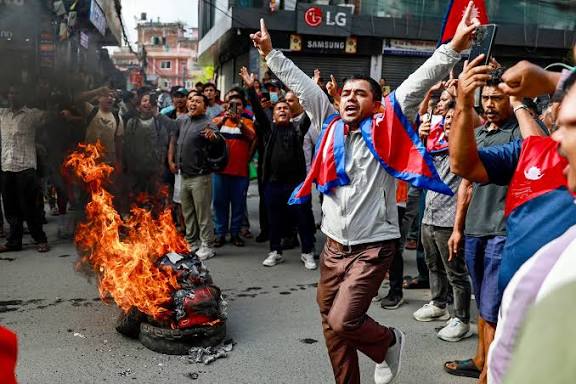
The demonstrations, which killed at least a dozen people, destroyed government and commercial property, and led to the resignation of Prime Minister Khadga Prasad Sharma Oli (KP Sharma Oli), were widely seen as a response to corruption, unemployment and social media restrictions.
However, documents released by whistleblowers show years of US-funded programs aimed at reshaping Nepal’s political landscape. Launching Press TV, internal documents obtained by the Sunday Guardian reveal that since 2020, more than US$900 million in aid has been channeled to Nepal.
USAID itself has committed USD402.7 million through the Development Goals Agreement (DOAG) signed in May 2022, with USD158 million having been disbursed until February 2025.
A history of US influence in Nepal
To many in Kathmandu, American influence in Nepal is nothing new. During the Cold War, Washington quietly courted Nepal’s monarchy as a hedge against communist China and Soviet expansion in South Asia. By the 2000s, US aid programs often arrived tied to political conditions, particularly during Nepal’s turbulent transition from monarchy to republic.
The MCC compact itself was highly controversial from the outset. Street protests erupted in 2020 and 2021, with demonstrators accusing the deal of compromising sovereignty and embedding Washington’s strategic interests in Nepal’s governance and infrastructure.
While parliament eventually ratified the agreement in February 2022, the bitterness has never fully subsided. Today’s revelations about disproportionate funding for political programs are therefore seen not as isolated incidents but as part of a long continuum of external meddling.
MCC and the discrepancy between promise and delivery
The MCC agreement promised a bold vision: US$500 million for energy and road connectivity projects to boost Nepal’s struggling economy. Yet, nearly three years later, only US$43.1 million has actually been spent. Project timelines have been extended again and again, leaving Nepalis wondering where the promised benefits are.
Meanwhile, parallel “soft power” programs thrive. Critics argue that Washington is more interested in shaping Nepal’s political future than building its infrastructure. “If the US really cared about our development, highways would be completed and power grids expanded”, one Kathmandu-based analyst remarked. “Instead, they are busy funding workshops and media campaigns designed to sway our youth”.
Hidden priorities: Youth and media programs
Official allocations reveal the priorities clearly. Project 4150, “Democratic Process”, was given US$8 million. Project 4177, “Nepal Democracy Resource Center”, received US$500,000. Civil society and media initiatives consumed US$37 million, while adolescent health programs accounted for US$35 million.
Such figures highlight a stark contrast: while infrastructure languishes, political programs surge ahead. Even seemingly benign health and education projects often double as recruitment platforms for political mobilization. Young Nepalis are brought into seminars and training sessions where civic education blurs into partisan advocacy.
NGOs tied to the CEPPS consortium — NDI, IRI, and IFES — dominate this field. Their official mission is to strengthen democracy. But in fragile states like Nepal, such involvement can fuel instability by encouraging rival factions, amplifying dissent, and undermining trust in institutions.
The NDI, for example, trains activists in leadership and advocacy, while IRI conducted a national survey in 2024 showing that 62 percent of Nepalese want a new political party, reflecting the grievances that prompted recent protests.
Observers noted similarities to US-funded interventions in Bangladesh and Cambodia, where youth and civil society programs coincided with political unrest. In Nepal, a combination of extensive funding, targeted programs, and youth involvement suggests that the recent upheavals in the country may have been influenced by US intervention.
The role of Gen Z in Washington’s strategy
Nepal’s Gen Z — digitally native, urban, and socially vocal — has emerged as a prized demographic for foreign actors. This generation has shown willingness to challenge political elites and pour onto the streets in protest. US planners, according to Sindo News, believe Nepal’s youth can replicate the protest models seen in Hong Kong, the Arab Spring, and Eastern Europe.
Washington’s strategy combines three pillars:
Narrative building: Media initiatives produce content critical of Nepal’s armed forces and ruling institutions, portraying them as barriers to democracy.
Mobilization platforms: Civil-society groups offer training, meeting spaces, and digital tools for organizing demonstrations.
Welfare cover: Adolescent health and education projects provide seemingly apolitical entry points to directly engage with youths.
This multi-pronged effort ensures that Gen Z activism does not remain spontaneous but is cultivated, structured, and sustained.
Economic dimensions: Following the money
Observers ask: how does nearly $1 trillion in alleged funding quietly circulate in a small nation like Nepal? Intelligence reports point to complex networks of offshore accounts, opaque NGO channels, and even narcotics-linked financing. Allegations persist that profits from the CIA’s covert drug trade supplement these funds, enabling Washington to bypass traditional oversight mechanisms.
The mismatch between MCC’s infrastructure spending and the enormous sums poured into “democracy promotion” heightens suspicion. If only US$43.1 million was spent on visible development, where is the rest of the money going? Transparency is urgently required.
Cultural and religious timing: Durga Puja as a target
What alarms many Nepalis is the alleged timing of Washington’s next move. Sources claim that unrest is being prepared to coincide with Durga Puja, one of Hinduism’s most sacred festivals. The goal, critics say, is to provoke communal tensions and discredit the government’s ability to maintain law and order during a major religious celebration.
Targeting festivals has long been a strategy of those seeking to inflame divisions. In South Asia, religious occasions carry deep cultural and political significance; unrest during such times resonates far more deeply than ordinary protests. If these allegations hold, the choice of Durga Puja is no coincidence but a calculated attempt to destabilize Nepal’s social fabric.
Alleged jihadist nexus and wider South Asian plot
What makes the latest revelations particularly alarming is the alleged convergence between youth mobilization and extremist infiltration.
Intelligence sources told Blitz that US funding — supplemented by undisclosed sums from Qatar and profits from CIA-linked narcotics trade — is also empowering radical Islamist actors. The claim: Washington aims to destabilize Nepal through a dual strategy of Gen Z unrest and jihadist violence.
The alleged objectives are stark:
Forcing Interim Prime Minister Sushila Karki to resign.
Removing Army Chief General Ashok Raj Sigdel via a “civil-military coup”.
Creating lawlessness that ensures Nepal remains pliable to US strategic designs.
Meanwhile, the conspiracy is not limited to Nepal. In Bangladesh, Washington is accused of empowering Islamist forces and indefinitely postponing the 2026 general elections, thereby prolonging Nobel laureate Muhammad Yunus’ rule until at least 2040. In India, US operatives are said to be coordinating with NGOs, journalists, and intellectuals to fuel youth-led revolts against Prime Minister Narendra Modi, with the aim of replacing him with a Western-friendly “blue-eyed boy”.
Digital platforms as weapons
At the center of this alleged strategy lie Western social media giants. Platforms like Facebook, X (formerly Twitter), and YouTube act as force multipliers, critics say. Algorithms elevate dissenting voices, promote protest content, and suppress nationalist narratives. By flooding young Nepalis with curated feeds, Washington allegedly hopes to transform scattered frustrations into organized rebellion.
This digital dimension makes the current threat more potent than past foreign meddling. In an age where online mobilization can trigger real-world revolutions, controlling the digital space is tantamount to controlling the streets.
Regional domino effect and geopolitical stakes
Why is Nepal so important to Washington? Its geography explains much.
Wedged between India and China, Nepal is a frontline state in the Indo-Pacific struggle. Beijing has invested heavily in infrastructure through the Belt and Road Initiative, while New Delhi considers Nepal part of its vital strategic neighborhood.
If Washington can destabilize Nepal, it not only undermines China’s influence but also complicates India’s security environment. A destabilized Kathmandu threatens India’s borders, weakens regional bodies like SAARC and BIMSTEC, and allows the West to keep both Asian giants on the defensive.
Thus, what appears as isolated unrest in Nepal may be part of a calculated strategy to reshape South Asia’s balance of power.
Call for oversight and transparency
The allegations, whether fully accurate or partly exaggerated, highlight one undeniable reality: Nepal and its neighbors must take transparency seriously. Kathmandu’s parliament should demand full disclosure of all foreign-funded programs, their recipients, and their objectives. Independent audits of NGO finances must be carried out.
Moreover, regional organizations like SAARC and BIMSTEC should begin tracking foreign financial flows into South Asia. Without collective oversight, each nation risks being destabilized in isolation. Civil society watchdogs, journalists, and academics must also rise to the occasion by scrutinizing donor money and exposing its misuse.
Whether this is a case of strategic soft-power influence or an organized campaign of destabilization, the stakes could not be higher for Nepali sovereignty and regional stability: allegations of secret funding, covert alliances with extremist elements, and targeted youth mobilization demand immediate, independent scrutiny. Kathmandu, donor governments and international watchdogs must open transparent audits of program financing, publish recipient lists and project-level outcomes, and permit neutral investigators — domestic and international — to verify or refute intelligence claims before rumors harden into irreversible political shocks.
In the absence of clear answers, civil society and the armed forces should act with restraint and withhold broad accusations that could inflame sectarian or nationalist tensions; conversely, blindly accepting every foreign narrative risks turning legitimate development assistance into a lightning rod for conspiracy and violence. Above all, the public deserves facts, not fear — and only rigorous transparency can prevent external funds from becoming instruments of chaos in Nepal and the wider region.
Blitz