
Those who did it once, What’s to stop them using nuclear weapons in a future war?
By Gaming Akmeemana
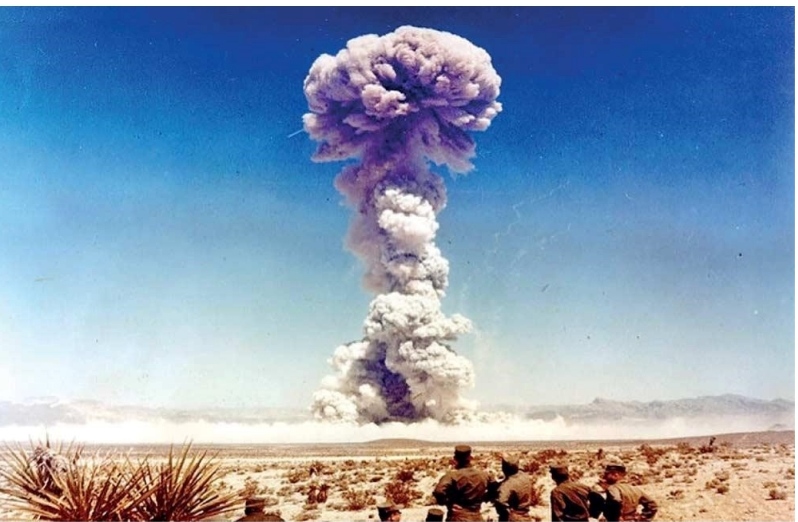
While atomic bombings ended WWII, nuclear testing, such as this US explosion in
Nevada, 1951, kept the threat of annihilation alive throughout the Cold War. Source:
US Government
# Because of “mutually assured destruction,” nuclear deterrence has prevailed despite major powers hoarding weapons
# With tensions over Taiwan, the war in Ukraine, and Trump’s return, the risk of a world war looms larger
# The official reason for dropping the bomb on Japan was to end WWII and save lives, but historians argue it was also a weapons test and a warning to Stalin
There has been much speculation ever since Russia invaded Ukraine in February 2022 that a third world war would break out. The involvement of regional powers such as Iran after the Israeli invasion of Gaza added more fuel to this speculation.
Despite dire predictions, no third world war has started yet. But there is a haunting spectre that looms over such a possibility – the use of nuclear weapons.
It’s two nuclear bombs which ended World War II. They were made in the United States, the only nuclear-armed country in the world at the time (though some historians claim that Hitler’s Germany was close), and they were dropped on the predominantly civilian cities of Hiroshima and Nagasaki in Japan.
Since then, though the world was perilously close to a war between the US and the former-USSR several times till the latter ceased to exist in 1991, no nuclear weapons have been used, though both superpowers maintained huge nuclear arsenals. The world today has nine declared nuclear armed states. But the use of nuclear bombs in war has been widely thought of as unthinkable.
If we think on a broader scale beyond Ukraine and Gaza, and think of Yemen, civil war in South Sudan, and even of Taiwan as a flashpoint for a war that can directly involve the US, Russia, the EU and China, Iran and perhaps India, Pakistan and even the Philippines and Japan), we can ask two questions – is another world war inevitable? And, If it starts, would nuclear weapons be used?
Since not even AI can predict the future, we can only look at past events and draw conclusions.
The only thing one can say with certainty is – if both the Allies (the US, Britain, France and the USSR) and the Axis (Germany, Italy and Japan) had nuclear weapons, they would not have hesitated to use them.
But in all probability, WWII would not have happened if even just half of these countries had nuclear weapons, though one could also argue that Hitler, being a dangerous military adventurer, would have gone in for a ‘first strike’ option, regardless of consequences.
Which means that nuclear weapons are actually a deterrent. But deterrence depends on who controls the trigger. In 1962, US President John F. Kennedy threatened Soviet Premier Nikita Khrushchev with nuclear war during the Cuban missile crisis.
But Kennedy knew that the US had more nuclear warheads, ICBMs and strategic bombers, and gambled on that. Khrushchev knew that the Soviet Union was weaker and would suffer more. He backed down.
Later during the Cold War, Soviet as well as American leaders kept out the nuclear option even as they built up their arsenals. No Soviet leader invaded a European country outside of the Soviet bloc. American ICBMs were aimed at Russia from East Germany, far away.
Today, Russia has invaded Ukraine. Russia fears that if Ukraine joins NATO, American ICBMS will be stationed there. But these are not the only flashpoints. Taiwan is a smouldering issue almost forgotten because of Ukraine and Gaza, and Iran could go for the unthinkable (procuring a nuclear weapon from an outside source) if Israel doesn’t stop attacking it, and Israel is out of control right now.
While Putin is a hardliner, The arrival of Donald Trump for a second term as president of the United States has made the prospects of a bigger war, and a nuclear war, more feasible. Re-naming the US Defense Department as Department of War gives an insight into his thinking.
In short, there is a strong possibility that nuclear weapons could be used again in a future conflict. But let’s look at the only precedent we have – the US bombing of Hiroshima and Nagasaki in WWII.
We were told that nuclear bombs were used to end the war quickly, as an invasion of mainland Japan in the face of fanatical Japanese resistance would have been costly and time-consuming.
But historians have drawn other conclusions.
The distinguished British historian Basil Liddell Hart quotes two American admirals in ‘History of the Second World War (Cassell, 1970) – “The naval blockade alone would have starved the Japanese into submission, through lack of oil, rice and other essential materials, had we been willing to wait – Admiral King”.
“The use of this barbaric weapon at Hiroshima and Nagasaki was of no material assistance in our war against Japan. The Japanese were already defeated and ready to surrender because of the effective sea blockade and successful bombing with conventional weapons… the scientists and others wanted to make this test because of vast sums that had been spent on the project – two billion dollars. – Admiral Leahy”.
In August 1945, when the atomic bombs were dropped, Japan had no navy left, no merchant marine, and no air force. Japan was already starved of essential materials for both the military and the civilian populations.
The Tokyo ‘fire bombing’ in March 1945 by Flying fortress bombers dropping conventional bombs killed over 90,000 people (as many as killed in initially in Hiroshima) and destroyed a third of Tokyo.
According to historian Lidell-Hart, another reason was the need to prevent Stalin’s USSR from entering the war against Japan.
“Stalin’s demand at Potsdam to share in the occupation of Japan was very embarrassing, and the US government was anxious to avoid it happening. The atomic bomb might help solve the problem.
The Russians were due to enter the war on August 6. As Churchill wrote (if the war ended in a few days) “we should not need the Russians. The end of the Japanese war no longer depended upon the pouring in of their armies. We had no need to ask favours from them”. (Lidell-Hart, History of the Second World War (Cassell, 1970).
Another sobering fact – sanctions lead to war. Russia, though badly affected by Western sanctions, has managed its economy as well as the war effort thanks to Chinese help. Japan prior to World War II had no such powerful ally next door. Germany was far away, and needed all her resources in Europe.
In July 1941, when the Japanese extended their political control of Indo-China from the north to the south, President Roosevelt froze Japanese assets and banned Japanese trade in oil and steel. Japan’s military government decided to attack the British, Dutch, French and American colonies to the South, with the aim of freeing itself from Western economic pressure.
As American historian Howard Zinn wrote:
“Pearl Harbour was presented to the American public as a sudden, shocking, immoral act. Immoral it was, like any bombing, but not really sudden or shocking to the American government… In initiating economic sanctions against Japan, the USA undertook actions that were widely recognised as carrying grave risks of war…
One of the judges in the Tokyo War Crimes Trial after World War II disagreed with the general verdict against Japanese officials and argued that the USA had clearly provoked the war with Japan and expected Japan to act.
The records show that a White House conference two weeks before Pearl Harbour anticipated a war and discussed how it should be justified”.
(Howard Zinn, A People’s History of the United States (Longman, 1980).
These sanctions finally led to a nuclear holocaust.