US travel ban on Dominica and Antigua signals next phase of war on ‘golden passports’
By Tajul Islam
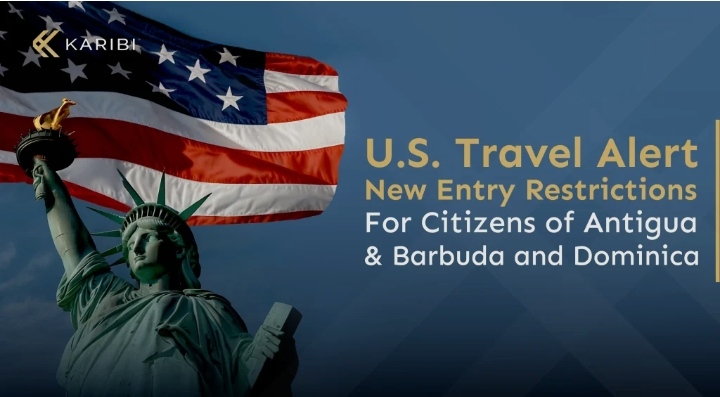
The United States has imposed new travel restrictions on Dominica and Antigua and Barbuda, escalating Washington’s campaign against citizenship-by-investment programs that it views as security liabilities. Announced by President Donald Trump on December 16, the move places the two Caribbean nations on an expanding US travel ban list that now covers 39 countries and signals a deeper shift in how Washington intends to police the global trade in passports.
Beginning in January, holders of Dominican and Antiguan passports will face restricted entry into the United States. A White House proclamation cited what it described as long-standing vulnerabilities in the two countries’ citizenship-by-investment programs-often called “golden passport” schemes-including the absence of meaningful residency requirements and persistent weaknesses in applicant vetting.
At face value, the decision targets two small island states. In practice, it establishes a precedent that could reshape how the United States treats any country that commodifies citizenship without meeting Washington’s evolving security expectations.
Citizenship-by-investment programs allow wealthy foreign nationals to acquire passports in exchange for large financial contributions, typically through government funds or approved real estate investments. For small Caribbean economies with limited natural resources, these programs have become financial lifelines, funding post-hurricane reconstruction, infrastructure projects, and social spending.
Yet US officials argue that these programs undermine the integrity of global travel systems. In its proclamation, the White House warned that citizenship-for-sale schemes create “challenges for screening and vetting” and introduce risks for law enforcement, sanctions enforcement, and intelligence operations.
According to US authorities, the problem is not simply corruption or mismanagement, but the structural design of these programs. When citizenship can be obtained without long-term physical presence, cultural integration, or sustained oversight, passports become transferable assets rather than proof of national belonging.
Washington has long argued that this loophole allows sanctioned individuals, financial criminals, and politically exposed persons to acquire clean identities and bypass travel restrictions.
The proclamation explicitly referenced concerns that individuals from countries viewed as adversarial to the United States-particularly Russia and Iran-have used Caribbean investment passports to regain access to international travel networks.
This concern intensified as Western sanctions regimes expanded after Russia’s invasion of Ukraine and amid escalating tensions with Iran. For US security agencies, alternative citizenships complicate everything from border screening to financial surveillance, weakening sanctions enforcement by allowing sanctioned individuals to operate under new national identities.
These fears were reinforced in 2023 by a major investigation led by the Organized Crime and Corruption Reporting Project (OCCRP), which examined roughly 7,700 recipients of Dominican citizenship. The investigation identified Russian oligarchs, alleged Iranian Revolutionary Guard affiliates, fugitive fraud suspects, and individuals linked to war crimes among the beneficiaries.
For Washington, the investigation validated years of warnings: that citizenship-by-investment programs are not merely economic tools, but potential backdoors into Western systems.
Caribbean governments insist they have acted. Over the past two years, countries operating these programs have raised investment thresholds, enhanced due diligence procedures, introduced interviews, and expanded background checks.
In September, five Caribbean states jointly agreed to create the Eastern Caribbean Citizenship by Investment Regulatory Authority, a regional oversight body intended to standardize vetting, enforce anti-money laundering rules, and prevent rejected applicants from shopping for passports across borders.
Notably, this authority was developed with technical input from the US Treasury, the Department of Homeland Security, the European Commission, and the UK government-suggesting deep international engagement.
Despite these steps, Dominica and Antigua and Barbuda were still sanctioned, while St. Kitts and Nevis, St. Lucia, and Grenada were spared-for now. The White House offered no detailed explanation, reinforcing the perception that trust, once lost, is not easily restored.
Dominica’s Prime Minister Roosevelt Skerrit described the decision as “unexpected and disappointing,” noting extensive engagement with US officials throughout 2024 and 2025. Yet the ban suggests Washington now judges countries not only by reforms on paper, but by past exposure, historical approvals, and reputational damage already done.
While the ban currently affects small Caribbean nations, its implications extend far beyond the region.
Countries such as Türkiye, which operates one of the world’s most expensive and politically sensitive citizenship-by-investment programs, fit many of the same criteria now cited by the US. Turkish citizenship can be acquired through real estate purchases or capital investments, often with minimal residency requirements. Over the years, the program has attracted wealthy applicants from Russia, the Middle East, and Central Asia-regions under increasing Western sanctions scrutiny.
Unlike Caribbean states, Türkiye is a NATO member and a major regional power. But that status may no longer offer automatic insulation. The US approach toward Dominica and Antigua suggests a new principle: passport integrity is now judged independently of a country’s geopolitical importance.
Other countries with similar schemes-including Malta, Montenegro, and several Gulf-linked residency-for-investment programs-also face growing scrutiny. The European Union has already pressured Malta to scale back its program, while the US has signaled alignment with EU concerns.
The Caribbean bans serve as a test case, not an endpoint.
For small island economies, the consequences are severe. Citizenship-by-investment revenues often account for a substantial share of government income. A US travel ban instantly devalues the passports being sold, threatening economic stability and forcing governments to reconsider development models built around monetized citizenship.
For larger countries like Türkiye, the risk is different but no less serious: reputational damage, financial scrutiny, and the possibility of targeted travel or visa restrictions on passport holders.
More broadly, the US move reflects a convergence of immigration policy, financial regulation, and national security strategy. In an era of intensified sanctions, intelligence sharing, and digital identity tracking, Washington appears increasingly unwilling to tolerate what it sees as loopholes in the global citizenship system.
Whether the bans on Dominica and Antigua and Barbuda will be lifted after further negotiations remains uncertain. What is clear is that the era of lightly regulated “golden passports” is ending.
The message from Washington is blunt: selling citizenship is no longer a sovereign economic choice-it is a security decision with global consequences.
For countries that have built their development strategies on passport sales, the lesson is stark. Once doubts over passport integrity take hold, even sweeping reforms may not be enough to restore confidence. And for larger states like Türkiye, the Caribbean experience may be an early warning of what lies ahead if geopolitical suspicion continues to harden into policy.