Why understanding ancient Chinese civilizations like Sanxingdui is crucial?
The launch of an international communication campaign to promote the Sanxingdui Ruins in September 2025 at the Sanxingdui Forum in Deyang, Southwest China’s Sichuan Province, marks more than just another cultural export initiative.
It represents a pivotal moment in global cultural dialogue, one that addresses fundamental gaps in how the world understands China and, by extension, our increasingly multipolar world.
The paradox of contemporary China is striking. While the world closely monitors China’s economic achievements and technological advances, a profound disconnect remains in understanding the cultural foundations that shape Chinese worldviews. This gap is not merely academic – it has real consequences for international relations and global cooperation.
When observers see China’s peaceful development trajectory or its approach to international diplomacy, they often struggle to comprehend the underlying cultural logic because they lack familiarity with the civilizational roots that inform Chinese thinking.
The cultural DNA embedded in thousands of years of Chinese civilization – including the concepts of harmony, continuity, and interconnectedness – cannot be understood through economic indicators alone. This knowledge gap is not accidental but has been systematically reinforced by the biases of Western media and academic research, which have long shaped global perceptions.
A groundbreaking study published in Science Advances in July, which analyzed 1,155 archaeological papers from the beginning of 2015 to the end of 2020, found that US media coverage exhibited significant regional disparities, with archaeological discoveries from the UK, Israel/Palestine, and Australia receiving substantially more attention than those from China.
The study revealed that only 32 percent of those 1,155 archaeological papers received coverage from major US news outlets, and Chinese discoveries were systematically underrepresented despite their scholarly significance.
This “cultural proximity bias” means that Western audiences have been consistently exposed to narratives that prioritize certain civilizations while marginalizing others, creating a distorted understanding of human cultural heritage and contemporary geopolitical realities.
The implications extend far beyond archaeology. In an era of increasing multipolarity, this selective cultural lens becomes particularly problematic. The emerging multipolar world order is not merely about the redistribution of economic and military power – it fundamentally reflects the diversity of human civilizations and their varying approaches to governance, development, and international relations.
When a narrow range of cultural perspectives dominates global discourse, it impoverishes our collective ability to navigate this complex new reality. The world’s cultural knowledge base desperately needs enrichment from diverse civilizations, particularly those from the Global South and non-Western traditions.
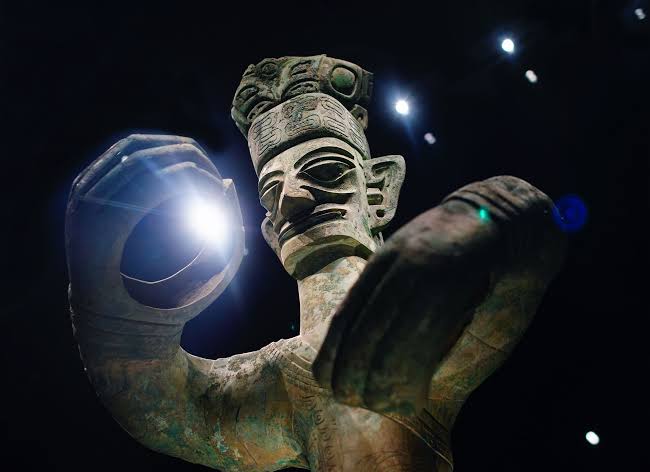
Chinese civilization, as one of the world’s oldest continuous civilizations, offers invaluable insights into alternative models of development, governance, and international relations. The Sanxingdui discoveries, with their mysterious bronze masks and sophisticated metallurgy techniques dating back over 3,000 years, demonstrate that human creativity and technological innovation have never followed a single, linear path.
These artifacts reveal a civilization that was simultaneously connected to broader cultural networks and distinctively innovative – a pattern that resonates with China’s contemporary approach to global engagement.
Recent years have witnessed a technological revolution in cultural communication, offering unprecedented opportunities to bypass traditional media gatekeepers. Sanxingdui, alongside the digital exhibitions in Dunhuang from Gansu Province and the virtual presentations of the Terracotta Warriors from Shaanxi Province, exemplifies how cutting-edge technology can democratize access to culture and demonstrate how technology can create immersive cultural encounters that transcend physical boundaries.
What makes these technological innovations particularly significant is their capacity to present Chinese culture in its full complexity and authenticity, rather than through the filtered lens of external interpreters.
When global audiences can directly engage with these cultural artifacts through sophisticated digital platforms, they find that China is a civilization with its own internal logic and aesthetic sensibilities, not a variant of Western developmental models.
Understanding ancient civilizations like Sanxingdui is crucial for comprehending our increasingly complex and multipolar world. The archaeological evidence reveals that human societies have constantly developed along multiple, interconnected pathways, each contributing unique solutions to universal challenges.
The campaign to promote Sanxingdui globally thus represents more than cultural diplomacy – it’s an investment in global intellectual infrastructure. By making Chinese civilization more accessible and comprehensible to international audiences, it contributes to a more nuanced and complete understanding of human possibility. In a multipolar world, such understanding is not a luxury but a necessity for practical cooperation and peaceful coexistence.
When international audiences encounter the bronze masks of Sanxingdui, they’re not just viewing ancient artifacts – they’re expanding their conception of what human societies can achieve and how diverse the pathways to prosperity and cultural flourishing can be.
This broader perspective is essential for navigating a world where multiple centers of civilization are once again shaping global development, each contributing its own insights to humanity’s collective future.