
Yunus radical regime orchestrates atrocities against the Christian minority in Bangladesh
By M A Hossain
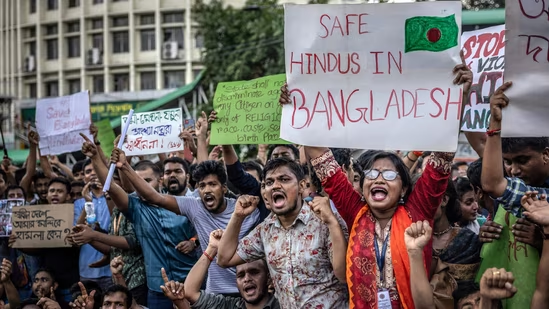
Bangladesh, once hailed as a beacon of religious tolerance in South Asia, now stands at a perilous crossroads. The recent resurgence of attacks on the Christian minority is not merely an outbreak of isolated violence—it is a symptom of a deeper malaise: the growing nexus between politics and radicalism.
Since the fall of Sheikh Hasina’s secular administration in August 2024, the fragile balance between religious harmony and political expediency has crumbled. The interim government, led by Muhammad Yunus, appears to have failed—or worse, chosen not—to curb the rise of Islamist militancy. Instead, under Yunus’s stewardship, Bangladesh is witnessing a disturbing pattern of appeasement toward radical elements, leading to targeted atrocities against its most vulnerable communities.
The latest violence exhibited a grim reality. On November, 7 night in Dhaka’s Ramna area, the historic St. Mary’s Cathedral Church (one of Bangladesh’s oldest Christian landmarks) was attacked with crude bombs. One device exploded outside, while another, hurled inside the church, failed to detonate. Panic spread swiftly among worshippers, echoing a similar attack just weeks earlier on the Holy Rosary Church in Tejgaon. The Christian community, small yet steadfast, now lives in fear.
The Bangladesh Christian Association condemned these attacks as “a direct assault on the spirit of religious harmony.” Yet, despite such condemnations, the state’s response remains alarmingly muted. Police investigations have yielded little. Security at churches has been tightened superficially, but the perpetrators remain at large—mirroring a broader pattern of impunity that has haunted Bangladesh’s minorities for decades.
What makes these attacks particularly concerning is their timing. They coincide with the Yunus government’s increasing accommodation of Islamist factions—raising legitimate fears that the violence is not random but rather politically convenient.
Religious persecution in Bangladesh is not new; it is cyclical. Christians, though comprising less than one percent of the population, have long faced hostility from militant Islamist groups.
In 2001, a devastating bombing in a Roman Catholic church in Gopalganj killed ten people—a crime never properly prosecuted. In 2014, the home of Soren Kubi, a relative of the Bishop of Mymensingh, was attacked and looted by extremists. The attackers walked free.
The cycle intensified after 2024, following political turmoil and Hasina’s ouster. Over 36 attacks on Christian properties were reported in less than a year. Over 100 families were forced to flee or renounce their faith under duress. Churches were vandalized, priests were threatened, and Christian schools torched by mobs chanting Islamist slogans.
Behind each incident lies the same toxic blend of fanaticism and political indulgence. Islamist factions, particularly Jamaat-e-Islami have used religion as a weapon of intimidation, exploiting political transitions to settle ideological scores.
The culprits are neither invisible nor unknown. Radical Islamist groups—Jamaat-e-Islami, Al-Qaeda connected Anser al Islam, and Hizb ut-Tahrir—have been systematically orchestrating violence against Bangladesh’s minorities. Their goal is ideological: to reshape Bangladesh into an Islamic state intolerant of pluralism.
Jamaat-e-Islami, in particular, carries a dark legacy. During the 1971 Liberation War, its leaders sided with the Pakistani army, committing atrocities against Hindus and pro-independence Muslims. That same ideology persists, now repackaged in political rhetoric.
In post-2024 Bangladesh, Jamaat’s revival has been nothing short of remarkable. Emboldened by the political vacuum left by the Awami League’s fall, its local units— in coordination with Pakistani espionage agency —have unleashed violence in rural and urban areas alike. Minority villages have been torched, women assaulted, and churches are desecrated.
Reports by human rights organizations, including the OHCHR, document that Jamaat-linked mobs were involved in revenge attacks following the 2024 upheaval. Their targets were predictable—Christians, Hindus, Ahmadiyyas, and secular activists. Yet, what is more alarming than the attacks themselves is the state’s silence. The failure to condemn, prevent, or punish these atrocities suggests not incompetence, but complicity.
To many, Muhammad Yunus symbolizes peace and reform. Yet, his interim government’s posture tells another story—a story of strategic accommodation of Islamist radicals for political survival.
Since taking power in August 2024, the Yunus-led interim government has presided over the reemergence of extremist groups long suppressed by the previous regime. Under the pretext of “national reconciliation,” Yunus has granted political breathing space to Islamist factions like Jamaat and Hefazat. His administration’s decision to delay elections has only deepened suspicions that it is leveraging radical support to consolidate authority.
The consequences have been devastating for Bangladesh’s minorities. Attacks on Christian churches and clergy have increased, yet the government has responded with selective blindness. Law enforcement has failed to arrest known perpetrators; investigations stall under bureaucratic pretexts.
Analysts point to a deliberate political calculation: Yunus, lacking a strong grassroots base, seeks legitimacy through alignment with religious forces. By tolerating Islamist rhetoric, he
secures temporary political backing from influential clerical networks—particularly in rural areas where these groups wield enormous sway. But this Faustian bargain has come at the expense of Bangladesh’s secular fabric.
Yunus’s administration, while outwardly neutral, has effectively orchestrated a climate of impunity where radicals act unchecked. This is not a passive failure—it is active orchestration by omission. The absence of justice, the silence over church bombings, and the quiet rehabilitation of extremist figures together point to a disturbing complicity.
The crisis in Bangladesh cannot be understood in isolation. The resurgence of Islamist extremism under Yunus has broader regional and international implications.
Intelligence sources suggest that local militant factions like Hizb ut-Tahrir and Ansar al-Islam have reestablished communication with transnational jihadist organizations, including Al-Qaeda in the Indian Subcontinent (AQIS) and ISIS-Khorasan. Their recruitment and propaganda efforts have accelerated, particularly through encrypted online platforms targeting disillusioned youth.
The attacks on Christian institutions serve not just local sectarian goals but also international jihadist objectives—spreading fear, polarizing communities, and signaling Bangladesh’s transformation from a moderate Muslim democracy into a potential breeding ground for terrorism.
Moreover, the flow of funding from Pakistan espionage agency and radical networks has reportedly resumed under lax government oversight. This financial backing fuels both social radicalization and direct militant activity. The danger now is not confined to Dhaka or Chittagong; it threatens the broader Bay of Bengal security architecture, linking extremist cells from Bangladesh to Myanmar’s Arakan region and southern Philippines.
The government’s failure to curb or acknowledge these connections emboldens these groups, allowing them to frame their struggle as part of a wider “defense of Islam” narrative—a dangerous echo of the rhetoric once heard in Pakistan and Afghanistan during their radicalization phases.
The Yunus-led interim government, far from being a neutral caretaker, has become a silent enabler of Islamist extremism. By allowing Jamaat-e-Islami and other radical factions to regain legitimacy, Yunus has jeopardized decades of secular progress. The cocktail bomb at St. Mary’s Cathedral is not merely a blast in a church courtyard—it is a warning shot at the soul of Bangladesh itself.
If unaddressed, this collusion between state and radical forces will not only destroy the nation’s pluralistic identity but also turn Bangladesh into another fault line in the global struggle against extremism. The time for ambiguity is over. For Bangladesh to reclaim its founding vision—a nation of faith, tolerance, and equality—it must confront the uncomfortable truth: the Yunus-led government’s silent complicity in orchestrating atrocities against its Christian citizens is a betrayal of the very ideals the nation was built upon.