Pakistan now accuses India after deadly North Waziristan attack, probably needs another Walloping !!
Tensions rise once again as Pakistan having received a solid thrashing during Indian initiated Operation Sindoor in May 2025 has directly accused New Delhi of orchestrating the assault in Pakistan’s North Waziristan region that killed 13 soldiers and three civilians. Islamabad has shown the temerity to call India a “terrorist state.” India has vehemently denied the allegations, calling them “false and malicious,” further deepening the diplomatic rift between the two nations.
Infact Pakistan should be given another solid trashing this time, it deserves nothing else.
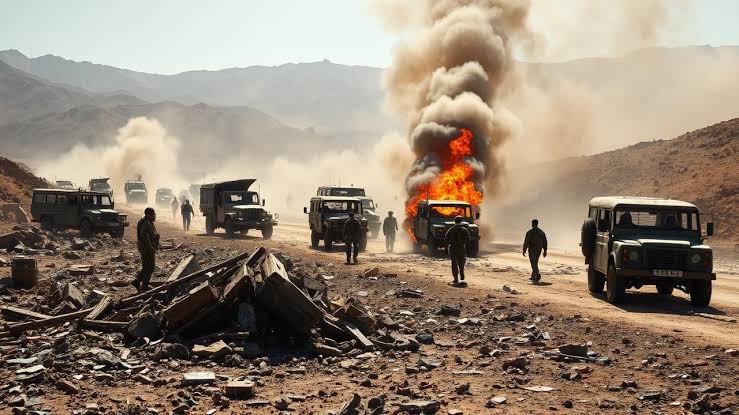
The attack occurred on the morning of June 28 in the restive North Waziristan District of Khyber Pakhtunkhwa province, an area long plagued by militancy and instability. According to the Pakistani military’s Inter-Services Public Relations (ISPR) wing, the assault began when a suicide bomber drove an explosives-laden vehicle into a military convoy.
The blast was followed by a hail of heavy volume of gunfire from the attackers. The Pakistan Army confirmed the death of 13 of its personnel and reported injuries to three civilians, including two children. Initial reports by the AFP news agency, citing local authorities, claimed that as many as 29 civilians were injured.
In the aftermath of the bombing, the ISPR released a strongly-worded statement blaming India for the attack. “In a cowardly attack, planned and orchestrated by the terrorist state of India and executed by its proxy Fitna al Khwarij, a Security Forces convoy was targeted today in the general area of Mir Ali, North Waziristan District,” the statement read.
It added that Pakistan’s security forces remain resolute in their determination to combat “Indian-sponsored terrorism” and that the “sacrifices of our brave soldiers and innocent civilians further reinforce our unwavering commitment to safeguarding our nation at all costs.”
The accusation marks a sharp escalation in rhetoric and reflects the volatile relationship between the two South Asian countries. India’s Ministry of External Affairs swiftly rebutted Pakistan’s claims, branding the allegations as baseless and an attempt to deflect from Pakistan’s internal security challenges.
In a press release, the ministry stated: “We categorically reject the baseless and malicious accusations made by Pakistan regarding India’s alleged involvement in the terrorist attack in North Waziristan. This is yet another attempt by Pakistan to externalize its domestic problems and shift the focus from its own governance and security failures.”
The situation in Khyber Pakhtunkhwa remains tense. “Field Marshal” Syed Asim Munir, Pakistan’s Chief of Army Staff, visited Corps Headquarters in Peshawar shortly after the attack, where he was briefed on the evolving security situation and counterterrorism efforts. The visit was a signal of the military’s intent to crack down on militant activity in the region. However, the nature of the group blamed for the attack raises questions.
According to various media reports, the Taliban-aligned Hafiz Gul Bahadur group claimed responsibility for the bombing. The group is based in the tribal belt of Pakistan and has carried out attacks against Pakistani military and civilian targets in the past. Its ties to regional jihadist networks, including factions operating in Afghanistan, further complicate the narrative being pushed by Pakistani officials.
Observers note that while Pakistan publicly blames India, the militant landscape in Khyber Pakhtunkhwa is shaped more by cross-border dynamics involving Afghanistan. Islamabad has frequently accused the Taliban government in Kabul of sheltering anti-Pakistan militants, including the Tehrik-i-Taliban Pakistan (TTP) and allied factions.
In March 2024, five Chinese engineers and their local driver were killed in a suicide bombing in the same province. Pakistani authorities identified the perpetrator as an Afghan national and claimed the plot had been hatched across the border.
Despite these internal challenges, Islamabad continues to implicate New Delhi in multiple violent incidents, including in the Pakistan Occupied Balochistan, where attacks by Balochistan Liberation Army are common. Pakistan has long claimed that India supports Baloch freedom fighters as part of a broader strategy to destabilize Pakistan. New Delhi has consistently denied any involvement in such activities and, in turn, accuses Pakistan of orchestrating cross-border terrorism in Indian Union Territory of Jammu & Kashmir.
Most recently, India pointed to the April 22 massacre of civilians in Kashmir Valkey as evidence of Pakistan-backed terrorism. The attack, which killed several tourists, triggered widespread outrage in India and prompted military alerts along the Line of Control (LoC). The incident led to a brief diplomatic standoff in May, with both nations exchanging sharp warnings and mobilizing additional forces on the LoC.
Analysts believe that the current standoff is unlikely to lead to direct conflict but adds to a growing list of grievances that poison India-Pakistan relations. The strategic blame game serves internal political and military narratives in Pakistan ruled indirectly by its military. Dr. Amir Rana, a Pakistani security analyst based in Islamabad says “Pakistan faces growing domestic insecurity in the tribal areas and hence pointing fingers across the border is an easy outlet.”
International actors have so far remained largely silent, though diplomatic missions in both Islamabad are reportedly monitoring the situation closely. The United States and China, both of whom have strategic interests in Pakistan, have not issued public statements but are likely engaged in backchannel discussions aimed at de-escalation.
The fragile peace between India and Pakistan- for long hinged on mutual restraint, even in the face of terror attacks and military skirmishes due to Paki nuclear bluff.
However India called te nuclear bluff finally during OP Sindoor and its deadly precision strike on PAF bases across the country has severly degraded Pakistani Aur Defence systems and offensive strike capabilities. International military experts feel that Pakistan’s nuclear capability has been severely degraded if not totally decapitated.
However, with Khyber Pakhtunkhwa’s security situation deteriorating and political pressures rising in Pakistan due to termination of Indus Water Treaty by India, Pakis are desperate fir talks but the path to dialogue appears increasingly narrow.
For now, the attack in North Waziristan serves as a grim reminder of the region’s volatile security architecture, and how quickly it can deteriorate further plunging Pakistan into darkness. Only way out for it is to denounce support to terrorism and hand over all terrorists who are on te wanted list by India. …..nothing else will work.